
- How does central air conditioning work, step by step?
- What are the main parts of a central AC system?
- How does the refrigerant cycle actually cool your home?
- What factors affect central AC efficiency and comfort?
- How does central AC compare to window and portable units?
- Key takeaways
- What I tell every homeowner about their central AC
- Upright Construction & HVAC is here when your system needs attention
- FAQ
- Recommended
TL;DR:
- Central air conditioning removes indoor heat and humidity by cycling refrigerant through indoor and outdoor coils. Proper system sizing, fan settings, and regular maintenance improve efficiency and comfort.
Central air conditioning is defined as a whole-home cooling system that removes heat and humidity from indoor air and transfers it outside using a continuous refrigerant cycle. Central AC accounts for about 12% of household electricity use and costs American homeowners roughly $29 billion annually. Understanding how your system works puts you in control of your comfort and your energy bills.
The core principle is simple: your AC does not create cold air. It moves heat from inside your home to the outside. Refrigerant is the substance that carries that heat through a closed loop of coils, valves, and a compressor. Once you understand that loop, every other detail about your system clicks into place.
How does central air conditioning work, step by step?
Central air conditioning works by pulling warm indoor air across a cold evaporator coil, absorbing heat into the refrigerant, and then releasing that heat outside through the condenser coil. The closed-loop refrigeration cycle repeats continuously until your thermostat reads the target temperature and signals the system to stop. The result is cooler, drier air circulated through your home via ductwork.
The thermostat is the brain of the entire operation. Thermostats control AC cycling by sending a signal to start or stop the system based on the temperature you set. A programmable or smart thermostat, such as a Nest or Ecobee, lets you schedule cooling cycles to avoid running the system when no one is home.
What are the main parts of a central AC system?
Every central air system relies on six core components working together. Each one has a specific job in the cooling process.
- Evaporator coil: Located in the indoor air handler, this coil holds cold refrigerant. Warm air from your home passes over it, and the refrigerant absorbs the heat.
- Condenser coil: Located in the outdoor unit, this coil releases the heat the refrigerant collected indoors. A fan blows air over it to push the heat away.
- Compressor: This is the pump of the system. It pressurizes the refrigerant, raising its temperature so it can release heat effectively at the condenser.
- Expansion valve: This valve drops the refrigerant’s pressure rapidly, cooling it down before it enters the evaporator coil again.
- Blower fan: Mounted in the indoor air handler, this fan pulls air from your home across the evaporator coil and pushes cooled air back through the ductwork.
- Ductwork: The network of metal or flexible channels that carries cooled air to every room and returns warm air back to the air handler.
Most residential systems are split-system units with separate indoor and outdoor components. Packaged units, which house all components in a single outdoor cabinet, are common in homes without attic or basement space for an indoor air handler.
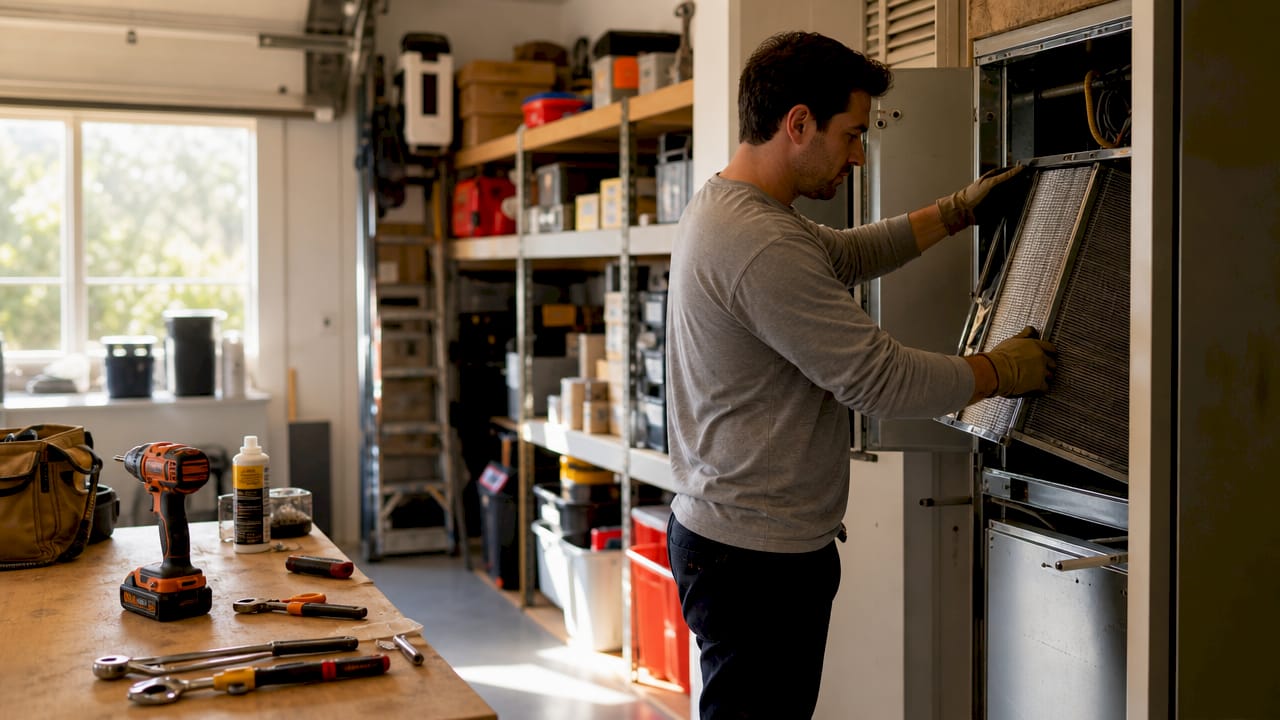
Pro Tip: Clean or replace your air filter every 1–3 months. A dirty filter restricts airflow and forces the blower to work harder, raising your energy bill and straining the system.
How does the refrigerant cycle actually cool your home?
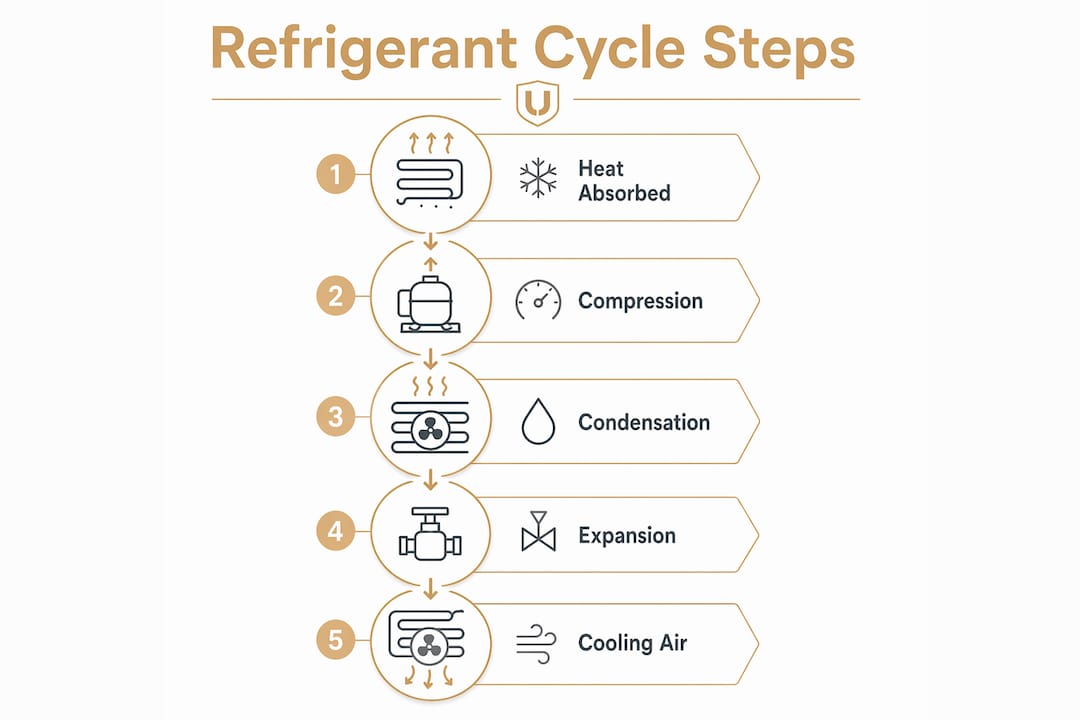
The refrigerant cycle is the engine behind every degree of cooling your system delivers. Here is how it moves through the system in sequence.
- Refrigerant enters the evaporator coil as a cold liquid. The expansion valve just dropped its pressure, which lowered its temperature dramatically.
- Warm indoor air passes over the coil. The refrigerant absorbs that heat and evaporates into a gas. This is the moment your home’s air actually loses heat.
- The gaseous refrigerant travels to the compressor. The compressor squeezes it under high pressure, raising its temperature even further.
- The hot, pressurized gas moves to the condenser coil outdoors. The outdoor fan blows air across the coil, and the refrigerant releases its heat to the outside air. It condenses back into a liquid.
- The liquid refrigerant passes through the expansion valve again. Pressure drops, temperature drops, and the cycle restarts.
This loop runs continuously until the thermostat setpoint is reached. Standard central AC requires approximately 20 BTUs per square foot of conditioned space. The average system consumes more than 2,000 kWh per year, which makes cycle efficiency a real factor in your monthly costs.
Key fact: Refrigerant never gets “used up.” It circulates in a sealed loop indefinitely. If your system is low on refrigerant, that means there is a leak, not a refill schedule.
What factors affect central AC efficiency and comfort?
Proper sizing is the single biggest factor in how well your system performs. Oversized units short cycle, meaning they cool the air quickly but shut off before removing enough moisture. The result is a home that feels cold and clammy at the same time. A Manual J load calculation, performed by a licensed HVAC technician, determines the correct unit size for your specific home.
Fan settings matter more than most homeowners realize. Setting the fan to “AUTO” means it only runs when the compressor is running. Setting it to “ON” keeps the fan running continuously, which re-evaporates moisture from the evaporator coil back into your home. For Los Angeles homes where summer humidity spikes, “AUTO” is the right choice almost every time.
Electrical capacity is another factor that gets overlooked. Larger AC units require dedicated circuits to avoid electrical stress and potential hazards. An undersized circuit causes the compressor to run harder, shortening its lifespan and increasing energy costs. Before installing a new or larger unit, have a licensed electrician verify your panel can handle the load.
Pro Tip: Check your HVAC maintenance checklist each spring before cooling season starts. Catching a dirty coil or low refrigerant early prevents a breakdown on the hottest day of the year.
How does central AC compare to window and portable units?
Central AC delivers whole-home cooling that window and portable units simply cannot match at scale. Central systems distribute air evenly via ductwork and operate much more quietly than room units, which run their compressors inside the living space. For a home with more than two or three rooms to cool, central AC is the more practical and cost-effective solution.
| Feature | Central AC | Window/Portable Units |
|---|---|---|
| Coverage | Whole home via ductwork | Single room only |
| Noise level | Low (compressor is outdoors) | Moderate to high |
| Humidity control | Yes, whole-home dehumidification | Limited to one room |
| Installation | Requires ductwork | Minimal setup |
| Energy efficiency | Higher for multi-room cooling | Higher for single-room use |
| Convenience | One thermostat controls all zones | Each unit set separately |
Homes without existing ductwork can use a ductless mini-split system, which uses the same refrigerant cycle but delivers air through wall-mounted heads instead of ducts. Mini-splits are a strong option for room additions or older homes in Los Angeles where running new ductwork is not practical.
Key takeaways
Central air conditioning works by cycling refrigerant through indoor and outdoor coils to continuously remove heat from your home, with correct sizing, fan settings, and regular maintenance determining how efficiently and comfortably the system operates.
| Point | Details |
|---|---|
| Refrigerant moves heat, not cold air | The system absorbs indoor heat and expels it outside through a closed refrigerant loop. |
| Correct sizing prevents moisture problems | Oversized units short cycle and fail to dehumidify, leaving homes feeling clammy. |
| Fan set to “AUTO” controls humidity | Constant fan operation re-evaporates moisture from the coil back into your home. |
| Dedicated circuits protect the compressor | Undersized electrical circuits force the compressor to overwork, shortening its lifespan. |
| Filter maintenance directly affects efficiency | A clogged filter restricts airflow, raises energy use, and strains every component downstream. |
What I tell every homeowner about their central AC
After 15 years running Upright Construction & HVAC in Los Angeles, the mistake I see most often is not neglect. It is misplaced confidence in a system that was never sized correctly to begin with.
Homeowners assume that a bigger unit means better cooling. The opposite is true. An oversized unit cools your living room in eight minutes, shuts off, and never runs long enough to pull moisture out of the air. You end up with a 72-degree home that still feels uncomfortable because the humidity is sitting at 65%. A Manual J calculation takes about an hour and costs almost nothing compared to replacing a unit that was wrong from day one.
The second thing I push hard on is dehumidification. In Los Angeles, we think of humidity as a coastal problem, but summer afternoons in the Valley can be brutal. Your AC is a dehumidifier first and a cooler second. If you are running the fan on “ON” all day, you are actively fighting your own system. Switch it to “AUTO” and you will notice the difference within a week.
My honest advice: treat your AC like your car. You would not skip oil changes and then wonder why the engine failed at 80,000 miles. Schedule a preventive HVAC maintenance visit every spring, change your filter on a calendar reminder, and call a professional the moment something sounds or smells different. The cost of a service call is a fraction of a compressor replacement.
— Ernie M
Upright Construction & HVAC is here when your system needs attention
Understanding how your central AC functions is the first step. Keeping it running well is the next one.

At Upright Construction & HVAC, we have served Los Angeles homeowners for over 15 years with honest diagnostics, fast repairs, and maintenance plans that actually prevent breakdowns. Whether your system is short cycling, struggling with humidity, or just due for a seasonal checkup, our team is available 24/7. Read through our guide on common HVAC repair challenges to know what warning signs to watch for, and reach out to us whenever you are ready for a professional assessment tailored to your home.
FAQ
How does central air conditioning remove humidity?
The evaporator coil chills the air below its dew point, causing moisture to condense on the coil and drain away. This dehumidification effect is a core function of the cooling cycle, not a bonus feature.
Why does my central AC run but not cool the house?
The most common causes are a dirty air filter restricting airflow, low refrigerant from a leak, or a frozen evaporator coil. A licensed technician can diagnose the issue quickly and restore normal operation.
How often should I replace my central AC filter?
Replace standard 1-inch filters every 1–3 months. Thicker media filters, such as 4-inch or 5-inch models, typically last 6–12 months. A dirty filter reduces airflow and forces the system to work harder.
What is the difference between a split system and a packaged unit?
A split system separates the indoor air handler from the outdoor condenser. A packaged unit combines all components in one outdoor cabinet and is common in homes without attic or basement space.
How long does a central AC system typically last?
Most central AC systems last 15–20 years with regular maintenance. Skipping annual service, running with a dirty filter, or operating an incorrectly sized unit shortens that lifespan considerably.