- Key Takeaways
- What does your gas furnace AFUE rating actually measure?
- How do the AFUE tiers break down, and what counts as good?
- How does AFUE affect your fuel bills? A worked example
- What actually changes between an 80% and a 95% installation?
- Why your real-world efficiency may differ from the AFUE sticker
- How do you choose the right AFUE for your home?
- What federal standards, rebates, and tax credits apply to AFUE?
- Los Angeles and Southern California: when does high AFUE actually make sense?
- What I tell every homeowner who calls about a new furnace
- Upright Construction & HVAC serves Los Angeles homeowners who want it done right
- Sources
- FAQ
- Recommended
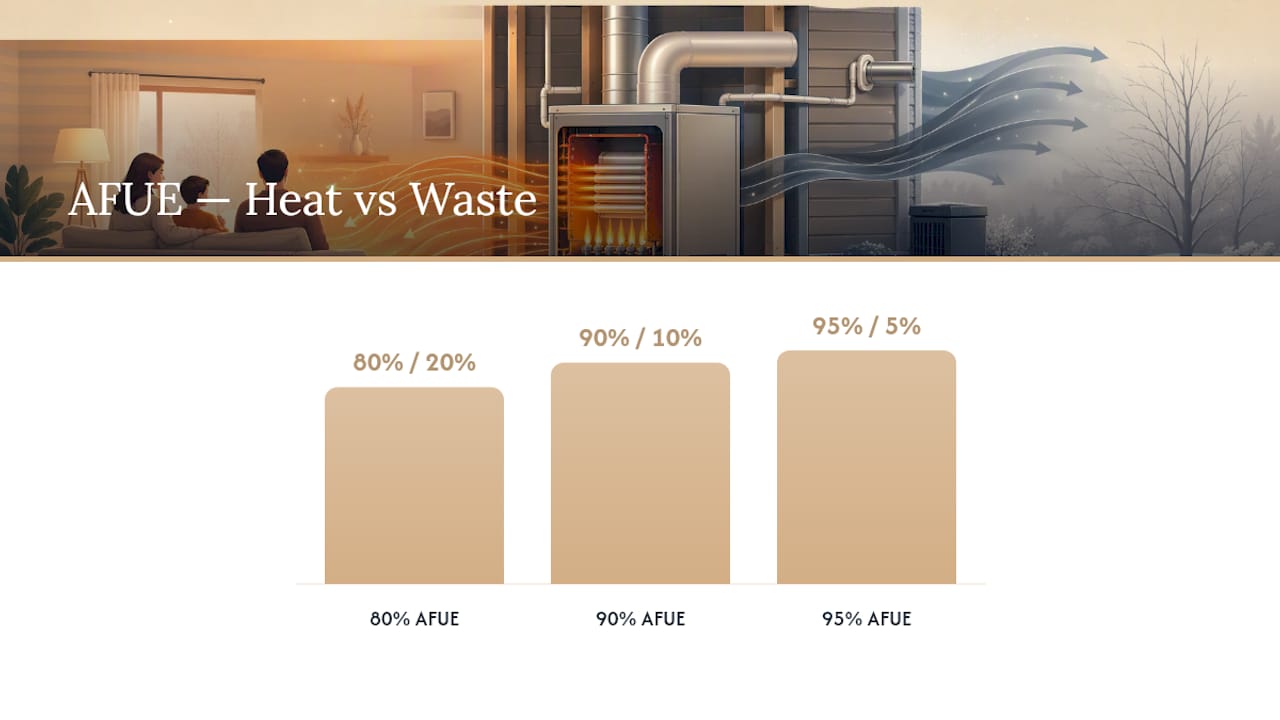
AFUE stands for Annual Fuel Utilization Efficiency, and it tells you what percentage of the gas your furnace burns actually becomes heat in your home. An 80% AFUE furnace converts 80 cents of every dollar of gas into heat and wastes the other 20 cents up the flue. A 95% unit wastes only 5 cents. That single number belongs on every quote you get for a new furnace.
Here’s the quick version before we go deeper:
- 80% AFUE (non-condensing): The federal minimum for most of the U.S., lower upfront cost, uses a metal flue or existing chimney. Roughly one-fifth of your gas bill goes out the exhaust.
- 90–98.5% AFUE (condensing): Requires PVC venting and a condensate drain, costs more to install, but cuts fuel waste to 2–15%. Worth the premium in cold climates with high heating hours.
- Where to find it: The bright yellow FTC EnergyGuide label on the unit, or the data plate on the cabinet. Always ask to see it on contractor quotes before you sign anything.
Key Takeaways
Correct installation and duct condition determine how much of your furnace’s rated AFUE you actually receive in delivered heat, making those factors as important as the efficiency number itself.
| Point | Details |
|---|---|
| AFUE measures fuel-to-heat conversion | It’s the percentage of gas energy converted to heat; 80% wastes 20%, 95% wastes only 5%. |
| Condensing units need different venting | Units above ~90% AFUE require PVC venting and a condensate drain, adding installation cost. |
| Climate drives payback math | Mild LA climates mean fewer heating hours, which lengthens the payback period for high-AFUE equipment. |
| Installation quality is the real variable | A PARR/GTI field study found rated AFUE reliably predicts installed performance when installation follows manufacturer specs. |
| Upright Construction & HVAC covers the full job | From Manual J sizing to duct sealing and permit coordination, Upright Construction & HVAC handles furnace installs across Los Angeles. |
What does your gas furnace AFUE rating actually measure?
AFUE is a ratio: heat delivered to your home divided by the total fuel energy consumed, expressed as a percentage. A furnace rated at 95% AFUE produces 95 BTUs of usable heat for every 100 BTUs of natural gas it burns. The remaining 5 BTUs leave as exhaust.
The DOE establishes AFUE under 10 CFR Part 430, Appendix N, using ANSI/ASHRAE Standard 103 test conditions. The test runs the furnace through simulated on/off cycles that represent a typical heating season, which is why the metric is called annual fuel utilization efficiency rather than just combustion efficiency. It accounts for start-up and cool-down losses that a simple steady-state combustion test would miss.
Two things AFUE deliberately leaves out matter a lot in real homes. First, it excludes duct distribution losses entirely. If your ducts run through an unconditioned attic or garage, a meaningful share of that heat never reaches your living space regardless of what the AFUE sticker says. Second, AFUE ignores the electricity your blower motor and control board consume. A furnace with an ECM (electronically commutated motor) blower uses significantly less electricity than one with a standard PSC motor, and that difference shows up on your electric bill, not your gas bill.
The test also uses national-average assumptions for factors like furnace oversizing and heating degree days. That makes AFUE a reliable comparative tool when you’re shopping between models, but not a precise forecast for your specific house in your specific zip code.
How do the AFUE tiers break down, and what counts as good?
Think of gas furnace efficiency in three practical bands:
- Below 80% AFUE: Older equipment, often 15–30 years old. If your furnace is in this range, replacement almost always pays back quickly regardless of climate.
- 80% AFUE (standard/non-condensing): The current federal minimum for most product classes. Single-stage, typically less expensive to purchase and install. Uses a metal Type B vent or existing masonry chimney. No condensate produced.
- 90–98.5% AFUE (condensing): The furnace extracts so much heat from combustion gases that the exhaust cools below the dew point, producing liquid condensate. Requires PVC or CPVC sealed-combustion venting and a condensate drain. Two-stage or modulating burners are common at this tier.
The condensing/non-condensing line sits at roughly 90% AFUE. That’s not just a marketing distinction — it’s a physical one. Below 90%, exhaust gases stay hot enough to vent through metal.
ENERGY STAR sets regional AFUE cutoffs that reflect this geography: the northern U.S. requires a higher AFUE threshold to earn the ENERGY STAR label than the southern U.S. does. In the South (which includes California), the threshold is lower. Check the ENERGY STAR product database to confirm the qualifying level for your region before assuming a unit qualifies for rebates.
How does AFUE affect your fuel bills? A worked example
The math is straightforward. DOE/FEMP sample tables illustrate how higher-AFUE models use fewer therms annually and can deliver measurable lifetime energy-cost savings over a 21-year horizon.
Here’s a simplified comparison using the DOE/FEMP framework:
Note: Exact dollar figures depend on your local gas rate, heating hours, and load size. Use the DOE/FEMP tables with your utility’s current therm price for a personalized estimate.
- Climate and heating hours. More heating degree days means more gas burned, which means the efficiency gap between 80% and 95% translates into more dollars saved per year.
- Local gas price. Higher gas rates accelerate payback. In Southern California, SoCalGas rates have historically been moderate, which lengthens payback compared to colder, higher-rate markets.
- Upfront premium. A condensing furnace typically costs more to purchase, and the PVC venting and condensate drain add installation labor. That premium is the denominator in your payback calculation.
- Expected ownership time. If you’re planning to sell in three years, a long payback period changes the math entirely.
- Duct condition. Leaky ducts in an unconditioned space reduce delivered heat regardless of AFUE, so sealing ducts first often yields better ROI than upgrading AFUE alone.
- Installation complexity. Drilling through a foundation for PVC venting or running condensate lines to a distant drain adds cost that pure AFUE comparisons don’t capture.
Pro Tip: Before signing a quote, ask your contractor for the annual therm estimate at your specific AFUE level, your local gas rate, and the full installed cost including venting and condensate work. Plug those three numbers into a simple payback formula: upfront premium ÷ annual savings = years to break even.
What actually changes between an 80% and a 95% installation?
The efficiency number is the headline, but the installation differences are where the real cost surprises hide.
Venting
It uses a Type B double-wall metal vent pipe or an existing masonry chimney. If the chimney is oversized for the new furnace, it may need a liner to prevent condensation and draft problems — that liner can add several hundred to over a thousand dollars to the job.
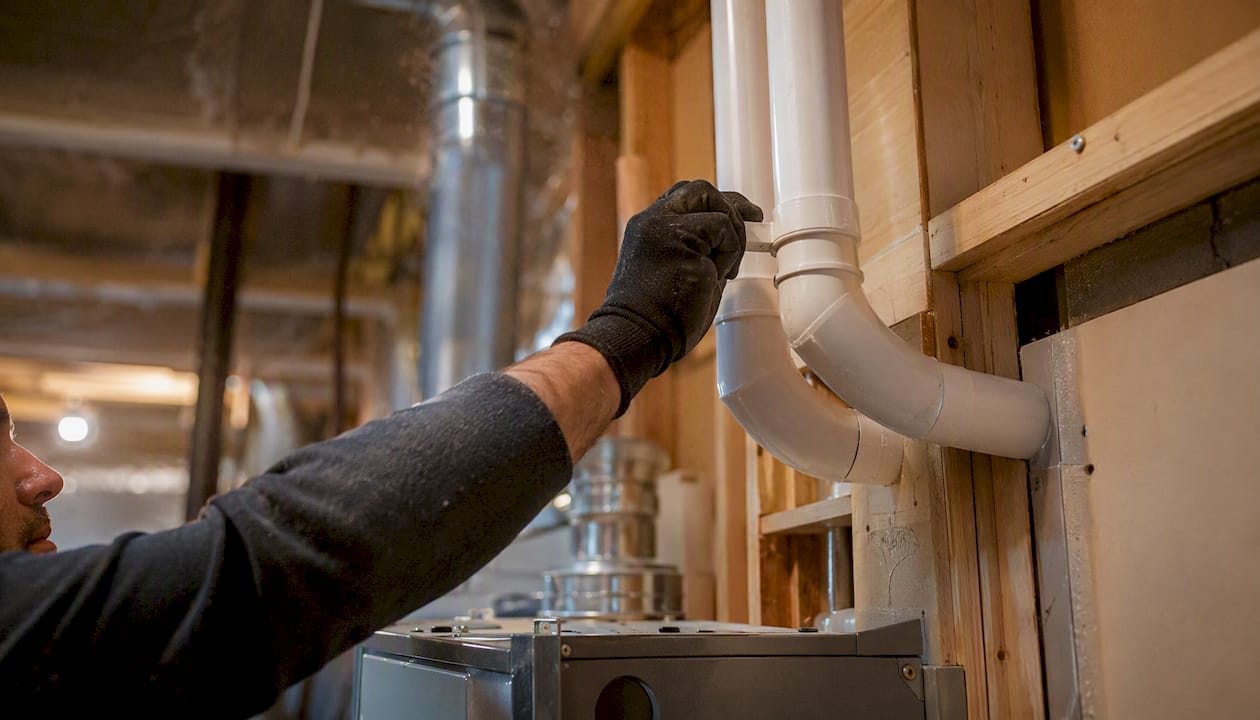
Two PVC pipes typically run through an exterior wall or up through the roof: one for exhaust, one for combustion air intake. Running those pipes through multiple stories or through a finished basement wall adds labor. If the only viable exit point requires drilling through a concrete foundation, budget for that specifically.
Condensate handling
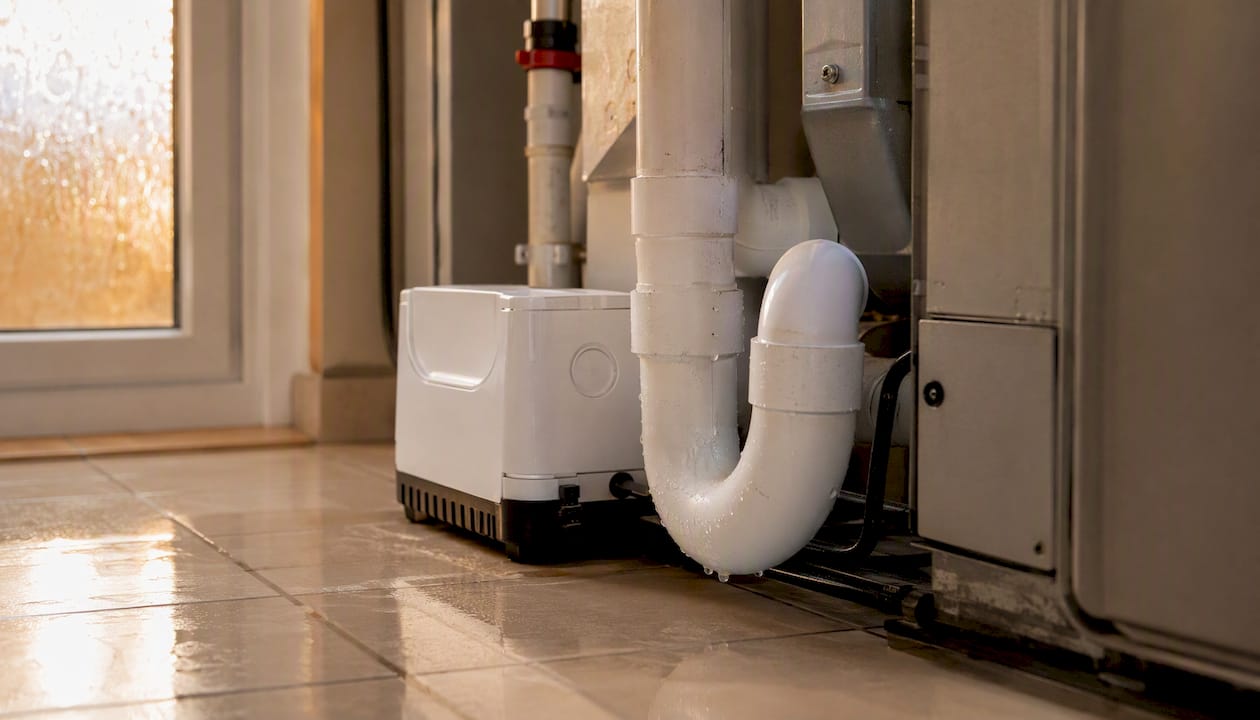
Condensing furnaces produce liquid water as a byproduct of the combustion process. That water needs to drain somewhere. A floor drain nearby is ideal. Without one, a condensate pump is required, which adds a small device and a power connection. The condensate line also needs a trap to prevent flue gases from back-drafting through the drain.
Combustion air
Modern condensing furnaces are typically sealed-combustion units: they pull outside air directly into the burner through the dedicated intake pipe rather than drawing air from the mechanical room. That’s actually an advantage in tight homes because it doesn’t depressurize the living space. But it means the intake pipe location matters — it can’t terminate near an exhaust vent, a gas meter, or a window that opens.
Red flags to watch for on estimates:
- No mention of a venting plan or venting material
- No line item for condensate drain or pump
- No note about combustion air source
- Chimney liner not addressed when replacing a non-condensing unit with another non-condensing unit in an older home
- Vague “miscellaneous installation” charges with no breakdown
Ask every installer: “Where does the exhaust vent terminate, what material are you using, and where does the condensate drain go?” If they can’t answer that before the job starts, that’s a problem.
Why your real-world efficiency may differ from the AFUE sticker
A PARR/Gas Technology Institute field study found that rated AFUE is generally a good indicator of installed performance when furnaces are installed per manufacturer instructions, with little measured efficiency degradation observed over long service intervals in the sampled homes. The mean difference between lab-measured annual efficiency and rated AFUE was small in that sample. So the number on the label is trustworthy — if the installation is done right.
The gap between rated and delivered efficiency usually comes from these sources:
- Duct leakage. Ducts in unconditioned attics or garages can lose a substantial portion of conditioned air before it reaches living spaces. High AFUE means less at the furnace; leaky ducts mean less at the register.
- Incorrect sizing. An oversized furnace short-cycles, meaning it fires up, heats quickly, and shuts off before completing a full burn cycle. That wastes energy on repeated start-up losses and creates uneven temperatures.
- Poor airflow. Dirty filters, undersized return ducts, or blocked registers force the blower to work harder and reduce heat transfer efficiency.
- Deferred maintenance. A dirty burner, cracked heat exchanger, or degraded igniter all reduce combustion efficiency over time.
Maintenance tasks that protect your AFUE over time: Replace filters every 1–3 months depending on household conditions. Schedule an annual professional tune-up that includes burner inspection, heat exchanger check, flue inspection, and blower cleaning. Verify that venting connections remain sealed and that the condensate trap (on condensing units) is clear.
The heating maintenance savings from consistent upkeep are real: a well-maintained furnace holds closer to its rated AFUE throughout its service life than a neglected one does.
How do you choose the right AFUE for your home?
This is where most homeowners get sold on a number rather than a solution. Here’s a practical sequence:
- Estimate your heating hours. Los Angeles averages far fewer heating degree days than Chicago or Minneapolis. That directly affects how much the efficiency gap between 80% and 95% is worth in dollars per year.
- Get a Manual J load calculation. This is the ACCA-standard method for sizing a furnace to your home’s actual heat loss. No contractor should quote a furnace size without one. An oversized furnace is a comfort and efficiency problem regardless of AFUE.
- Check your duct location and condition. If ducts run through an unconditioned attic, sealing and insulating them may deliver more real-world efficiency gain than jumping from 80% to 95% AFUE.
- Compare full installed cost, not just equipment cost. Get the venting plan, condensate drain plan, and any electrical work itemized separately. The 95% unit’s installed cost premium is what you divide by annual savings to get payback years.
- Factor in your ownership horizon. Planning to stay 10+ years? A higher AFUE has time to pay back. Selling in 3–5 years? The 80% unit may be the smarter financial choice.
- Ask about blower motor type and staging. An ECM blower motor reduces electricity consumption significantly compared to a PSC motor. Two-stage or modulating burners improve comfort and reduce short-cycling. These features often matter more to comfort than the last few AFUE percentage points.
Questions to put on every contractor quote:
- Did you perform a Manual J, or will you before sizing the equipment?
- What’s the venting plan, material, and termination location?
- Where does the condensate drain, and is a pump needed?
- What blower motor type is included (ECM or PSC)?
- Is the burner single-stage, two-stage, or modulating?
- What’s the equipment warranty and what does the labor warranty cover?
- Who pulls the permit, and who is responsible for the inspection?
Red flags that warrant a second opinion: No Manual J offered, vague venting plan, no permit mentioned, or a quote that arrives within minutes of a phone call with no site visit.
For a deeper look at comparing contractor estimates, that resource walks through exactly what line items to scrutinize.
What federal standards, rebates, and tax credits apply to AFUE?
The regulatory picture has a few moving parts worth knowing.
- DOE minimum standards: The DOE’s consumer furnace rulemaking sets the floor for what manufacturers can sell. Current federal minimums vary by product class and region. Homeowners and contractors should monitor the DOE rulemaking timeline because minimum standards have been updated and may change again, affecting what equipment is available for purchase.
- ENERGY STAR regional thresholds: As noted above, ENERGY STAR uses different AFUE cutoffs by region. A unit that earns the ENERGY STAR label in the South may not qualify in the North. Always verify using the ENERGY STAR product database with your specific model number.
- Federal tax credits: The Inflation Reduction Act created tax credits for qualifying high-efficiency HVAC equipment. Eligibility typically requires meeting a minimum AFUE threshold (check current IRS guidance for the exact percentage and credit amount, as these can change). Keep your invoice, the model number, the serial number, and any ENERGY STAR certification documentation.
- Utility and state rebates: SoCalGas, LADWP, and other California utilities periodically offer rebates for high-efficiency furnace installations. These programs change frequently. Check your utility’s website directly, or use the DSIRE database (dsireusa.org) for state-level incentive programs.
Pro Tip: Before your installation date, download and save the ENERGY STAR product listing page for your specific model. Rebate programs sometimes require that exact documentation, and product pages occasionally get updated after installation.
Los Angeles and Southern California: when does high AFUE actually make sense?
Here’s my honest local take. Los Angeles has a mild climate. Most of the coastal basin sees relatively few heating degree days compared to the national average. If you’re running your furnace 400 hours a year instead of 1,200, the dollar savings shrink accordingly.
A San Diego regional example illustrates this well: with a modest heating load and local gas rates, the annual savings from upgrading to a condensing unit can be modest enough that the payback period stretches well beyond a decade when you account for the full installed cost premium.
- Inland valleys and foothill communities (Burbank, Pasadena, the San Gabriel Valley) that see meaningfully colder winters than the coast
- Homes with high heating loads due to poor insulation, high ceilings, or large square footage
- Homeowners planning to stay 10+ years who want to lock in lower operating costs
- Homes where the existing chimney needs expensive repair or lining — at that point, switching to PVC venting for a condensing unit may cost less than repairing the chimney
On the electrification question: California’s policy direction is toward heat pumps and away from new gas appliances in many contexts. If you’re replacing a furnace that’s 5–8 years old, it’s worth at least getting a heat pump quote alongside your gas furnace quotes. A heat pump installation in LA’s mild climate can deliver both heating and cooling efficiently, and LADWP rebates can offset the upfront cost. For a broader comparison of system types, the homeowner’s HVAC guide covers when a gas furnace still makes sense versus when a heat pump is the better long-term call.
Pro Tip: In California, furnace installations require a permit in virtually every jurisdiction. Ask your contractor to confirm they’re pulling one. An unpermitted installation can create problems when you sell the home and may void the equipment warranty. Verify your contractor holds a valid C-20 HVAC license through the California Contractors State License Board (cslb.ca.gov) before signing.
What I tell every homeowner who calls about a new furnace
When someone calls me about replacing their furnace, the first thing I tell them is this: the AFUE number matters, but it’s not the whole story. And I’ve seen homeowners in mild coastal neighborhoods pay a significant premium for condensing equipment that won’t pay back in their ownership window.
My advice is always the same: focus on the quality of the installation, the sizing calculation, and the contractor’s willingness to explain their work. A contractor who can’t tell you where the exhaust terminates or whether a Manual J was done isn’t someone you want touching your heating system. The AFUE sticker is a starting point, not a finish line.
If you want a straight answer about what makes sense for your specific home, I’m happy to come out, look at your current setup, and give you an honest assessment. No pressure, no upsell — just the information you need to make a good decision.
Upright Construction & HVAC serves Los Angeles homeowners who want it done right
Replacing a furnace in Los Angeles means navigating permit requirements, venting constraints, condensate drainage, and a climate that doesn’t always justify the highest-AFUE option on the shelf. Upright Construction & HVAC handles all of it: Manual J load calculations, condensing and non-condensing furnace installations, duct sealing, condensate drain and pump installs, and ongoing HVAC maintenance plans that keep your system at rated efficiency year after year. Financing options are available for qualifying installations.

We serve homeowners across Los Angeles, Burbank, Beverly Hills, and the surrounding communities. If you’ve been quoted a furnace and want a second opinion on the AFUE choice, the venting plan, or the sizing, we’ll give you a straight answer. For a broader look at HVAC efficiency ratings and what they mean for your home, that page is a good next step. Ready to talk specifics? Request an estimate and we’ll schedule a site visit.
Sources
These are the authoritative references behind the guidance in this article. Each one is worth bookmarking if you want to verify specifics or dig deeper.
- What AFUE Means for Furnaces – Accelerate Net Zero
FAQ
What is a good AFUE rating for a gas furnace?
What AFUE rating qualifies for a federal tax credit?
Federal tax credit eligibility under the Inflation Reduction Act requires meeting specific minimum AFUE thresholds set by the IRS, which can change. Check the current IRS guidance and the ENERGY STAR product database with your specific model number to confirm eligibility before purchase.
Is 80% AFUE still worth buying in 2026?
Yes, in the right situation.
Is a furnace with 78% AFUE considered high efficiency?
No.
Does AFUE include duct losses and blower electricity?
No on both counts. AFUE measures only the fuel-to-heat conversion at the furnace itself. Duct losses and the electricity consumed by the blower motor are excluded, which means your real operating cost can be higher than the AFUE number alone suggests.
Recommended
- Single Vs. Two Stage Furnace: Pros And Cons – Upright Construction & HVAC
- HVAC Efficiency Ratings Explained For Homeowners
- Home HVAC Furnaces: Top 8 Quick Fixes For Heating Problems With Home HVAC Furnaces – Upright Construction & HVAC
- 5 Key Steps To Planning Your Budget For Furnace Replacement In Los Angeles – Upright Construction & HVAC