
- What is HVAC efficiency rating and how is it calculated?
- Why do HVAC efficiency ratings matter for homeowners?
- How to read and compare HVAC equipment labels
- What factors beyond ratings affect real-world HVAC performance?
- Key takeaways
- What I’ve learned after 15 years of HVAC installations in Los Angeles
- How Upright Construction & HVAC helps you choose the right system
- FAQ
- What is SEER2 and how does it differ from SEER?
- What AFUE rating is considered high efficiency for a furnace?
- Does a higher HVAC efficiency rating always mean lower energy bills?
- Which efficiency rating matters most in a hot climate like Los Angeles?
- Can HVAC efficiency ratings affect my eligibility for tax credits?
- Recommended
TL;DR:
- HVAC efficiency ratings measure how effectively a system uses energy to provide heating or cooling. Higher ratings lead to lower utility bills and better indoor comfort, especially when combined with proper installation and maintenance. Climate influences which efficiency metric is most important for homeowners in different regions.
An HVAC efficiency rating is a standardized measure of how much useful heating or cooling a system delivers for every unit of energy it consumes. The higher the rating, the less energy your system burns to keep your home comfortable. The U.S. Department of Energy mandates minimum efficiency standards through metrics like SEER2, EER2, HSPF2, and AFUE. Understanding what is hvac efficiency rating means is the difference between choosing a system that saves you money every month and one that quietly drains your wallet. At Upright Construction & HVAC, we walk homeowners through these numbers every day so they can make confident, informed decisions.
What is HVAC efficiency rating and how is it calculated?
HVAC efficiency ratings measure how effectively a system converts energy input into conditioned air output. Each rating targets a specific type of equipment and a specific operating condition. Knowing which metric applies to your system is the first step toward understanding your energy bills.

SEER2: the seasonal cooling standard
SEER2 stands for Seasonal Energy Efficiency Ratio 2. It calculates total cooling output over an entire cooling season divided by the total electrical energy consumed during that same period. The “2” signals that this rating uses the updated M1 testing procedure, which simulates real-world duct pressure better than the older SEER standard. Post-2023 SEER2 ratings run slightly lower than older SEER numbers, but they reflect what your installed system will actually deliver. Federal minimums for 2026 set the bar at 14.0 SEER2 in southern states and 13.4 SEER2 in northern regions.
EER2: peak-day performance
EER2 measures efficiency at a fixed outdoor temperature of 95°F. It gives you a snapshot of peak-day performance rather than a seasonal average. That distinction matters a great deal in places like Los Angeles, where summer afternoons regularly push past 95°F. A unit with a strong EER2 will hold its efficiency when the heat is at its worst. ASHRAE Standard 90.1 governs EER measurements, and the metric is especially relevant for steady-state efficiency comparisons.
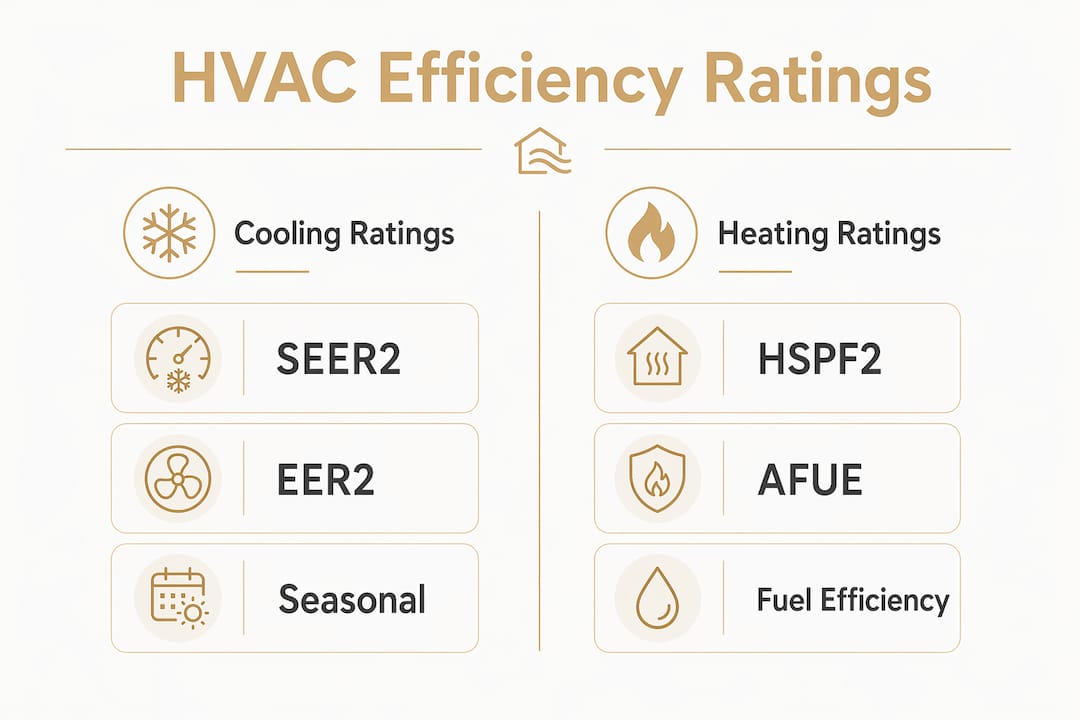
HSPF2 and AFUE: heating efficiency metrics
HSPF2 measures the heating output of a heat pump per unit of electrical energy consumed over an entire heating season. A higher HSPF2 means lower electricity costs during winter months. AFUE, or Annual Fuel Utilization Efficiency, applies to gas and oil furnaces. An 80% AFUE furnace wastes 20 cents of every dollar of fuel as exhaust heat. Furnaces rated 90% AFUE and above qualify as high-efficiency units and deliver meaningful savings on heating bills.
| Rating | Equipment type | What it measures | Typical range |
|---|---|---|---|
| SEER2 | Central AC, heat pumps | Seasonal cooling efficiency | 13.4–26+ |
| EER2 | Central AC, heat pumps | Peak-day cooling efficiency | 10–15+ |
| HSPF2 | Heat pumps | Seasonal heating efficiency | 7.5–13+ |
| AFUE | Gas/oil furnaces | Annual fuel-to-heat conversion | 80%–98% |
Why do HVAC efficiency ratings matter for homeowners?
Efficiency ratings directly affect what you pay every month on your utility bill. Moving from a 14 SEER2 to a 16 SEER2 unit can produce a meaningful reduction in monthly electricity use for cooling. That gap compounds over the 15-year lifespan of a typical system.
Ratings also affect comfort, not just cost. Higher-efficiency systems often run longer cycles at lower capacity rather than blasting on and off repeatedly. That behavior keeps indoor temperatures more consistent and reduces humidity swings. Homeowners frequently notice the difference in how the air feels, not just what the thermostat reads.
Financial incentives add another layer of importance. Higher-rated units may qualify for Inflation Reduction Act tax credits, which reduce the effective purchase price despite higher upfront costs. Utility companies in many states also offer rebates for systems that exceed minimum federal efficiency thresholds.
Local climate shapes which rating deserves the most attention. Heating-dominant climates benefit most from high HSPF2, while regions with long, hot summers should prioritize SEER2 and EER2. A homeowner in Minnesota and a homeowner in Phoenix are shopping for very different efficiency profiles, even if they are looking at the same equipment catalog.
Key factors that efficiency ratings influence:
- Monthly utility costs: Higher ratings mean fewer kilowatt-hours consumed per degree of cooling or heating.
- System comfort: Longer, steadier run cycles reduce temperature swings and humidity.
- Tax credits and rebates: IRA credits and utility rebates often require minimum SEER2 or AFUE thresholds.
- Equipment lifespan: Systems that run efficiently experience less mechanical stress over time.
- Environmental impact: Lower energy consumption means a smaller carbon footprint per household.
Pro Tip: Before buying any system, check your utility company’s rebate portal. Many utilities in California offer cash rebates for systems rated above the federal minimum, and those rebates can offset hundreds of dollars of the purchase price.
How to read and compare HVAC equipment labels
Equipment specification sheets list multiple ratings, and reading them correctly prevents costly mistakes. The most common error homeowners make is comparing a new SEER2 rating directly against an old SEER rating from a previous system. SEER2 ratings run slightly lower than their SEER equivalents because the M1 testing method applies more realistic duct resistance. A new 15 SEER2 unit is not less efficient than an old 16 SEER unit. They are roughly equivalent in real-world performance.
Reading the label correctly
Every new residential system sold in the U.S. must display its SEER2 rating prominently. Heat pumps also list HSPF2. Gas furnaces display AFUE as a percentage. When you see these numbers on a spec sheet or yellow EnergyGuide label, compare them only against other units using the same rating generation. Pre-2023 equipment uses SEER and HSPF. Post-2023 equipment uses SEER2 and HSPF2.
When to weigh SEER2 against EER2
In hot climates, comparing SEER2 and EER2 together gives a more complete picture than either number alone. A unit with a slightly lower SEER2 but a higher EER2 can outperform a higher-SEER2 unit during peak summer heat. That trade-off is worth understanding before you sign a purchase agreement. For a basic overview of how HVAC systems work before diving into ratings, that foundation makes the numbers easier to interpret.
Pro Tip: Ask your contractor to show you both the SEER2 and EER2 ratings for any unit they recommend. If they only quote SEER2, push for EER2 as well. In Southern California’s summer heat, EER2 often tells the more relevant story.
| Scenario | Rating to prioritize | Reason |
|---|---|---|
| Hot, dry summers (LA, Phoenix) | EER2 + SEER2 | Peak-day efficiency matters as much as seasonal average |
| Mild summers, cold winters | HSPF2 | Heating season drives most energy use |
| Year-round moderate climate | SEER2 | Balanced seasonal performance is the primary driver |
| Gas heat, hot summers | AFUE + SEER2 | Two separate systems, two separate ratings to evaluate |
What factors beyond ratings affect real-world HVAC performance?
A high efficiency rating is a ceiling, not a guarantee. The actual savings you see depend on several factors that have nothing to do with the number printed on the label.
Proper system sizing is the most critical variable. Manual J load calculation determines the exact heating and cooling capacity your home needs based on square footage, insulation, window area, and local climate data. Skipping this step and guessing at size is one of the most expensive mistakes in HVAC installation.
Oversized equipment creates its own problems. An oversized unit cycles on and off too frequently, a pattern called short-cycling. Short-cycling wastes energy, accelerates mechanical wear, and leaves indoor humidity uncontrolled. A 20 SEER2 unit that short-cycles will underperform a properly sized 16 SEER2 unit in both comfort and cost.
Ductwork design and condition play a major role as well. Leaky or undersized ducts can bleed conditioned air into unconditioned spaces before it ever reaches the living area. Understanding how air handlers distribute conditioned air through your duct system helps clarify why installation quality matters as much as equipment ratings.
Maintenance keeps efficiency from degrading over time. Dirty coils, clogged filters, and low refrigerant charge all reduce a system’s real-world efficiency below its rated level. A consistent maintenance schedule preserves the efficiency you paid for when you bought the equipment.
Occupant behavior and climate conditions also shift actual energy use. Running the system at extreme setpoints, leaving doors and windows open, or living through an unusually hot summer all push consumption above what the rating predicts. Ratings are measured under controlled lab conditions. Real homes are messier than labs.
Key takeaways
HVAC efficiency ratings are standardized energy metrics, not performance guarantees, and their real-world value depends equally on correct system sizing, quality installation, and consistent maintenance.
| Point | Details |
|---|---|
| Ratings measure energy use, not quality | SEER2, EER2, HSPF2, and AFUE quantify energy consumed per unit of output, not overall build quality. |
| Federal minimums set the floor | 2026 standards require at least 14.0 SEER2 in southern states and 13.4 SEER2 in northern regions. |
| Climate determines which rating matters most | Hot climates prioritize EER2 and SEER2; heating-dominant climates prioritize HSPF2 or AFUE. |
| Sizing and installation are non-negotiable | A high-rated unit that is oversized or poorly installed will underperform a correctly sized lower-rated unit. |
| Higher ratings unlock financial incentives | IRA tax credits and utility rebates often require systems to exceed minimum federal efficiency thresholds. |
What I’ve learned after 15 years of HVAC installations in Los Angeles
The number I hear homeowners fixate on most is SEER2. They come in having done their research, and they want the highest SEER2 they can afford. I understand the instinct. But in my experience, the rating on the box is only part of the story.
The homeowners who get the best return on their investment are the ones who let us do a proper Manual J calculation before we ever talk about equipment. I’ve seen a 26 SEER2 unit installed in an oversized configuration deliver worse comfort and higher bills than a 16 SEER2 unit that was sized correctly. That outcome is not rare. It happens more often than most people realize.
The other thing I tell every customer is to think about their climate honestly. In the San Fernando Valley, where summer temperatures regularly hit triple digits, EER2 deserves as much attention as SEER2. A unit that looks great on a seasonal average but struggles on a 105°F afternoon is not the right tool for that job.
My honest advice: treat the efficiency rating as a shortlist filter, not a final decision. Use it to eliminate units that fall below your standards. Then let installation quality, proper sizing, and a good maintenance plan carry the rest of the work. Those three factors will determine whether you actually see the savings the rating promises.
— Ernie M
How Upright Construction & HVAC helps you choose the right system
Choosing an HVAC system based on efficiency ratings alone leaves too much to chance. Upright Construction & HVAC brings over 15 years of Los Angeles installation experience to every consultation, starting with a proper load calculation before any equipment recommendation is made.

Our team walks you through SEER2, EER2, HSPF2, and AFUE in plain language so you understand exactly what you are buying and why. We also help you identify common HVAC repair challenges before they become expensive emergencies. After installation, our maintenance plans keep your system running at its rated efficiency year after year. Call Upright Construction & HVAC today and get a consultation built around your home, your climate, and your budget.
FAQ
What is SEER2 and how does it differ from SEER?
SEER2 uses the updated M1 testing procedure to better reflect real-world duct conditions, producing ratings that are slightly lower but more accurate than older SEER numbers. A new 15 SEER2 unit performs comparably to an older 16 SEER unit in an actual home.
What AFUE rating is considered high efficiency for a furnace?
A furnace rated 90% AFUE or above is classified as high efficiency, meaning it converts at least 90 cents of every fuel dollar into usable heat. Standard furnaces typically carry an 80% AFUE rating.
Does a higher HVAC efficiency rating always mean lower energy bills?
A higher rating reduces energy consumption per unit of output, but actual savings depend on correct system sizing, installation quality, and regular maintenance. An oversized high-rated unit can cost more to operate than a properly sized lower-rated unit.
Which efficiency rating matters most in a hot climate like Los Angeles?
In hot climates, both SEER2 and EER2 deserve attention. EER2 measures efficiency at peak outdoor temperatures of 95°F, making it the more relevant metric on the hottest days of the year.
Can HVAC efficiency ratings affect my eligibility for tax credits?
Higher-rated systems may qualify for Inflation Reduction Act tax credits, which reduce the net purchase cost. Utility companies in many states also offer rebates for systems that exceed federal minimum efficiency thresholds.