
- What is an AC coolant recharge, exactly?
- How do you know your car’s AC needs recharging?
- How to recharge your car’s AC step by step
- Common mistakes that can damage your AC system
- When to skip DIY and call a professional
- What does a professional AC recharge cost in the U.S.?
- Expert insights on AC recharge and keeping your system healthy
- Key Takeaways
- A straight take on AC recharges
- FAQ
- Recommended
TL;DR:
- An AC coolant recharge restores refrigerant levels in a car’s air conditioning system, but it does not fix leaks. Recharges are temporary solutions unless leaks are identified and repaired, especially for systems needing frequent recharging. Professional repairs cost more but provide precise leak detection and long-term system health.
An AC coolant recharge is the process of replenishing the refrigerant in your car’s air conditioning system so it can cool the cabin again. The industry term is “refrigerant recharge,” and it matters because your AC system runs on a closed loop — refrigerant circulates continuously and never gets consumed. If the level is low, something is leaking.
What is an AC coolant recharge, exactly?
Your car’s AC works by cycling refrigerant through a loop: it absorbs heat from inside the cabin and releases it outside. When refrigerant levels drop, that heat transfer breaks down and you get warm air instead of cold. A recharge restores the refrigerant to the correct level so the system can do its job.
The refrigerant type matters. Older vehicles (pre-1994) used R-12, commonly called Freon, which is now phased out entirely. Most cars made between 1994 and roughly 2020 use R134a. Newer vehicles, especially 2017 and later models, increasingly use R-1234yf.
Here is what a recharge typically involves:
- Identifying the correct refrigerant type for your vehicle
- Checking low-side pressure with a gauge to confirm low refrigerant
- Connecting a recharge kit or professional equipment to the low-pressure port
- Adding refrigerant slowly while monitoring pressure
- Verifying cooling performance after the charge
One thing worth knowing upfront: a recharge addresses the symptom, not the cause. If your system lost refrigerant, there is a leak somewhere. A proper recharge without finding and fixing that leak is a temporary fix at best.
How do you know your car’s AC needs recharging?
Warm air from the vents is the most obvious sign, but it is not the only one. Several symptoms point specifically to low refrigerant rather than other AC problems:
- Vents blow warm or inconsistent air, especially after the system initially cools then loses it
- AC works at highway speeds but blows warm at idle, a classic sign of low charge affecting compressor circulation
- Longer time to cool the cabin compared to previous summers
- Ice or frost on the AC lines near the evaporator, caused by pressure imbalance from low refrigerant
- Rapid clicking or cycling from the compressor, indicating pressure issues
- Oily residue around AC hoses or fittings, a visible sign of a refrigerant leak
- Windows not clearing on defrost, since AC removes cabin moisture and low refrigerant reduces that function
If your AC needs recharging more than once every three years, that frequency points to a significant leak requiring professional diagnosis, not just another top-off.
How to recharge your car’s AC step by step
What you need
- A recharge kit compatible with your vehicle’s refrigerant type (R134a kits run $30–$60 at most auto parts stores)
- Safety glasses and gloves
- Your vehicle’s service manual or owner’s manual to confirm refrigerant type and port location
DIY recharge is appropriate for R134a systems in vehicles made between 1994 and roughly 2016 with minor refrigerant loss. R-1234yf systems require professional service because the refrigerant is flammable and the equipment is specialized (specialized).
Step-by-step process
- Confirm your refrigerant type. Check the label under the hood or your owner’s manual. Never mix refrigerant types.
- Locate the low-pressure port. It sits on the larger-diameter AC line, usually near the accumulator. Standard recharge kits with quick-connect fittings physically cannot attach to the high-pressure port, which is a built-in safety feature.
- Check static pressure before adding anything. Connect the gauge hose with the engine off. A reading of zero means the system is completely empty — stop and call a mechanic. That is not a low-refrigerant situation; it signals a major failure.
- Start the engine and set AC to max cold, fan on high. This activates the compressor so you can monitor live pressure.
- Check the compressor clutch. Look at the center of the compressor. If the clutch is spinning, you can proceed. If it is not spinning, add half a can and watch. If it still does not engage, the leak is too serious for a DIY fix.
- Add refrigerant in short bursts. Hold the can upright, squeeze the trigger, and rock it from 12 o’clock to 3 o’clock while watching the gauge. Stop when the needle reaches the green zone specified in the kit instructions.
- Disconnect and test. Remove the hose, replace the port cap, and check vent temperature. A properly charged system should deliver noticeably colder air within a few minutes.
Pro Tip: Never add a full can at once. Short bursts with gauge checks between them are the only way to avoid overcharging, which reduces cooling and can damage the compressor.
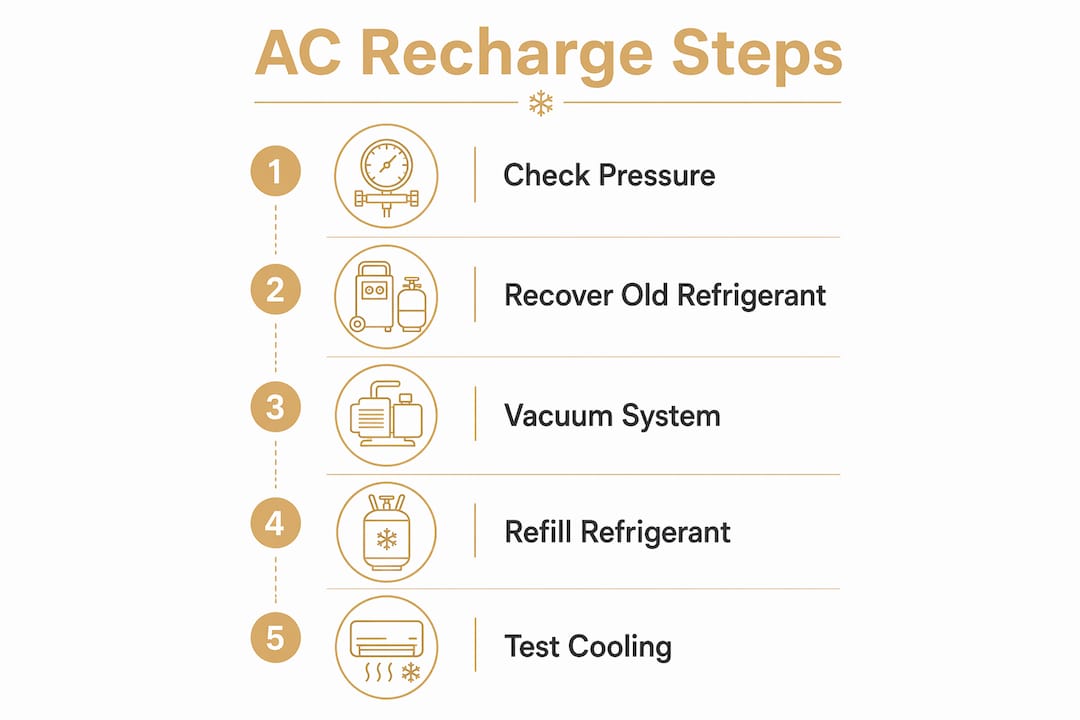
At a professional shop, the recharge process includes recovering old refrigerant with a recovery machine, pulling a vacuum to remove moisture, leak detection with UV dye, and refilling to the exact manufacturer-specified weight. That precision is what separates a shop recharge from a DIY top-off.

Common mistakes that can damage your AC system
Getting the recharge wrong costs more than doing nothing. These are the mistakes worth knowing before you open a kit:
- Overcharging. Too much refrigerant raises system pressure, reduces cooling efficiency, and can damage the compressor. Always add in small amounts and monitor the gauge.
- Connecting to the high-pressure port. Standard kits prevent this with quick-connect fittings, but if your kit lacks one, consult your service manual to identify the correct port before connecting anything.
- Using the wrong refrigerant. R134a and R-1234yf are not interchangeable. Mixing them contaminates the system and can require a full flush.
- Ignoring a zero gauge reading. A zero low-side reading does not mean “really low refrigerant.” It typically indicates a catastrophic leak or major component failure. Adding refrigerant in that situation risks further damage.
- Skipping safety gear. Refrigerant causes frostbite on contact with skin and can damage eyes. Gloves and safety glasses are not optional.
Pro Tip: If you have a hybrid or electric vehicle, do not use a standard retail recharge kit. The electrically driven compressors in hybrids are incompatible with the oils and seal conditioners in most consumer kits, and using the wrong product can create a serious electrical hazard.
When to skip DIY and call a professional
Some situations are simply beyond what a recharge kit can fix. Here is when to hand it off:
- The system needs recharging more than once every 2–3 years. That frequency means a significant leak that stop-leak additives cannot address.
- You hear unusual noises from the compressor. Grinding, squealing, or rattling from the compressor suggests mechanical failure, not a refrigerant issue.
- The compressor clutch cycles rapidly or erratically. Erratic cycling often points to pressure problems beyond low refrigerant.
- You see oily residue on AC components. Visible residue confirms a leak that needs professional detection and repair.
- Your vehicle uses R-1234yf. This refrigerant requires specialized equipment and certified handling. DIY is not appropriate.
- The AC stopped working suddenly or has never worked. Sudden failure usually means a compressor or major component issue, not low refrigerant.
For those situations, a professional inspection pays for itself. Understanding the benefits of professional inspections for home systems applies equally to your vehicle’s AC: catching a small leak early costs far less than replacing a compressor later.
What does a professional AC recharge cost in the U.S.?
Professional recharge costs vary based on refrigerant type, whether a leak repair is needed, and your location. Here is a realistic breakdown:
- R134a recharge only: roughly $100–$175
- R-1234yf recharge: roughly $200–$400, reflecting the higher refrigerant cost
- Recharge plus leak detection: typically $200–$300
- Recharge plus leak repair: $300–$800 or more depending on the component
- DIY kit (R134a): $30–$60 for a single-can kit
The DIY savings are real for a healthy system with minor permeation loss. For a system with an active leak, repeated DIY recharges without fixing the underlying problem cost more over time than a single professional repair. A properly sealed system should hold its charge for the life of the vehicle with no maintenance required.
Always get a written estimate before authorizing work, and ask whether the shop uses a recovery machine to capture old refrigerant rather than venting it. Venting refrigerant is illegal under EPA Section 609 regulations.

Expert insights on AC recharge and keeping your system healthy
The word “recharge” is a bit misleading. It implies the refrigerant ran out naturally, the way a battery drains. It does not work that way. Refrigerant in a properly sealed system never depletes. Every recharge is compensating for a leak, which is why professionals prioritize leak detection and sealing before adding refrigerant.
Preventive care makes a real difference here. A professional AC inspection every two to three years catches aging O-rings and seals before they become significant leaks. That proactive approach is far cheaper than waiting for the system to fail on the hottest day of the year.
A few preventive habits worth building:
- Run your AC for at least ten minutes weekly, even in winter. This keeps seals lubricated and prevents them from drying out.
- Have a certified technician check AC pressure during your annual service.
- Address any unusual smells or sounds from the AC immediately rather than waiting for cooling to fail.
For broader HVAC repair guidance, the same principle applies: catching problems early keeps repair costs manageable and extends the life of the system.
Key Takeaways
A car’s AC system is a closed loop, so low refrigerant always means a leak — and a recharge without fixing that leak is only a temporary solution.
| Point | Details |
|---|---|
| Recharge restores refrigerant | It replenishes refrigerant to restore cooling, but does not fix the underlying leak causing the loss. |
| Know your refrigerant type | R134a suits most 1994–2016 vehicles; R-1234yf systems (2017+) require professional service only. |
| DIY kits cost between thirty and sixty dollars | They work for minor refrigerant loss in R134a systems; overcharging or ignoring leaks causes damage. |
| Professional recharge usually costs one hundred to three hundred dollars | R134a recharge runs $100–$175, recharge plus leak detection typically $200–$300, and R-1234yf recharge $200–$400 depending on refrigerant type and level of service in the U.S. |
| Recharge more than once every few years | That frequency signals a significant leak requiring professional diagnosis and repair, not another top-off. |
A straight take on AC recharges
Most of the calls I get about car AC problems follow the same pattern: someone bought a recharge kit, topped off the system, got cold air for a few weeks, and now it is warm again. They want to know if they should buy another kit. My honest answer is no.
The kit did not fail. The leak is still there. Every can of refrigerant you add without sealing the leak is money leaving your wallet and refrigerant entering the atmosphere. R134a is a greenhouse gas, and venting it repeatedly is both wasteful and, in a professional context, illegal.
What I tell people is this: if your AC worked fine and gradually got less cold over a couple of years, a DIY recharge is a reasonable first step. That pattern fits normal slow permeation through aging seals. But if you recharged it last summer and it is already warm again, stop buying kits and get the system inspected. The AC repair timeline for a leak repair is usually short, and the cost is almost always less than people expect.
Safety matters too. Zero gauge readings, hybrid vehicles, and R-1234yf systems are not DIY territory. Knowing when to hand something off is not a sign of inexperience. It is just good judgment.
FAQ
How much does an AC recharge usually cost?
A professional AC recharge typically runs $100–$300 depending on refrigerant type and whether leak repair is needed. R-1234yf systems cost more due to the higher price of that refrigerant.
Can I refill my AC refrigerant myself?
Yes, for R134a systems in vehicles made between 1994 and roughly 2016, using a DIY recharge kit costing $30–$60. R-1234yf systems require professional service due to the refrigerant’s flammability and specialized equipment requirements.
How often does AC coolant need to be filled?
A properly sealed system never needs recharging. If yours needs a refill more than once every 2–3 years, it has a leak that requires professional diagnosis and repair.
Will AutoZone recharge my AC?
AutoZone sells DIY recharge kits and gauges for R134a systems, but the store does not perform AC recharges as a service. For a full professional recharge with leak detection, you need a certified automotive shop.