- How do you know when an HVAC upgrade is needed?
- What are the key steps in planning an efficient HVAC upgrade?
- What does an HVAC upgrade actually cost, and what can you save?
- What installation mistakes cost homeowners the most?
- Key Takeaways
- What I’ve learned after 15 years of HVAC upgrades in Los Angeles
- How Upright Construction & HVAC can help with your upgrade
- FAQ
- Recommended
TL;DR:
- HVAC upgrades should start with a Manual J load calculation to ensure proper sizing and efficiency. Proper installation, including sealing ducts and confirming refrigerant charge, is crucial for system performance and energy savings. Using tax credits and utility rebates can significantly offset costs, but choosing reputable contractors ensures long-term reliability.
HVAC system upgrade planning is the process of evaluating your home’s needs, selecting properly sized equipment, and executing quality installation to cut energy costs and improve comfort. High-efficiency upgrades typically reduce energy use by 20–40%, with most homeowners saving $300–$500 annually. Federal tax credits under Section 25C further reduce costs by up to 30%, capped at $2,000 for qualifying heat pumps and $600 for other equipment. Getting this process right from the start means lower bills, fewer repairs, and a home that stays comfortable year-round.
How do you know when an HVAC upgrade is needed?
The clearest signal is age. Most HVAC systems have a practical lifespan of 12–15 years, and once a system crosses that threshold, repair costs start outpacing the value of keeping it running. The 12-year rule is a reliable benchmark: if your system is older than 12 years and needs a major repair, replacement is almost always the better financial call.
Here are the four most common signs that an upgrade makes sense:
- System age over 12 years. Older systems lose efficiency gradually. A unit that once ran at peak performance now works harder to deliver the same result, driving up your energy bill every month.
- A repair estimate above $5,000. When a single repair costs that much, the math rarely favors fixing the old unit. Replacing both AC and furnace components together saves $500–$2,000 in labor compared to replacing them separately at different times.
- Rising energy bills despite regular maintenance. If your bills keep climbing even after filter changes and tune-ups, the equipment itself is likely the problem.
- Inconsistent comfort or humidity issues. Hot and cold spots, sticky indoor air, or a system that runs constantly without reaching the set temperature all point to a unit that can no longer handle your home’s load.
Beyond age and repair costs, your home’s specific characteristics shape what kind of system you actually need. Square footage, ceiling height, insulation quality, window efficiency, and local climate all affect the load your HVAC must handle. Existing ductwork condition matters too. Leaky or undersized ducts can waste 20–30% of conditioned air before it ever reaches a room. A professional home energy audit and a Manual J load calculation are the two non-negotiable starting points before any equipment is selected.
What are the key steps in planning an efficient HVAC upgrade?
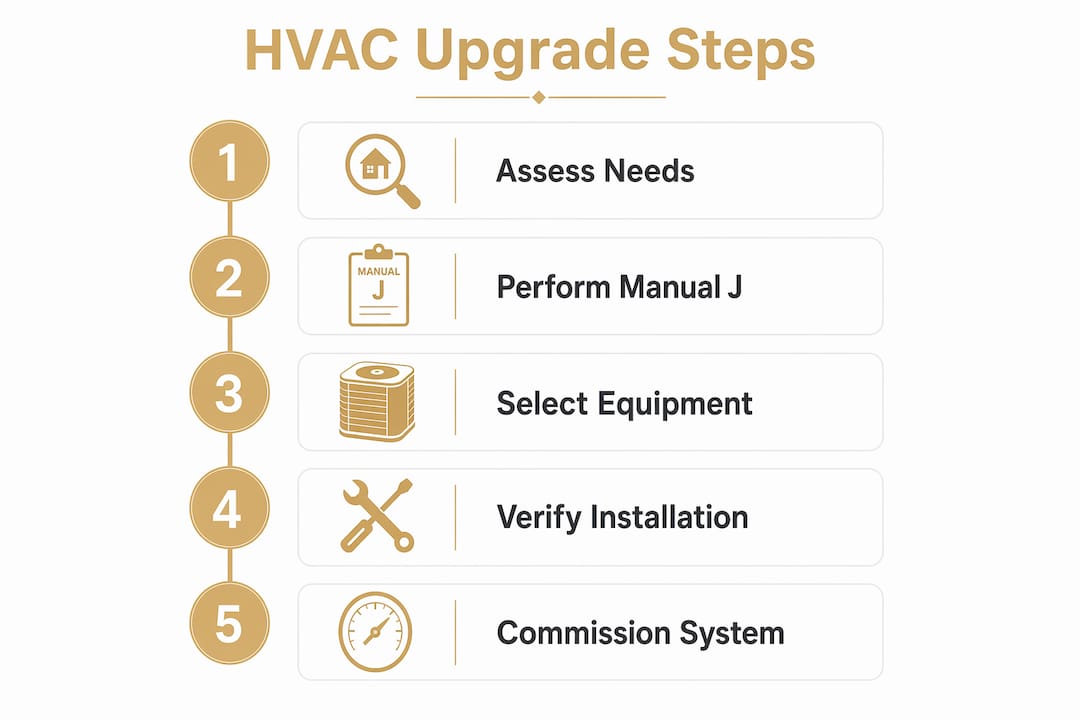
Planning a system replacement well before the old unit fails gives you time to make smart choices instead of rushed ones. The steps below apply whether you are replacing a central air conditioner, a furnace, or a full system.
- Start with a Manual J load calculation. This calculation accounts for your home’s insulation, window area, local weather, and occupancy to determine the exact heating and cooling capacity you need. Correct HVAC sizing prevents the two most common mistakes: an oversized system that short-cycles and an undersized one that never keeps up.
- Match efficiency ratings to your timeline. Equipment efficiency is measured in SEER2 for cooling, HSPF2 for heat pump heating, and AFUE for furnaces. Higher ratings cost more upfront but save more over time. If you plan to stay in your home for 10 or more years, a top-tier unit pays for itself. If you are selling in three years, a mid-tier unit is the smarter financial fit. Matching efficiency to ownership duration avoids overspending on premium models you will not benefit from long enough.
- Evaluate and seal your ductwork. New equipment installed on a leaky duct system will never perform at its rated efficiency. Ask your contractor to test duct leakage and address any issues before the new unit goes in.
- Consider heat pumps, variable-speed compressors, and zoning. Modern heat pumps handle both heating and cooling efficiently in most climates. Variable-speed compressors adjust output to match demand rather than cycling on and off at full power. Zoning systems let you control temperatures in different areas of the home independently, which cuts waste in rooms you rarely use.
| Equipment type | Efficiency metric | Best for |
|---|---|---|
| Central air conditioner | SEER2 | Homes with existing furnace |
| Heat pump | SEER2 + HSPF2 | Mild to moderate climates |
| Gas furnace | AFUE | Cold climates, existing gas lines |
| Dual-fuel system | SEER2 + AFUE | Extreme temperature swings |
Pro Tip: Before signing any contract, ask your contractor to confirm they will provide a commissioning report after installation. This document should include temperature splits, refrigerant subcooling and superheat readings, and static pressure measurements. If a contractor cannot explain what a commissioning report is, that tells you everything you need to know.
What does an HVAC upgrade actually cost, and what can you save?
Cost is the question every homeowner asks first, and the honest answer is that it varies. A full system replacement, including both the air conditioner and furnace, typically runs $8,000–$16,000 after rebates for high-efficiency equipment. Payback periods range from 4–10 years depending on your climate, usage patterns, and local energy rates.
The 2026 federal tax credit under Section 25C is one of the most valuable tools available to homeowners right now. Qualifying heat pumps receive a credit of up to 30% of installed cost, capped at $2,000. Other qualifying equipment, including high-efficiency furnaces and central air conditioners, qualifies for up to $600. Systems must meet the highest efficiency tiers defined by the Consortium for Energy Efficiency to qualify. The credit applies in the tax year of installation, so timing your project matters.
| Upgrade type | Typical installed cost | Est. annual savings | Federal credit | Payback period |
|---|---|---|---|---|
| High-efficiency heat pump | $10,000–$16,000 | $300–$500 | Up to $2,000 | 4–10 years |
| High-efficiency central AC | $5,000–$9,000 | $200–$400 | Up to $600 | 5–8 years |
| High-AFUE gas furnace | $4,000–$8,000 | $150–$350 | Up to $600 | 5–9 years |
| Full system (AC + furnace) | $12,000–$20,000 | $400–$700 | Up to $2,600 | 4–8 years |
Many utility companies also offer rebates on top of federal credits. Check with your local utility before purchasing, since some rebates require pre-approval. Financing options from licensed contractors can spread the upfront cost over several years, which makes the math easier when you factor in the monthly savings on your energy bill.
Pro Tip: Replace your air conditioner and furnace at the same time if both are aging. The labor savings of $500–$2,000 from a single installation visit often offset a significant portion of the second unit’s cost.
What installation mistakes cost homeowners the most?
Installation quality is the single biggest variable in how well your new system performs. A top-rated unit installed poorly will underperform a mid-range unit installed correctly. This is the part of the process most homeowners underestimate.
- Skipping the Manual J calculation. Some contractors size systems by square footage alone, which is not accurate. An oversized system short-cycles, meaning it turns on and off too frequently. Oversized systems cause poor humidity control, faster component wear, and reduced comfort despite higher energy use.
- Accepting an incorrect refrigerant charge. An improper refrigerant charge reduces efficiency and strains the compressor. Ask for documented subcooling and superheat readings after installation.
- Ignoring duct system problems. Installing new equipment on a duct system with leaks or poor design wastes a significant portion of the efficiency gains you paid for. Address duct leakage issues before the new unit is commissioned.
- Skipping warranty registration. Most manufacturers require online registration within 60 days of installation to activate extended warranties. Failing to register can cut a parts warranty from 10 years down to 5, which significantly increases your long-term repair risk.
- Choosing a contractor based on price alone. The lowest bid almost always reflects shortcuts somewhere. Total ownership cost over the system’s lifespan is the number that matters, not the installation invoice.
Pro Tip: Ask every contractor three questions before hiring: Do you perform a Manual J calculation? Will you provide a commissioning report? Do you handle warranty registration? A qualified contractor answers yes to all three without hesitation. If they hesitate or deflect, keep looking. You can also check for contractor red flags before you sign anything.
Key Takeaways
Thorough HVAC system upgrade planning, anchored by a Manual J calculation, proper equipment sizing, and federal tax credit timing, delivers the best combination of comfort, efficiency, and long-term savings.
| Point | Details |
|---|---|
| Use the 12-year rule | Systems older than 12 years needing major repairs are almost always better replaced than fixed. |
| Start with Manual J | A load calculation prevents oversizing and undersizing, the two most expensive planning mistakes. |
| Claim Section 25C credits | Qualifying heat pumps earn up to $2,000 in federal tax credits; time your installation to the tax year. |
| Prioritize installation quality | A commissioning report with refrigerant and pressure readings confirms your new system performs as rated. |
| Register your warranty | Register equipment within 60 days of installation to preserve full parts and compressor warranty coverage. |
What I’ve learned after 15 years of HVAC upgrades in Los Angeles
I have seen homeowners make the same mistake over and over: they treat an HVAC upgrade like buying a refrigerator. They pick the lowest price, sign the contract, and assume the job is done. Then they call me two years later wondering why their energy bills are still high and the system is already struggling.
The truth is that your HVAC system is infrastructure. It is as important to your home as the roof or the foundation. When you plan it right, you feel the difference every single day. When you cut corners, you pay for it every month for the next 15 years.
The homeowners I have worked with who got the best outcomes did three things. They planned ahead instead of waiting for a breakdown. They insisted on a Manual J calculation and a commissioning report. And they asked about tax credits before choosing equipment, not after. One family in the San Fernando Valley saved over $1,800 in the first year after upgrading to a qualifying heat pump system and claiming the full Section 25C credit. That is not a lucky outcome. That is what happens when the planning is done right.
My honest advice: do not let price be your first filter. Let installation quality and contractor credibility be your first filter. Price comes after you know the contractor will do the job correctly. A system that runs well for 18 years at a slightly higher upfront cost beats a system that struggles for 10 years at a lower price every single time.
— Ernie M
How Upright Construction & HVAC can help with your upgrade
Upright Construction & HVAC has served Los Angeles homeowners for over 15 years with a straightforward promise: quality installation backed by full transparency.

Every upgrade project starts with a Manual J load calculation and a thorough home evaluation. The team walks you through equipment options matched to your home’s actual needs, not a generic recommendation. Upright Construction & HVAC also helps you navigate 2026 federal tax credits and utility rebates so you capture every dollar available. After installation, you receive a full commissioning report confirming your system performs exactly as specified. If you are weighing repair against replacement, the HVAC repair challenges guide is a good place to start. Contact Upright Construction & HVAC for a personalized consultation and get your upgrade planned the right way.
FAQ
How long does HVAC system upgrade planning take?
Most homeowners complete the planning process in two to four weeks when they start with a professional energy audit and contractor consultations. Rushing the process increases the risk of poor equipment selection and installation mistakes.
What is a Manual J load calculation?
A Manual J load calculation determines the exact heating and cooling capacity your home needs based on insulation, window area, climate, and occupancy. It is the industry standard for correct HVAC sizing and prevents the costly problems caused by oversized or undersized equipment.
Do I qualify for the 2026 federal HVAC tax credit?
Homeowners who install qualifying high-efficiency equipment in 2026 can claim the Section 25C credit, which covers up to 30% of cost capped at $2,000 for heat pumps and $600 for other equipment. Systems must meet the efficiency tiers set by the Consortium for Energy Efficiency to qualify.
Should I replace my AC and furnace at the same time?
Replacing both units together saves $500–$2,000 in labor costs and ensures the components are matched for peak efficiency. If one unit is near the end of its lifespan, replacing both during the same installation visit is almost always the better financial decision.
How do I find a reliable HVAC contractor for my upgrade?
Ask every candidate whether they perform a Manual J calculation, provide a commissioning report, and handle warranty registration. Contractors who skip any of these steps are a risk to your investment. Reviewing HVAC contractor red flags before you hire protects you from the most common mistakes.