
How long does an AC unit actually last?
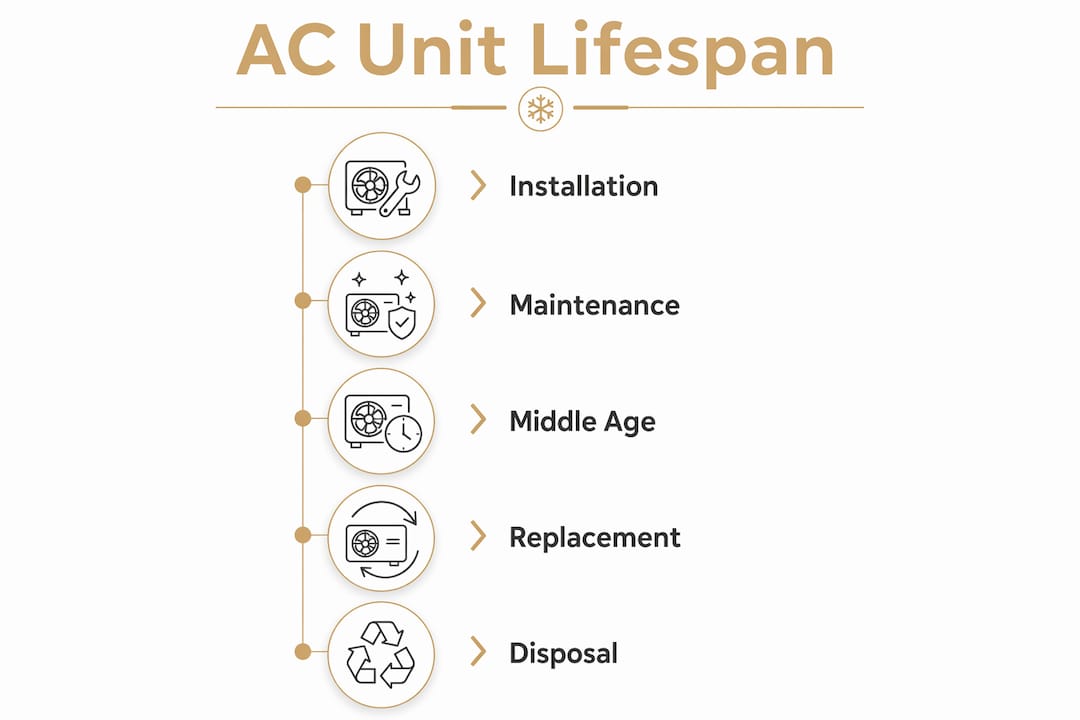
Most residential central air conditioners last somewhere between 15 and 20 years. That’s the practical window I give homeowners here in Los Angeles, and it lines up with what the research confirms: a median lifetime of 18 years for central AC units, with a mean closer to 19 years. Think of those numbers as a guideline, not a guarantee.
A unit in Phoenix running through brutal summers won’t age the same way as one in San Diego’s mild coastal air. Maintenance history, installation quality, and how hard the system works all shift that window. Some units quit at 10 years; others, well cared for, push past 20.
Quick reference for typical AC lifespan:
- 15–20 years: Standard expected range for most residential central AC units
- 18 years: Median lifespan based on national survey data
- 10 years: Likely endpoint for neglected units or those in harsh climates
- 20–25 years: Achievable with consistent professional maintenance and favorable conditions
The industry’s repair-vs-replace conversation usually begins once the unit reaches middle age. After that point, a combination of age and repair costs provides better guidance than age alone.
How to find out how old your AC unit is
Knowing your unit’s age is the first practical step. Here’s how to track it down:
- Check the outdoor unit’s data plate. The manufacturer label is usually on the side of the condenser. It lists the model and serial number.
- Decode the serial number. Most manufacturers embed the manufacture date in the serial number. The format varies by brand: some use the first four digits as week and year, others use letter codes for the month.
- Search the serial number online. Several free HVAC age-lookup tools let you enter a serial number and get the manufacture date back in seconds.
- Pull your installation records. If you have the original invoice or permit, the install date is right there.
- Check your home inspection report. If you bought the house, the inspector likely noted the unit’s age.
Pro Tip: If you can’t decode the serial number yourself, a licensed HVAC technician can read it in under a minute during a routine visit. Don’t guess on this one — the age affects every repair-vs-replace calculation you’ll make.
What actually shortens (or extends) your AC’s life?
The average lifespan of AC units swings from about 10 years to 25 years depending on a handful of factors you largely control.
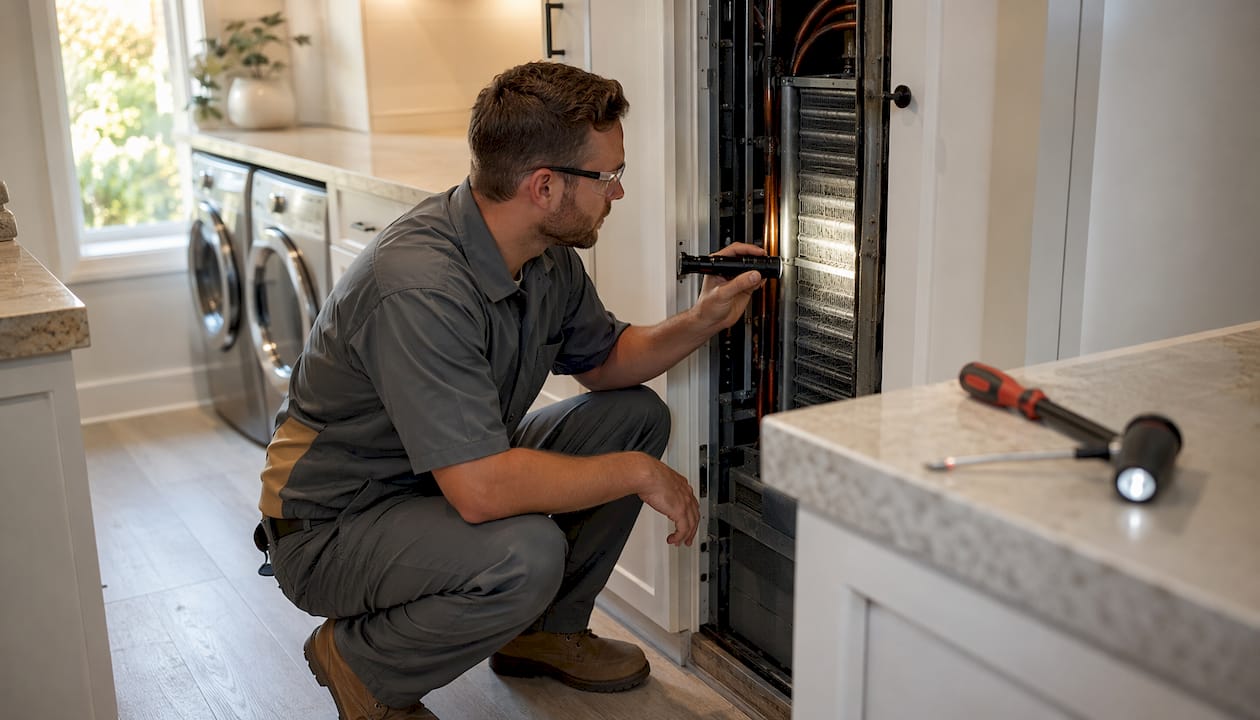
- Maintenance frequency. Skipping professional service for three years doubles the risk of premature compressor or heat exchanger failure. Annual tune-ups catch refrigerant leaks and electrical stress before they become expensive.
- Correct sizing. An oversized unit short-cycles, turning on and off too frequently, which accelerates wear on the compressor and reduces dehumidification. Proper sizing, guided by a Manual J load calculation, prevents this entirely.
- Climate severity. Salt air near the coast, extreme heat, and high humidity all degrade coils and electrical components faster than moderate climates do.
- Operating hours. A unit running 24/7 in a poorly insulated home ages faster than one cycling normally in a well-sealed house.
- Refrigerant type. Units still running on R-22 (phased out in 2020) face parts shortages and high refrigerant costs, which often makes repair impractical regardless of the unit’s age.
When should you replace your AC unit?
Age alone is a poor trigger for replacement. What matters is the combination of age, repair costs, and comfort. Energy Star’s guidance offers two practical rules:
- The 50% rule. If a repair costs more than half the price of a new unit, replace it.
- The $5,000 rule. Multiply the unit’s age by the repair cost. If the result exceeds $5,000, replacement usually wins financially.
Other signals worth weighing:
- Repairs are becoming more frequent, not just more expensive
- Energy bills are climbing without a change in usage patterns
- The unit struggles to hold a steady temperature or control humidity
- Parts for your model are discontinued or hard to source
- The system uses R-22 refrigerant
Stat to know: By mid-life, efficiency typically drops enough to noticeably increase energy bills compared to the unit’s original performance. A 12-year-old system isn’t automatically dead, but it’s worth a professional assessment. You can also use this repair vs. replacement checklist to work through the decision step by step.
Signs your AC unit is showing its age
Physical and performance symptoms often appear before a full breakdown. Watch for:
- Warm or uneven airflow despite the thermostat being set correctly
- Unusual noises like grinding, rattling, or banging from the outdoor unit
- Musty or burning smells coming from the vents
- Visible rust, corrosion, or refrigerant oil stains on the outdoor unit
- Frequent cycling where the unit turns on and off in short bursts
- Ice buildup on the coils or refrigerant lines
Any one of these on a unit past 10 years old is worth a professional look. Two or more together on a unit past 15 years usually points toward replacement. For a full breakdown of what to watch for, see 9 signs your HVAC needs replacement.
How to dispose of or recycle an old AC unit responsibly
Old AC units contain refrigerants, oils, and metals that require proper handling. You can’t just set one at the curb.
The U.S. Environmental Protection Agency requires that refrigerants be recovered by a certified technician before disposal. Releasing refrigerant into the atmosphere is illegal under Section 608 of the Clean Air Act. When Upright Construction & HVAC removes a unit, refrigerant recovery is always part of the process.
For the physical unit itself, most municipalities offer bulk appliance pickup or drop-off at a certified recycling facility. Utility companies sometimes run appliance recycling programs with rebates attached. The steel, copper, and aluminum in an old condenser have real scrap value, so a licensed recycler will often take the unit at no charge once the refrigerant is out.
Key Takeaways
Most residential AC units last 15–20 years, with a research-confirmed median of 18 years, but maintenance quality and climate conditions can push that range in either direction by five years or more.
| Point | Details |
|---|---|
| Typical lifespan | Central AC units last 15–20 years; the research median is 18 years. |
| Age-cost replacement rule | Multiply unit age by repair cost; replace if the result exceeds $5,000. |
| Efficiency decline | By year 12, energy bills often rise 25–35% due to efficiency loss. |
| Maintenance impact | Skipping service for three years doubles the risk of compressor failure. |
| Disposal requirement | EPA law requires certified refrigerant recovery before any AC unit is discarded. |
FAQ
What is the typical age limit for an AC unit?
Most residential central AC units reach the end of their practical service life between 15 and 20 years. The research median is 18 years, though neglect or harsh climates can cut that to around 10 years.
Is a 12-year-old AC unit still worth repairing?
A 12-year-old system is middle-aged, not end-of-life. Apply the $5,000 rule: multiply 12 by the repair cost, and if the result tops $5,000, replacement usually makes more financial sense than the repair.
Is a 14-year-old AC unit too old to keep?
Not automatically, but the unit is approaching the upper end of its expected range. Frequent repairs, rising energy bills, or R-22 refrigerant use all tip the scale toward replacement.
Can I set my AC to 67°F without stressing the system?
Running the thermostat very low forces the unit to work harder and run longer cycles, which adds wear over time. A moderate temperature setting is easier on the system and keeps energy costs reasonable.
Is an AC unit considered a 7-year depreciable property?
For federal tax purposes, residential HVAC equipment is generally classified as 5-year or 7-year property depending on use and ownership structure. Consult a tax professional for your specific situation, as classifications vary.