
- Why HVAC noise is concerning and what it really means
- What are the common HVAC noises and what do they indicate?
- How does HVAC noise affect your comfort, sleep, and air quality?
- What practical steps can homeowners take to diagnose HVAC noise?
- Why regular HVAC maintenance prevents noise problems
- Key Takeaways
- What I’ve learned after 15 years of diagnosing noisy HVAC systems
- Upright Construction & HVAC is ready to help with your HVAC noise concerns
- FAQ
- Recommended
TL;DR:
- Unusual HVAC noise signals mechanical or electrical problems that need immediate attention. Recognizing these sounds early can prevent costly failures and improve indoor comfort. Most noise issues are fixable, especially when diagnosed and addressed promptly.
Unusual HVAC noise is a diagnostic signal, not just an inconvenience. Your heating and cooling system communicates through sound, and those bangs, squeals, and buzzes are its way of telling you something is wrong. More than 75% of American households report HVAC issues annually, and abnormal noise is one of the most common early symptoms. Understanding why HVAC noise is concerning gives you the power to act before a minor problem becomes a costly failure. The good news is that many of these issues are fixable, especially when you catch them early.
Why HVAC noise is concerning and what it really means
HVAC noise is the system’s early warning system. Noise signals mechanical wear, airflow restrictions, or electrical faults before they cause a full breakdown. Most homeowners assume a noisy system is just aging, but that assumption costs them money. Ignoring the sound delays the diagnosis, and delayed diagnosis turns a $150 repair into a $1,500 replacement.
The industry term for evaluating these sounds is acoustic diagnostics. It means listening to the character, frequency, and timing of a noise to identify its source. A trained ear, or even a careful homeowner, can narrow down the problem significantly before a technician ever arrives. Knowing your HVAC system components makes this process much faster.
What are the common HVAC noises and what do they indicate?
Different sounds point to different problems. Banging, squealing, buzzing, and whistling each have distinct mechanical or electrical causes, and each carries a different level of urgency.
| Noise | Likely cause | Urgency level |
|---|---|---|
| Banging or clanking | Loose or broken component inside the unit | High. Shut down and inspect. |
| Squealing | Worn fan belt or dry motor bearings | Medium. Schedule service soon. |
| Buzzing | Electrical fault, loose wiring, or failing capacitor | High. Do not delay. |
| Whistling | Blocked register, dirty filter, or undersized duct | Low to medium. Check airflow first. |
| Humming | Normal motor operation or minor vibration | Low. Monitor for changes. |
| Grinding | Motor bearing failure | High. Stop the system immediately. |
Banging and clanking usually mean something has come loose inside the air handler or outdoor unit. A broken fan blade or a disconnected blower wheel will knock against the housing with every rotation. Left alone, it destroys surrounding components fast.
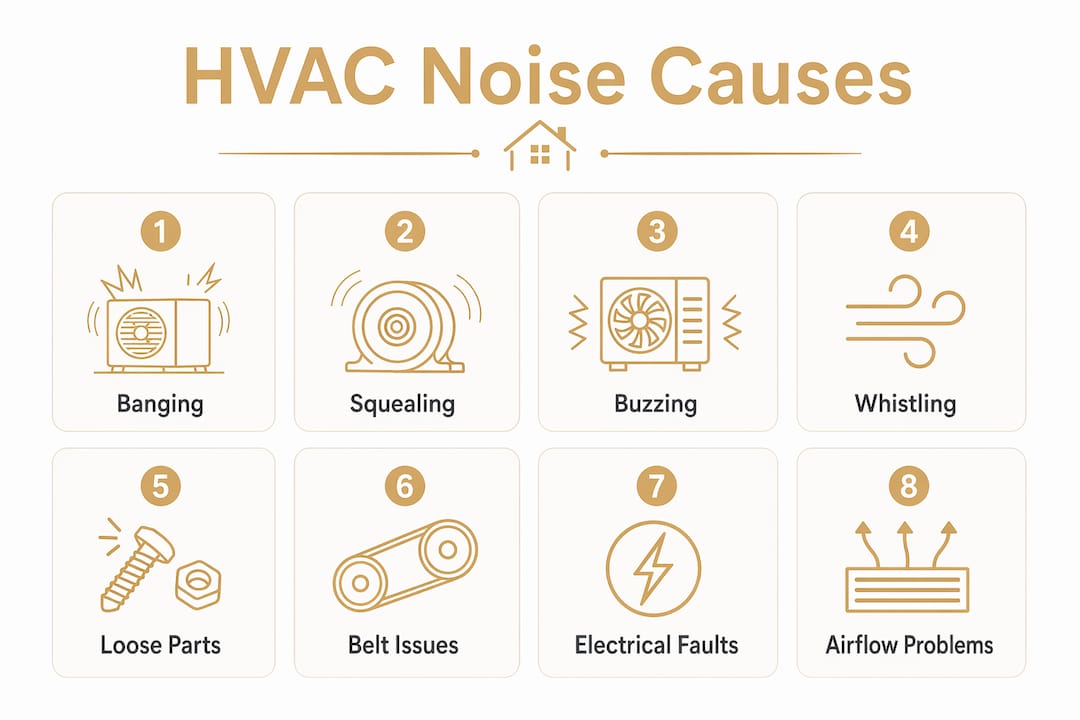
Squealing is almost always a belt or bearing issue. Older systems use rubber belts to drive the blower fan, and those belts crack and slip over time. Newer systems with direct-drive motors squeal when bearings dry out. Both are fixable before they cause motor failure.
Electrical buzzing and grinding noises indicate immediate safety risks. A failing capacitor, loose electrical connection, or motor bearing on its last legs can cause the system to overheat or short out. These sounds require professional attention, not a wait-and-see approach.
Pro Tip: Record the noise on your phone before calling a technician. A 30-second audio clip of the sound, captured at the unit, helps a technician diagnose the problem faster and arrive with the right parts.
How does HVAC noise affect your comfort, sleep, and air quality?
HVAC noise does more than irritate your ears. Indoor HVAC noise exceeding 40 dB correlates with increased annoyance, disrupted sleep, and reduced concentration. That 40 dB threshold is roughly the volume of a quiet library. Many malfunctioning systems push well past that level.
“Noise perception influences how people feel about air freshness and temperature. A noisy HVAC system can make a room feel stuffier or warmer than it actually is, even when temperature and humidity readings are normal. This cross-modal effect means your discomfort is real, even if the thermostat disagrees.”
The acoustic character of a noise matters as much as its volume. Tonal and high-frequency noises cause more irritation than a steady hiss at the same decibel level. A high-pitched squeal at 38 dB feels more disruptive than a low hum at 42 dB. This is why sound pressure level measurements alone do not tell the full story of how a noisy system affects your household.
Sudden, intermittent noises cause cognitive arousal. Your brain treats unexpected sounds as potential threats, triggering a mild stress response even during sleep. Over weeks and months, this adds up to fatigue, irritability, and reduced sleep quality. A well-maintained, quiet HVAC system is not a luxury. It is a health factor.

What practical steps can homeowners take to diagnose HVAC noise?
About 60% of common HVAC noise issues can be safely diagnosed and fixed by homeowners. The causes are usually simple: loose screws, a clogged filter, or debris in the outdoor unit. Here is a safe, step-by-step approach.
- Turn off the system first. Never inspect a running unit for mechanical noise. Switch the thermostat to “off” and cut power at the breaker before opening any panels.
- Check and replace the air filter. A clogged filter restricts airflow and forces the blower to work harder, creating a low rumble or whistle. Replace filters every 1–3 months.
- Inspect the outdoor unit for debris. Leaves, twigs, and dirt inside the condenser housing cause rattling and banging. Clear the area and remove any debris from inside the unit.
- Tighten visible screws and panels. Loose access panels vibrate against the cabinet during operation. A screwdriver takes 60 seconds and often eliminates the noise entirely.
- Check all supply and return registers. Closed or blocked registers increase air velocity in the ducts, causing whistling. Open every register fully and remove any furniture blocking them.
- Listen for the noise location. Is it at the air handler, the outdoor condenser, or inside the ductwork? Location narrows the cause significantly.
For whistling specifically, the fix is almost never soundproofing. Whistling requires airflow correction, not acoustic treatment. Undersized ducts or blocked registers create excessive air velocity. Adding duct liner over a velocity problem only masks the symptom while the pressure continues to stress your system.
When soundproofing is the right solution, the options are affordable. Vibration isolation pads cost $20–$60 and decouple the unit from the building structure, cutting structure-borne noise effectively. Compressor sound blankets and acoustic duct liners are also available. Full soundproofing solutions range from $400 to $1,760 depending on the scope.
Pro Tip: Most DIYers jump straight to soundproofing when they hear noise. Check airflow balance first. A $0 fix, like opening a closed register, often eliminates the noise completely.
Call a professional when you hear electrical buzzing, grinding, or any noise that returns immediately after you address the obvious causes. These sounds point to issues that require tools, training, and safety equipment. The HVAC contractor red flags to watch for include any technician who diagnoses over the phone without inspecting the unit.
Why regular HVAC maintenance prevents noise problems
Regular maintenance cuts noise-related emergency repair calls by 40% and extends system lifespan. That statistic reflects a simple truth: most noise problems start small and grow. A technician who catches a worn belt in april prevents the motor failure that would have happened in july.
The maintenance tasks that directly prevent noise include:
- Filter replacement every 1–3 months to prevent airflow restriction and blower strain
- Belt inspection and replacement on older systems before cracking causes slippage and squealing
- Motor lubrication to prevent dry bearings from grinding
- Duct cleaning every 3–5 years to remove debris that causes rattling and airflow turbulence
- Electrical connection checks to catch loose wiring before it causes buzzing or arcing
- Outdoor unit cleaning each spring to remove debris from the condenser coil and housing
An annual professional inspection catches the noise symptoms that homeowners miss. A technician measures refrigerant levels, checks capacitor health, and tests motor amperage draw. Each of these readings reveals wear before it becomes audible. The HVAC maintenance checklist from Upright Construction & HVAC covers every one of these tasks in a structured format.
| Maintenance task | Noise problem it prevents |
|---|---|
| Filter replacement | Whistling, blower strain hum |
| Belt inspection | Squealing, slipping belt noise |
| Motor lubrication | Grinding, dry bearing squeal |
| Duct cleaning | Rattling, airflow turbulence |
| Electrical checks | Buzzing, arcing, capacitor failure |
Skipping annual service does not save money. It shifts the cost from a predictable maintenance fee to an unpredictable emergency repair, often at the worst possible time. Why HVAC maintenance matters is a question with a clear financial answer: prevention costs less than repair, every time.
Key Takeaways
Unusual HVAC noise is a mechanical warning signal that demands attention, not tolerance, because early diagnosis prevents costly failures and protects indoor comfort.
| Point | Details |
|---|---|
| Noise is a warning signal | Banging, buzzing, and grinding indicate mechanical or electrical faults before full failure. |
| 40 dB threshold matters | HVAC noise above 40 dB disrupts sleep, focus, and perceived air quality. |
| 60% of issues are DIY fixable | Loose screws, dirty filters, and debris are common causes homeowners can address safely. |
| Soundproofing is not always the answer | Whistling requires airflow correction, not acoustic treatment. |
| Maintenance prevents emergencies | Regular servicing cuts noise-related emergency calls by 40% and extends system life. |
What I’ve learned after 15 years of diagnosing noisy HVAC systems
The most common mistake I see homeowners make is waiting. They hear a new noise, assume it is normal, and call us six months later when the system has stopped working entirely. By that point, what started as a $200 belt replacement has turned into a $2,000 motor replacement or a full system swap.
Here is the uncomfortable truth: most homeowners know something is wrong the moment they hear it. The noise feels off. But they talk themselves out of acting because the system is still running. Running and running well are two very different things. A car with a flat tire is still moving, but you would not drive it across town.
The other thing I want you to take away is this: noise is information. A banging sound tells you something is loose. A buzz tells you there is an electrical issue. A whistle tells you air is being forced through a restriction. Each sound has a cause, and each cause has a fix. The system is not broken beyond repair. It is asking for help.
My advice is simple. When you hear something new, write down when it happens, where it seems to come from, and whether it is constant or intermittent. That information cuts diagnostic time in half. Then call someone who will actually inspect the unit rather than guess over the phone. At Upright Construction & HVAC, we show up, we listen, and we tell you exactly what we find.
— Ernie M
Upright Construction & HVAC is ready to help with your HVAC noise concerns
Noisy HVAC systems are one of the most common calls we receive at Upright Construction & HVAC, and they are almost always fixable when caught early. Our team has over 15 years of experience diagnosing the full range of common HVAC repair challenges, from loose blower components to failing capacitors and restricted ductwork.

We serve Los Angeles homeowners with 24/7 emergency support and transparent diagnostics. Whether you need a quick inspection or a full preventative maintenance plan, we give you a clear picture of what is happening and what it will cost before any work begins. Contact Upright Construction & HVAC today and let us turn that noise into a solved problem.
FAQ
Is some HVAC noise normal?
A low, steady hum during operation is normal. Any new, sudden, or loud noise, including banging, squealing, buzzing, or grinding, signals a problem that needs attention.
What does a buzzing HVAC sound indicate?
Buzzing typically points to an electrical fault, loose wiring, or a failing capacitor. These are safety risks that require a licensed technician, not a DIY fix.
Can a dirty filter cause HVAC noise?
A clogged filter restricts airflow and forces the blower to strain, creating a low hum or whistling sound. Replacing the filter every 1–3 months prevents this and protects the motor.
Why does my HVAC whistle?
Whistling is almost always an airflow problem, not a mechanical one. Blocked registers, closed vents, or undersized ducts force air through a restriction at high velocity. Open all registers and check for obstructions before calling a technician.
When should I call a professional for HVAC noise?
Call a professional immediately for grinding, electrical buzzing, or any noise that returns after you address obvious causes like debris or a dirty filter. These sounds indicate mechanical or electrical failure that requires trained diagnosis.