
- What are the most common causes of an AC blowing warm air?
- How can homeowners troubleshoot AC blowing warm air before calling a professional?
- What are the effects of low refrigerant and how is it diagnosed professionally?
- How do airflow problems and frozen coils cause AC to blow warm air?
- Key Takeaways
- What I’ve learned from 15 years of warm air calls
- When warm air means it’s time to call Upright Construction & HVAC
- FAQ
- Recommended
TL;DR:
- An air conditioner blowing warm air indicates a disruption in the cooling cycle, often caused by refrigerant leaks or dirty filters. Homeowners should troubleshoot common issues such as thermostat settings and airflow restrictions before calling for professional help. Persistent problems like frozen coils or refrigerant leaks require licensed technicians for proper diagnosis and repair.
An air conditioner blowing warm air is a sign that the system’s cooling cycle has been disrupted and needs attention. The technical term for this failure is “loss of cooling capacity,” and it covers everything from a wrong thermostat setting to a refrigerant leak. Understanding why ac blows warm air saves you time, money, and a lot of frustration on a hot Los Angeles day. At Upright Construction & HVAC, we’ve diagnosed this exact problem thousands of times over 15 years, and the causes almost always fall into a short, predictable list. This guide walks you through each one, with clear steps you can take right now.
What are the most common causes of an AC blowing warm air?
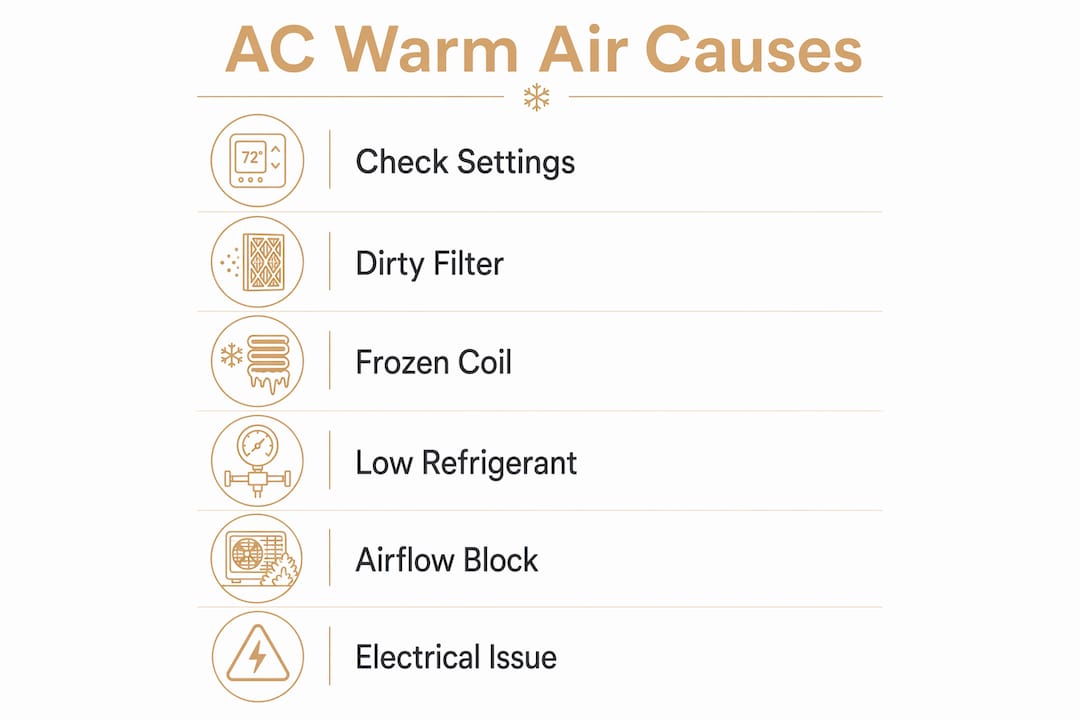
Most warm air problems trace back to one of six root causes. Knowing which one you’re dealing with is the fastest path to a fix.
- Low or leaking refrigerant. Refrigerant is the substance that absorbs heat from your indoor air and releases it outside. When the level drops due to a leak, the system loses its ability to cool. You may hear a hissing sound near the indoor unit or notice ice forming on the copper lines.
- Clogged or dirty air filter. A dirty air filter is the top cause of AC cooling failure. Experts recommend checking filters every 30–90 days and using MERV 8–11 rated filters, which balance filtration with proper airflow.
- Wrong thermostat or fan settings. Setting the fan to “On” instead of “Auto” keeps the indoor fan running between cooling cycles. The result is warm air between cycles that homeowners often mistake for a system failure.
- Frozen evaporator coils. Ice on the coils blocks heat absorption entirely. The AC keeps running, but no cooling happens. This is one of the more counterintuitive common AC problems.
- Outdoor condenser unit issues. If the condenser is blocked by debris, or if the fan motor has failed, heat cannot escape outside. The system recirculates warm air instead.
- Electrical failures. Failing capacitors prevent the compressor from starting, especially when outdoor temperatures climb above 90°F. A tripped circuit breaker can also cut power to the outdoor unit while the indoor fan keeps running.
- Blocked supply registers. Closing too many vents in unused rooms feels logical, but it raises pressure inside the ductwork and restricts airflow throughout the system.
Pro Tip: Airflow restrictions are the most overlooked cause of warm air complaints. Before assuming a refrigerant problem, check every vent in the house. You may find two or three closed registers that are quietly starving the system.
How can homeowners troubleshoot AC blowing warm air before calling a professional?
These steps follow a logical order from simplest to most involved. Work through them before scheduling a service call.
Check the thermostat settings. Set the thermostat to “Cool” and the fan to “Auto.” A fan set to “On” pushes unconditioned air through the vents between cooling cycles, which feels warm. This single setting causes a surprising number of service calls.
Replace or inspect the air filter. Pull the filter out and hold it up to light. If you can’t see light through it, replace it. A clogged filter starves the system of airflow and can cause the evaporator coil to freeze within hours.
Open your supply registers. At least 80% of supply registers must stay open and unblocked for the system to maintain proper pressure. Closing more than 20% raises duct pressure and triggers freeze-ups.
Check the circuit breaker. Go to your electrical panel and look for a tripped breaker labeled “AC” or “condenser.” Reset it once. If it trips again immediately, stop. Repeated resets can damage the compressor.
Look for ice on the indoor unit. Open the access panel on your air handler and check the evaporator coil. If you see ice, turn the AC off and switch the fan to “On.” Let it run for 1–2 hours to thaw the coil before restarting the system.
Replace thermostat batteries. A weak thermostat battery can cause a smart thermostat to lose its WiFi connection or stop sending cooling signals entirely. The display may look active while the system does nothing. This is a two-minute fix that homeowners frequently skip.
Call a professional. If none of these steps restore cooling, the problem is beyond safe DIY territory. Refrigerant leaks, failed capacitors, and compressor issues all require licensed technicians and specialized tools.
Pro Tip: Never reset a tripped breaker more than once. Repeated resets without finding the cause risk burning out the compressor, turning a $200 repair into a $2,000 replacement.
What are the effects of low refrigerant and how is it diagnosed professionally?
Refrigerant is the lifeblood of your cooling system. It circulates through a sealed loop, absorbing heat indoors and releasing it outside. The critical fact most homeowners don’t know is that refrigerant does not get used up. If your system is low, it means there is a leak somewhere in that sealed loop.
Topping off refrigerant without finding and repairing the leak is a temporary fix that causes long-term compressor damage. The refrigerant will simply escape again, and the compressor will run under stress until it fails.
Signs of a refrigerant leak include:
- A hissing or bubbling sound near the indoor unit or refrigerant lines
- Ice buildup on the copper suction line or evaporator coil
- Warm air from vents despite the compressor running
- Higher-than-normal electric bills as the system works harder to compensate
Refrigerant leaks often originate from aged brazed joints, corroded evaporator coils, or faulty Schrader valves, particularly in coastal or humid environments like parts of Los Angeles.
Diagnosing refrigerant levels requires professional tools. Technicians attach pressure gauges to the suction and discharge lines, then compare the readings against manufacturer specifications at the current outdoor temperature. Homeowners cannot perform this test accurately with consumer-grade tools.
Handling refrigerant legally requires EPA Section 608 certification. Any technician who offers to “top off” your system without first testing for leaks is cutting corners. A proper repair finds the leak, fixes it, and then recharges the system to the manufacturer’s specified pressure.
How do airflow problems and frozen coils cause AC to blow warm air?
A frozen evaporator coil is one of the most paradoxical problems in HVAC. Ice forms on the coil, yet the system produces no cooling. The ice physically blocks the coil’s surface from absorbing heat, so the air passing over it stays warm.

The two main triggers are dirty filters and closed supply registers. Dirty filters cause an estimated 30–40% of summer no-cooling service calls. That number reflects how often a simple maintenance task, one that costs a few dollars, leads to a full system shutdown. Closing more than 20% of supply vents raises duct pressure enough to reduce airflow across the coil, which drops the coil temperature below freezing.
| Cause | What happens | What you see |
|---|---|---|
| Dirty air filter | Airflow drops, coil gets too cold | Ice on coil, warm air from vents |
| Too many closed vents | Duct pressure rises, airflow drops | Ice on coil, uneven cooling |
| Low refrigerant | Coil pressure drops, temperature falls | Ice on suction line, hissing sound |
| Blocked condenser | Heat can’t escape outside | Warm air, outdoor unit running hot |
To thaw a frozen coil safely, turn the AC off at the thermostat and switch the fan to “On.” This circulates room-temperature air over the coil without running the compressor. After 1–2 hours of thawing, check the coil again. If it’s clear, replace the filter and restart the system. If it freezes again within a few hours, the problem is refrigerant-related and needs a professional.
Pro Tip: Put a towel under the air handler before you start thawing. Melting ice drips, and a wet ceiling or floor is an unpleasant surprise.
Key Takeaways
An AC blowing warm air almost always traces back to one of six fixable causes, and most homeowners can rule out the simple ones in under 30 minutes.
| Point | Details |
|---|---|
| Check settings first | Set thermostat to “Cool” and fan to “Auto” before assuming a mechanical failure. |
| Filter maintenance matters | Replace filters every 30–90 days using MERV 8–11 rated filters to maintain proper airflow. |
| Keep registers open | At least 80% of supply registers must stay open to prevent pressure buildup and coil freezing. |
| Refrigerant leaks need repair | Low refrigerant always means a leak. Topping off without fixing the leak damages the compressor. |
| Know when to call a pro | Frozen coils that refreeze, tripped breakers that trip again, and hissing sounds all require licensed service. |
What I’ve learned from 15 years of warm air calls
After 15 years running Upright Construction & HVAC in Los Angeles, I can tell you the most common mistake homeowners make: they assume the worst before checking the simplest things. I’ve driven out to jobs where the fix was a $12 filter or a thermostat set to “On” instead of “Auto.” Those calls are easy wins for the homeowner, but they didn’t need to happen.
The second mistake I see constantly is the repeated breaker reset. A homeowner trips the breaker, resets it, it trips again, they reset it again. By the time I arrive, the compressor is stressed and sometimes burned. One reset is the rule. After that, you call someone.
What actually extends an AC’s life is boring but true: change the filter on schedule, keep the outdoor unit clear of debris, and get a professional inspection once a year. The HVAC maintenance checklist we put together covers exactly what to check and when. Homeowners who follow it rarely face emergency calls in the middle of a heat wave.
The refrigerant situation is the one that frustrates me most. I still see technicians who top off refrigerant without finding the leak. That’s not a repair. That’s a delay. The refrigerant escapes again, the compressor runs dry, and the homeowner pays twice. Always ask your technician to show you the pressure readings and explain where the leak was found before they recharge the system.
If your AC is blowing warm air and you’ve worked through the basic checks without success, don’t wait it out. Heat in Los Angeles is serious, and a struggling compressor gets worse, not better, with time.
— Ernie M
When warm air means it’s time to call Upright Construction & HVAC
If you’ve checked the thermostat, replaced the filter, opened the registers, and reset the breaker once, and your AC is still blowing warm air, the problem is inside the system.

Upright Construction & HVAC has served Los Angeles homeowners for over 15 years, diagnosing and fixing exactly these situations. Our technicians carry pressure gauges, leak detection equipment, and replacement capacitors on every truck. We handle emergency AC repairs 24/7, including refrigerant leak repair, frozen coil service, and compressor diagnostics. For homeowners who want to stay ahead of problems, our HVAC repair services include full system inspections that catch issues before they become breakdowns. Call us and get a straight answer, not a sales pitch.
FAQ
Why is my AC running but blowing warm air?
The most common reasons are a wrong fan setting (“On” instead of “Auto”), a clogged air filter, or a frozen evaporator coil. Check these three things first before calling a technician.
Can I fix low refrigerant myself?
No. Refrigerant handling requires EPA Section 608 certification, and diagnosing the correct charge level requires professional pressure gauges. Adding refrigerant without finding the leak also causes compressor damage over time.
How do I know if my evaporator coil is frozen?
Open the access panel on your indoor air handler and look for ice on the coil or the copper suction line. If ice is present, turn the AC off and run the fan only for 1–2 hours to thaw it safely.
Why does my AC blow warm air only sometimes?
Intermittent warm air often points to a failing capacitor, which struggles to start the compressor when outdoor temperatures exceed 90°F. It can also result from a thermostat with weak batteries losing its connection to the system.
How often should I change my AC filter to prevent cooling problems?
Check your filter every 30–90 days and replace it when it’s visibly dirty or clogged. Use a MERV 8–11 rated filter, which provides good filtration without restricting the airflow your system needs to cool properly.
Recommended
- Wondering Why Your Heater Blowing Cold Air Instead Of Hot Air? Here’s Why – Upright Construction & HVAC
- Boost AC Efficiency How Capacitors Transform Performance – Upright Construction & HVAC
- Common HVAC Repair Challenges Every Homeowner Should Know
- Home HVAC Furnaces: Top 8 Quick Fixes For Heating Problems With Home HVAC Furnaces – Upright Construction & HVAC