Discover why heating maintenance saves money for homeowners. Prevent breakdowns, improve efficiency, and extend your system’s life! Learn more now.
Why Heating Maintenance Saves Money for Homeowners
- Key Takeaways
- Why heating maintenance saves money on your energy bill
- Avoiding expensive emergency repairs
- How maintenance extends your heating system’s life
- Combining maintenance with a whole-home energy strategy
- My honest take on heating maintenance as an investment
- Let Upright Construction & HVAC protect your home this season
- FAQ
- Recommended
TL;DR:
- Regular heating maintenance improves efficiency, prevents 80% of system failures, and extends equipment lifespan.
- Skipping annual tune-ups can lead to costly emergency repairs and early furnace replacement, costing thousands more.
Most homeowners assume skipping their annual heating tune-up is a harmless way to trim the budget. It isn’t. Understanding why heating maintenance saves money requires flipping that assumption on its head. A neglected system burns more fuel, breaks down more often, and dies years sooner than one that gets regular care. The numbers are not subtle. What feels like a $100 to $150 savings on skipping a service visit can quietly turn into a $500 emergency repair call or a $5,000 early furnace replacement. That math never works in your favor.
Key Takeaways
| Point | Details |
|---|---|
| Efficiency gains are real | Regular tune-ups can improve heating efficiency by up to 25%, directly reducing monthly utility bills. |
| Most failures are preventable | Annual inspections prevent roughly 80% of common heating system breakdowns before they become emergencies. |
| Lifespan nearly doubles | A maintained system can last 15 to 20 years versus just 10 years without proper care. |
| Timing your service matters | Scheduling maintenance off-season gets you better pricing and more flexible appointment windows. |
| Whole-home strategy wins | Combining maintenance with insulation and thermostat upgrades can cut energy bills by around 30%. |
Why heating maintenance saves money on your energy bill
The most immediate and measurable financial benefit of regular heating service is what you see on your utility bill every month. Your furnace or heat pump is designed to operate at a certain efficiency level. When components get dirty or parts wear down, the system has to work harder to produce the same amount of heat. That extra effort costs you money every single day.
Clogged filters and restricted airflow increase energy consumption by 15 to 25%, according to HVAC service data. Think about what that means in real terms. If your heating bill runs $200 a month during winter, a poorly maintained system could be costing you an extra $30 to $50 every month. That is $90 to $150 vanishing from your wallet over a single heating season, and you never even noticed it leaving.
Here is what a technician actually does during a tune-up that keeps those costs down:
- Cleans the heat exchanger and burners so combustion stays efficient
- Inspects and cleans the blower motor and fan blades
- Replaces or inspects the air filter to protect airflow (see why filter replacement matters)
- Checks refrigerant levels, coils, and electrical connections
- Calibrates the thermostat so it reads and responds accurately
Each of those steps directly removes resistance from the system. Less resistance means less energy consumed to reach your target temperature. Properly maintained systems show efficiency improvements of up to 25%, which translates to lower bills month after month.
Pro Tip: Change your air filter every 1 to 3 months depending on your home environment. Homes with pets or dust require more frequent changes. This single habit protects your system between professional visits and costs only a few dollars.
Avoiding expensive emergency repairs
There is a specific kind of financial pain that comes from a heating system breaking down on a cold January evening. Emergency service calls carry after-hours fees, expedited parts costs, and the kind of urgency that puts you at a negotiating disadvantage. Emergency repairs during peak season cost significantly more than the same repair handled during a scheduled visit.
The good news is that most of these emergencies are preventable. Here is how routine inspections stop small problems from becoming expensive ones:
- A technician spots a cracked heat exchanger during a fall tune-up and replaces it for a few hundred dollars. Left undetected, it causes a full system shutdown and potential carbon monoxide risk.
- A worn capacitor is identified during inspection and replaced for under $100. Ignored, it burns out the blower motor, which can cost $400 to $600 to replace.
- Loose electrical connections are tightened during a service visit. Without that attention, they can cause circuit failures that require full board replacements.
- Low refrigerant in a heat pump is topped off during maintenance. Running low causes the compressor to overwork, which is one of the most expensive components to replace in any system.
Annual tune-ups prevent roughly 80% of common heating system failures. That statistic alone justifies the cost of a service plan every single year.
“The homeowners who call us in a panic are almost never the ones on a maintenance plan. Regular service is not just about efficiency. It is about not getting caught off guard when you can least afford it.”
Knowing what drives up heating repair costs before you need emergency help puts you in a much stronger position as a homeowner.
How maintenance extends your heating system’s life
A furnace is not a cheap appliance. Replacing one runs anywhere from $3,000 to $7,000 installed, depending on the size and efficiency rating you choose. Anything that pushes that replacement date further into the future saves you real money, and consistent maintenance does exactly that.
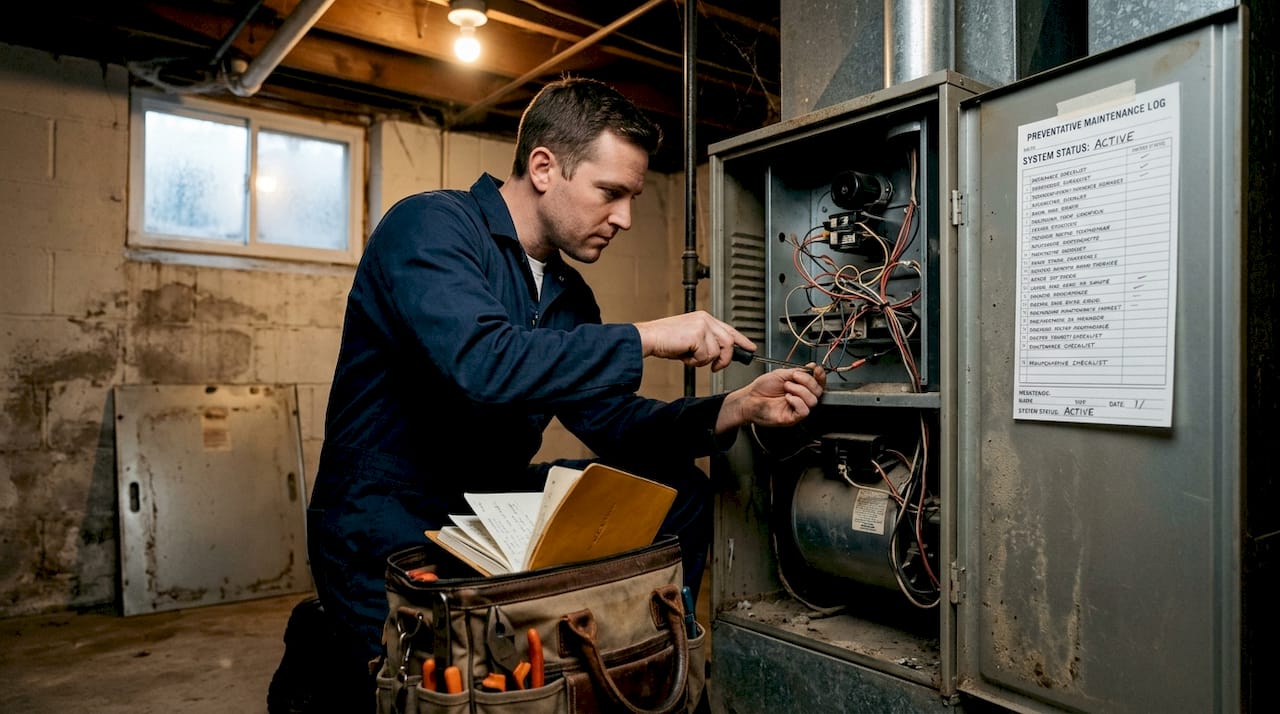
Well-maintained systems can last 15 to 20 years, while neglected systems often fail within 10 years. That difference is not random. It comes down to how much unnecessary strain the equipment carries over time.
Here is a simple comparison of what regular versus irregular maintenance actually looks like over the life of your system:
| Factor | With regular maintenance | Without regular maintenance |
|---|---|---|
| System lifespan | 15 to 20 years | 8 to 12 years |
| Average energy efficiency | Near original rating | 15 to 25% below original |
| Emergency repair frequency | Low, mostly preventable | High, often unpredictable |
| Replacement cost timing | Planned and budgeted | Sudden and stressful |
| Annual service cost | $100 to $200 per year | Near zero until failure |
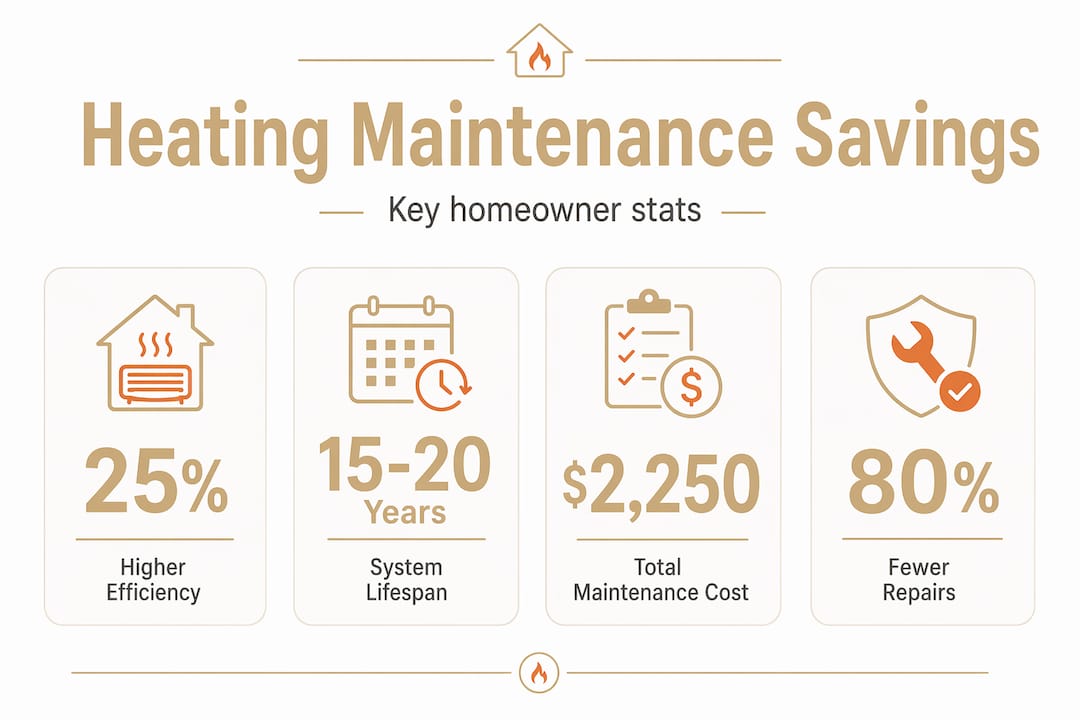
The math is clear. Spending $150 a year for 15 years costs you $2,250. Skipping service and replacing your unit at year 10 instead of year 18 costs you thousands more in both the replacement and the wasted energy along the way.
Pairing furnace and AC maintenance in a single service plan adds another layer of value. Shared components like the blower motor, ductwork, and air handler serve both systems. When a technician services both at once, they catch cross-season issues that would otherwise go unnoticed until they cause a failure.
Pro Tip: If your system is approaching the 10-year mark, ask your technician for an honest assessment during your next tune-up. Knowing whether you have 3 years or 8 years left helps you plan financially and avoid being surprised by a sudden replacement.
Combining maintenance with a whole-home energy strategy
Heating maintenance does not exist in a vacuum. It works best when it is part of a broader approach to how your home uses energy. The Department of Energy estimates that a whole-house approach combining maintenance with insulation improvements, duct sealing, and thermostat optimization can cut energy costs by around 30%. That is not a marginal gain. For a household spending $1,500 per year on heating, that is $450 back in your pocket annually.
Here is how to build that whole-home strategy around your regular HVAC service:
- Seal your ducts. Leaky ductwork can waste 20 to 30% of the air your system produces before it ever reaches a room. A technician can identify major leaks during service.
- Add a programmable or smart thermostat. Lowering the temperature by 7 to 10 degrees while you sleep or are away from home saves around 10% per year on heating costs, according to the DOE.
- Improve attic insulation. Heat rises and escapes through poorly insulated attics faster than most homeowners expect. Insulation upgrades work alongside your heating system, not separately from it.
- Schedule maintenance before peak season. Off-season scheduling gives you better pricing, easier appointment access, and time to address any issues before winter demand hits.
- Use heat balance strategies for multi-story homes. Uneven heating between floors wastes energy and puts unnecessary demand on your system.
Many homeowners delay maintenance until something goes wrong. By that point, the inefficiency has already been compounding for months or years. Getting ahead of it with a scheduled plan is always the financially smarter move.
My honest take on heating maintenance as an investment
I have been in this industry for over 15 years, and I have seen the same scenario play out more times than I can count. A homeowner calls us in the middle of winter, no heat, guests coming for the holidays, and the repair bill is painful. When I ask about their last service visit, the answer is usually “I didn’t think I needed one” or “I was trying to save money.”
What I’ve learned is that the homeowners who spend the least on their heating systems over time are never the ones who avoid maintenance. They are the ones who schedule it consistently, treat it like an oil change, and factor it into their yearly budget without drama.
I’ve seen furnaces run beautifully at 18 years old because someone cared for them. I’ve also seen systems fail at 9 years because nobody ever changed a filter or had a technician look at them. The difference in total cost between those two households is staggering when you add up the energy waste, the emergency calls, and the early replacement.
My advice is simple. Stop thinking of a tune-up as an expense and start thinking of it as a protection plan for a $5,000 appliance that runs every single day. You wouldn’t drive 50,000 miles without an oil change. Don’t ask your furnace to heat your home for years without any attention either.
Schedule your service before the season starts. Do it off-season when prices are lower and technicians have more availability. And if your system is older, get an honest assessment now instead of waiting for it to fail on the coldest night of the year.
— Ernie M
Let Upright Construction & HVAC protect your home this season
At Upright Construction & HVAC, we have spent over 15 years helping Los Angeles homeowners get ahead of heating problems instead of reacting to them. Our maintenance plans are designed to catch issues early, keep your system running at peak efficiency, and give you the kind of peace of mind that only comes from knowing a professional has actually looked at your equipment.

Whether you need a seasonal tune-up, a full HVAC inspection for your home, or guidance on whether your current system is worth maintaining or replacing, our team is ready. We offer 24/7 support, transparent pricing, and a track record our customers trust. If you are in the Los Angeles area and want to stop overpaying on your energy bills, schedule your heating service with us today.
FAQ
How much money can heating maintenance actually save?
Regular maintenance can improve your system’s efficiency by up to 25%, which directly reduces your monthly energy bills. Combined with insulation and thermostat upgrades, homeowners can save around 30% annually on heating costs.
How often should I schedule a heating system tune-up?
Most HVAC professionals recommend a professional heating tune-up once a year, ideally before the heating season begins. Scheduling in the off-season typically gets you better pricing and more appointment flexibility.
What does a heating tune-up actually prevent?
Annual inspections prevent approximately 80% of common heating failures, including motor burnout, heat exchanger cracks, and electrical faults that lead to costly emergency repairs during peak winter demand.
Is maintenance worth it if my system seems to be working fine?
Yes. Systems that appear to be working often operate well below their original efficiency rating, costing you more in energy bills than you realize. Most of the issues a technician finds during a tune-up are invisible until they cause a breakdown.
How long does a well-maintained heating system last?
A properly maintained furnace or heat pump can last 15 to 20 years, compared to roughly 10 years for a neglected system. That extra lifespan can save you thousands in premature replacement costs.
Recommended
- Why Annual HVAC Inspection Is Needed For Your Home
- Home HVAC Furnaces: Top 8 Quick Fixes For Heating Problems With Home HVAC Furnaces – Upright Construction & HVAC
- Common Reasons Your Heat Isn’t Working – Upright Construction & HVAC
- Essential Heat Balance Tips For Every Floor In Winter – Upright Construction & HVAC