Discover why annual HVAC inspection is needed to prevent costly repairs, boost efficiency, and ensure your home stays comfortable all year.
Why Annual HVAC Inspection Is Needed for Your Home
- Table of Contents
- Key Takeaways
- What happens during an annual HVAC inspection
- The real financial case for regular inspections
- Safety and air quality benefits you cannot afford to ignore
- When and how often to schedule your HVAC inspection
- Common misconceptions that cost homeowners money
- My take after years of watching homeowners learn this the hard way
- How Uprightch keeps your HVAC running all year
- FAQ
- Recommended
Your HVAC system runs nearly every hour of every day, pushing conditioned air through your home without a single complaint — until it stops. That silence is exactly why understanding why annual HVAC inspection is needed matters so much. Most homeowners never think about their system until something breaks, and by then, what could have been a $150 fix turns into a $2,000 emergency call. Your HVAC is not a set-it-and-forget-it appliance. It has coils, motors, electrical connections, refrigerant lines, and drainage systems that all degrade quietly under constant load. Catching that wear early is the entire point.
Table of Contents
- Key Takeaways
- What happens during an annual HVAC inspection
- The real financial case for regular inspections
- Safety and air quality benefits you cannot afford to ignore
- When and how often to schedule your HVAC inspection
- Common misconceptions that cost homeowners money
- My take after years of watching homeowners learn this the hard way
- How Uprightch keeps your HVAC running all year
- FAQ
Key Takeaways
| Point | Details |
|---|---|
| Annual inspections prevent failures | Technicians catch small issues before they trigger expensive component failures or full system breakdowns. |
| Energy bills drop with maintenance | A neglected system loses efficiency yearly, and professional servicing restores performance and lowers cooling costs. |
| Safety risks are real | Loose wiring and blocked drains create fire hazards and air quality problems that only inspections reliably catch. |
| Timing your inspection matters | Schedule furnace checks in fall and AC checks in spring to avoid technician backlogs during peak seasons. |
| Warranties require documentation | Most manufacturers need proof of annual professional maintenance to honor warranty claims. |
What happens during an annual HVAC inspection
A professional HVAC inspection is not a quick glance at your air filter. A trained technician works through a structured checklist that covers every major system component. Understanding what gets checked helps you see the real value of the visit.
Here is what a thorough inspection covers:
- Evaporator and condenser coils: Dirty coils reduce cooling ability, forcing your system to run longer and hotter, which strains the compressor and drives up your electric bill.
- Refrigerant levels: A system low on refrigerant can see a 20% drop in efficiency and risk compressor burnout. Refrigerant issues also require a certified technician due to environmental regulations.
- Electrical connections: Loose wiring can lead to part failure and house fires. These faults often exist long before any visible symptom appears.
- Thermostat calibration: A properly calibrated thermostat moderates energy use by communicating system needs accurately. Even a small miscalibration wastes energy every single cycle.
- Condensate drain lines: Blocked drains cause water damage and poor air quality if not cleared. Drain flushing is a standard task that protects both your system and your home’s structure.
- Lubrication of moving parts: Motors and fans with dry bearings draw more power and wear out faster.
- Airflow and duct condition: Uneven airflow or temperature across rooms often signals deeper system problems that need addressing at the source.
Pro Tip: Ask your technician for a written report after every inspection. That documentation becomes critical if you ever need to file a warranty claim or sell your home.
The real financial case for regular inspections
This is where most homeowners get surprised. The upfront cost of an annual inspection feels like an expense. The math tells a very different story.
Regular HVAC maintenance can extend your system’s lifespan from the typical 10 to 15 years toward 20 to 25 years by catching minor issues before they trigger the domino effect of part failures. That is potentially a decade of extra life on a system that costs $5,000 to $12,000 to replace. The math on that alone makes inspections look like the best investment in your house.

| Scenario | Estimated Cost |
|---|---|
| Annual inspection (twice yearly) | $150 to $300 per year |
| Minor repair caught during inspection | $100 to $400 |
| Emergency repair from neglected system | $800 to $2,500+ |
| Full system replacement (avoided with care) | $5,000 to $12,000 |
| Energy savings from restored efficiency | 5% to 15% reduction in monthly bills |
A neglected AC system loses 5 to 15% efficiency every year, which shows up directly on your utility bill. For a home spending $200 a month on cooling, that is $10 to $30 per month in pure waste. Over five years of skipping inspections, you could easily lose $600 to $1,800 just in inflated energy costs, before accounting for any repairs.
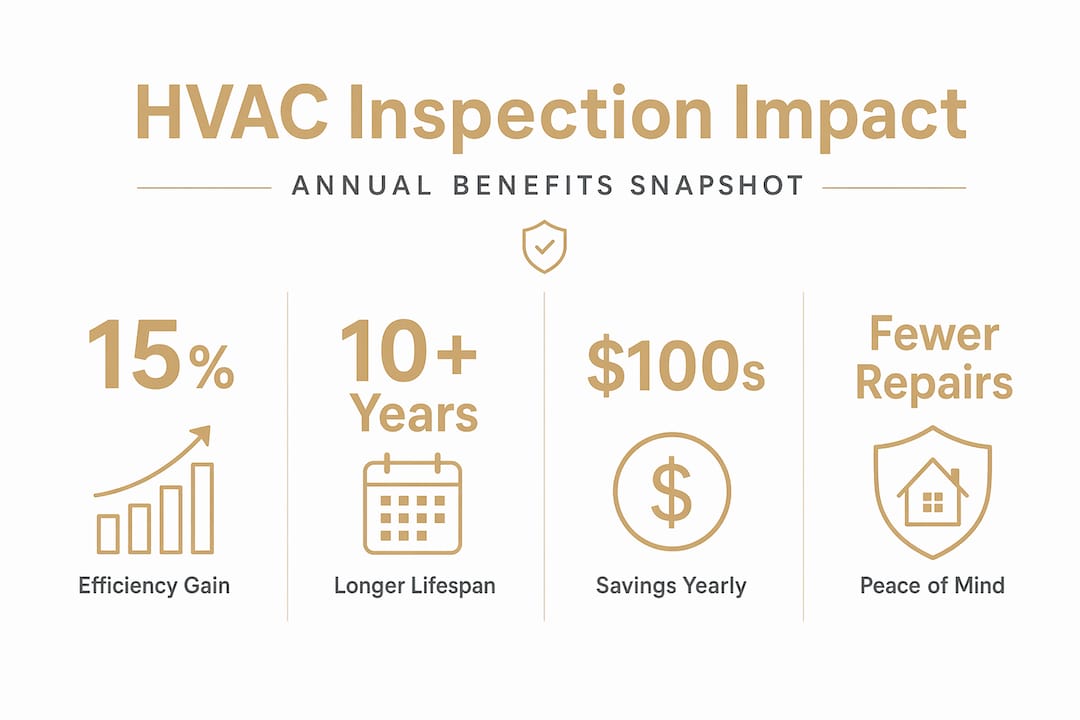
Energy loss inside HVAC systems often hides behind reasonable comfort. Your home still feels cool enough, so you assume everything is fine. The problem shows up on your bill, not in your living room, and most homeowners chalk it up to seasonal rate changes.
Pro Tip: Maintenance plans offered by reputable HVAC companies often pay for themselves through priority scheduling and discounts on parts and labor. If you are getting two inspections a year anyway, a plan is almost always the smarter financial move.
Safety and air quality benefits you cannot afford to ignore
The financial benefits of annual HVAC checks are compelling. The safety benefits are non-negotiable.
Your HVAC system handles combustion, high-voltage electricity, and refrigerant chemicals. When any of those components degrade without detection, the consequences go beyond discomfort. Loose electrical connections discovered during inspections often exist long before any visible symptoms, which means you could be living with a fire hazard and not know it. Gas furnaces with cracked heat exchangers can leak carbon monoxide into your living space, a risk that only a trained technician can reliably identify.
Indoor air quality is the other side of this equation, and it affects your family every day. Here is what a maintained system does for the air you breathe:
- Clean filters and coils trap allergens, dust, and particulates instead of recirculating them through your home.
- Clean ducts and filters optimize airflow and limit allergen circulation, a detail many homeowners overlook entirely in their basic maintenance routine.
- Blocked condensate drains cause water buildup that leads to mold growth inside the system, which then gets pushed into your living spaces.
- Proper moisture control prevents the conditions that allow mold and bacteria to thrive in your ductwork.
If anyone in your home has allergies, asthma, or respiratory sensitivities, the air quality improvements from a maintained HVAC system are not a luxury. They are a health measure. You can also check out signs your AC needs repair to catch problems before they affect your indoor air.
When and how often to schedule your HVAC inspection
The importance of annual HVAC checks is clear. The question most homeowners ask next is: when exactly should I schedule?
The industry standard is twice per year, and the timing is specific for a reason.
- Fall furnace inspection: Schedule your heating system check in September or October, before you need it. This gives your technician time to find and fix any issues before the first cold snap hits.
- Spring AC inspection: Schedule your cooling system check in March or April. Scheduling before peak seasons ensures system readiness and dramatically reduces emergency downtime.
- Avoid the rush: Technicians book out fast when systems fail suddenly under high demand. If you wait until the first 95-degree day to call, you may be waiting days for service while your home heats up.
- Check your filter monthly: Between professional visits, inspect your air filter every 30 days and replace it every 60 to 90 days depending on your home’s dust level and whether you have pets.
- Consider a maintenance plan: If your home is in a climate with extreme summers and winters, like Los Angeles where heat waves are common, twice-yearly professional service is not optional. It is the minimum.
Your climate and system age also affect HVAC maintenance frequency. Systems older than 10 years benefit from more thorough checks, and homes in areas with high humidity or heavy pollen loads may need filter attention more often than average.
Pro Tip: Set calendar reminders in March and September every year. Treat your HVAC inspection like a dentist appointment. You do not wait until it hurts.
Common misconceptions that cost homeowners money
The biggest barrier to regular HVAC servicing is not cost. It is mindset. Several persistent misconceptions keep homeowners from scheduling inspections until something goes wrong.
“If it’s working, it doesn’t need service.” This is the most expensive belief in home maintenance. HVAC systems degrade gradually. By the time you notice a problem, the damage is already significant. A compressor does not fail overnight. It fails after months of running hot because the coils were dirty and the refrigerant was low.
“I change my filter, so I’m covered.” Filter changes are good. They are not a substitute for professional inspection. Changing your filter is like checking your tire pressure. It matters, but it does not replace a full mechanic’s inspection of your brakes, engine, and transmission.
“Inspections are too expensive.” Emergency repairs cost 5 to 10 times more than scheduled maintenance. A $200 inspection that catches a $300 repair prevents a $1,500 emergency call on a Saturday night in July.
“My system is new, so I can skip a year.” New systems still need documentation. Most manufacturers require proof of annual professional maintenance to honor warranties. Skipping an inspection in year two of ownership could void a claim worth thousands of dollars.
Delaying service almost always causes system downtime during the worst possible weather. That is not a coincidence. It is the predictable result of skipping preventive care. If you notice heating problems developing, do not wait for the next scheduled visit.
My take after years of watching homeowners learn this the hard way
I have seen the same scenario play out more times than I can count. A homeowner calls in a panic on a 100-degree day. Their AC stopped working. They have not had it serviced in three years because it was “running fine.” The technician finds a burned-out capacitor that had been showing stress for months, a refrigerant level that was 30% low, and coils so caked with debris that airflow was barely functioning. What would have been a $250 inspection and a $180 capacitor replacement turned into a $1,400 emergency visit plus a compressor replacement the following month.
What surprises me most is how often this happens on systems that are only 7 or 8 years old. Homeowners assume age is the trigger for problems. It is not. Neglect is.
The homeowners I have seen get the most out of their systems are the ones who treat inspections like clockwork. They have documentation going back years. They know what their system looked like last fall and can compare it to this fall. When something changes, they catch it early. Their systems run longer, cost less to operate, and never leave them stranded in extreme weather.
There is also a resale value angle that almost nobody talks about. A home with a documented HVAC maintenance history is a stronger sell. Buyers and inspectors notice. A well-maintained system with records is a selling point. An aging system with no service history is a liability.
Annual inspections are not a product someone is selling you. They are the single most reliable way to protect a major home system that you depend on every day.
— lc
How Uprightch keeps your HVAC running all year

Uprightch has been serving Los Angeles homeowners for over 15 years with HVAC inspections and maintenance that go beyond the checklist. Every inspection includes a thorough diagnostic report so you know exactly what was found, what was fixed, and what to watch for next season. There is no guesswork and no upselling on repairs you do not need.
If your inspection turns up an AC issue, the team at Uprightch can walk you through your AC repair options the same day. For homeowners dealing with heating concerns heading into fall, Uprightch’s technicians handle everything from tune-ups to full furnace servicing. The team is available 24/7 for emergency situations, and maintenance plan members get priority scheduling so they are never stuck waiting when demand spikes. If you are ready to stop reacting and start protecting, schedule your annual heater and AC checkup with Uprightch today through uprightch.com/van-nuys-hvac-contractor.
FAQ
Why is an annual HVAC inspection needed?
Annual inspections catch hidden wear, electrical faults, and efficiency losses before they become expensive failures. Systems that skip regular service lose efficiency yearly and are far more likely to break down during peak weather.
How often should you inspect your HVAC system?
The standard HVAC maintenance frequency is twice per year: once in fall for your furnace and once in spring for your AC. Older systems or homes in extreme climates may benefit from additional checks.
Can skipping an inspection void my HVAC warranty?
Yes. Most manufacturers require documented proof of annual professional maintenance to honor warranty claims. Missing even one year can leave you without coverage on a repair worth thousands of dollars.
What are the biggest benefits of an HVAC inspection?
The benefits of HVAC inspection include lower energy bills, extended system lifespan, improved indoor air quality, reduced fire and carbon monoxide risk, and protection of your manufacturer warranty.
Is it worth paying for an HVAC maintenance plan?
For most homeowners, yes. Maintenance plans typically include two annual visits, priority scheduling, and discounts on parts and labor, which adds up to savings that exceed the plan cost in most years.
Recommended
- Essential Tips When Your Air Conditioner Needs Repairs – Upright Construction & HVAC
- Top 7 Air Handler Issues And Fixes For Encino Homeowners – Upright Construction & HVAC
- Home HVAC Furnaces: Top 8 Quick Fixes For Heating Problems With Home HVAC Furnaces – Upright Construction & HVAC
- 4 Common Reasons For Cold Air Blowing From HVAC Heaters – Upright Construction & HVAC