Learn to ac repair quote evaluate quickly with this guide! Compare quotes confidently to avoid overpaying and get quality service in LA.
How to Evaluate an AC Repair Quote Quickly in LA
- Table of Contents
- Key takeaways
- What to prepare before evaluating AC repair quotes
- How to evaluate an AC repair quote quickly and effectively
- Common mistakes to avoid when assessing quotes
- How to verify the work after accepting a quote
- My honest take on evaluating AC quotes in LA
- Get a transparent AC repair quote from Uprightch today
- FAQ
- Recommended
You get two or three AC repair quotes and suddenly you’re staring at a wall of numbers, part names, and labor fees you’ve never seen before. One quote is $400, another is $900, and you have no idea which one is actually fair. For Los Angeles homeowners dealing with summer heat, that confusion can cost you real money. Learning how to ac repair quote evaluate quickly is the skill that separates homeowners who get ripped off from those who get solid work at a fair price. This guide gives you the exact framework to do it fast.
Table of Contents
- Key takeaways
- What to prepare before evaluating AC repair quotes
- How to evaluate an AC repair quote quickly and effectively
- Common mistakes to avoid when assessing quotes
- How to verify the work after accepting a quote
- My honest take on evaluating AC quotes in LA
- Get a transparent AC repair quote from Uprightch today
- FAQ
Key takeaways
| Point | Details |
|---|---|
| Prepare before comparing | Gather unit age, symptoms, and past service records before requesting any quotes. |
| Use cost benchmarks | Most AC repairs fall between $250 and $700 nationally, so use that range as a quick sanity check. |
| Prioritize transparency over price | A detailed high quote is almost always more reliable than a vague low one. |
| Watch for red flags | Missing permits, no warranty info, and vague scope descriptions are signs of a problem contractor. |
| Verify after the work | Always confirm the final invoice matches the original quote before signing off on payment. |
What to prepare before evaluating AC repair quotes
Walking into a quote evaluation without preparation is like going grocery shopping without a list. You’ll overspend, miss things, and regret it later. Before you request a fast AC repair estimate from any contractor, pull together the following information.
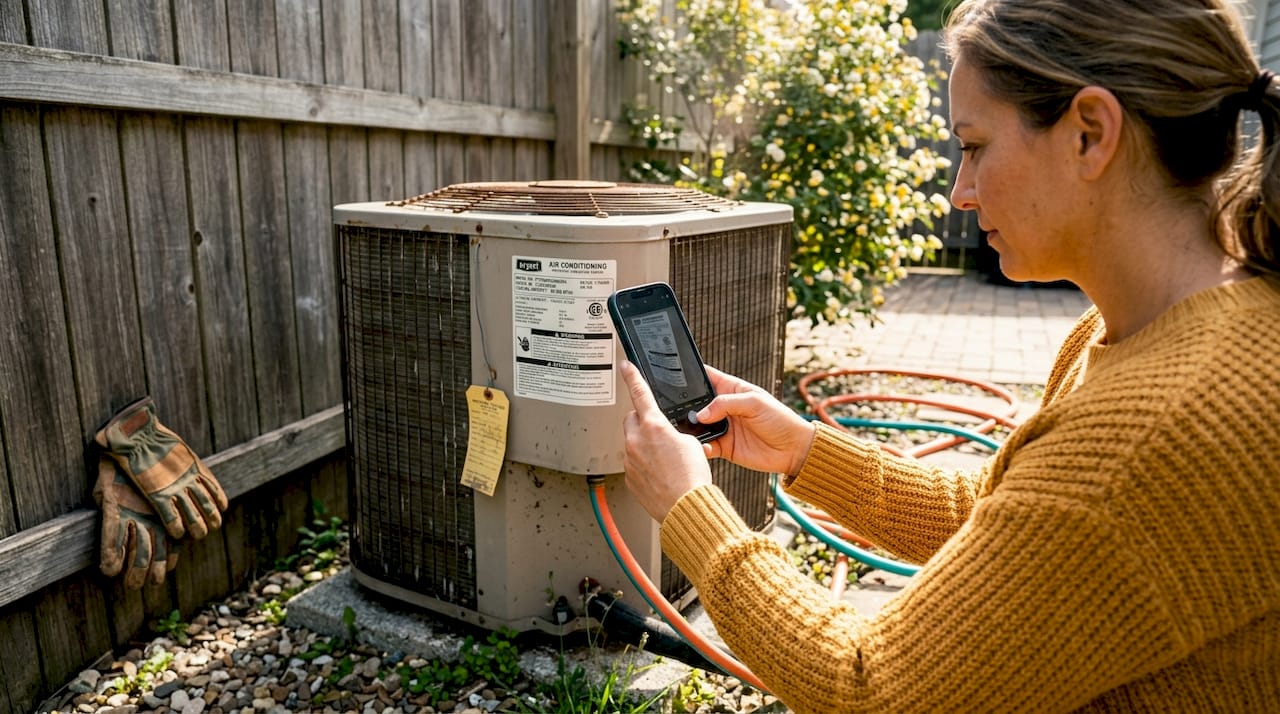
Know your unit. Write down the brand, model number, age, and the last time it was serviced. This matters because the age of your unit directly affects whether repair even makes sense. A 15-year-old system with a $600 repair quote looks very different than a 5-year-old system with the same quote.
Document the symptoms clearly. Is the AC blowing warm air? Making a grinding noise? Tripping the breaker? The more specific you are, the easier it is to spot whether a contractor’s proposed fix actually matches the problem you described.
Pull out past service invoices. Previous repair records tell you what parts have already been replaced and what warranties might still be active. This prevents you from paying twice for the same fix.
Here are the key items to have ready before you start comparing quotes:
- Unit age, make, and model number
- A written description of the symptoms and when they started
- Any existing warranty documents (manufacturer or extended)
- Previous service invoices or maintenance records
- A basic list of HVAC terms: compressor, capacitor, refrigerant, evaporator coil, condenser
Getting familiar with those five components helps you recognize what you’re being charged for. You don’t need to be an expert. You just need to know enough to ask a smart question when something looks off.
Homeowners should get 3 to 5 detailed quotes and compare them line by line, including equipment specs, warranties, and labor. A simple spreadsheet with columns for each contractor works perfectly for this.
Pro Tip: Before any technician arrives, photograph your outdoor unit, the air handler, and the thermostat settings. This creates a visual baseline that makes it much harder for a contractor to claim damage that wasn’t there before.
How to evaluate an AC repair quote quickly and effectively
Once you have your quotes in hand, here is how to move through them fast without missing anything important.
1. Check for itemization first. Any quote worth trusting will break down labor, parts, permits, and warranty separately. If a quote just says “AC repair: $450” with no further detail, that is a red flag, not a bargain.
2. Match the scope to your problem. Read the description of work and ask yourself: does this actually fix what I described? A compressor replacement quote when you reported a refrigerant leak is a mismatch worth questioning.
3. Run a cost benchmark check. Most AC repairs cost between $250 and $700 nationally, with the national average sitting around $375. Major repairs can reach $2,800. Use these numbers as a quick sanity check. A $1,200 quote for a capacitor swap is almost certainly inflated. A $150 quote for a refrigerant recharge is almost certainly incomplete.
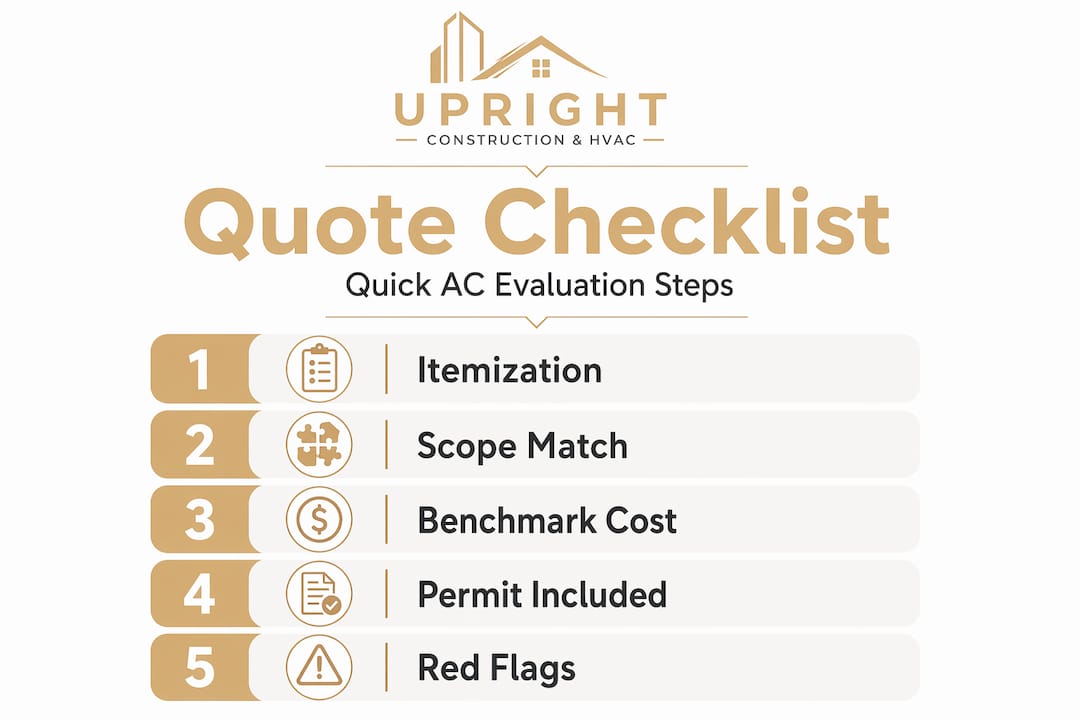
4. Compare line by line across quotes. Put the quotes side by side. Look at the specific parts listed, the brand or model of replacement components, and the labor hours. Two quotes for the same repair can look identical at the top line but differ by $400 because one uses OEM parts and the other uses generic equivalents.
5. Ask about emergency or after-hours fees. Emergency and after-hours service can add $50 to $150 above standard service fees. A repair that costs $300 on a Tuesday morning can run $500 or more on a Saturday afternoon. Always ask if the quote reflects your actual service window.
6. Verify licensing and insurance. California requires HVAC contractors to hold a C-20 license. Ask for the license number and verify it at the CSLB website. An unlicensed contractor is not just a legal risk. It means no accountability if the work fails.
7. Look for permit inclusion. Certain repairs and all replacements require permits in Los Angeles. A quote that excludes permits either assumes you won’t notice or plans to skip them entirely. Lowball quotes often exclude permits and warranties, which creates expensive compliance problems down the road.
8. Flag vague language. Phrases like “repair as needed,” “parts may vary,” or “labor TBD” are not acceptable in a written quote. Every line item should be specific.
Pro Tip: When comparing a transparent $750 quote against a vague $450 quote, the $750 quote is almost always the better deal. Transparent quotes with detailed itemization are a reliable indicator of contractor quality and trustworthiness.
Common mistakes to avoid when assessing quotes
Speed is useful when evaluating quotes. Rushing is not. These are the mistakes that cost Los Angeles homeowners the most money.
- Accepting the cheapest quote without reading it. Price alone tells you almost nothing. A $300 quote that excludes refrigerant disposal fees, permits, and a return visit charge can easily become a $700 bill.
- Ignoring company ownership. Large private-equity-owned HVAC brands tend to charge 30 to 50 percent more than smaller local operators. That national brand name on the truck does not mean better quality. It often means a higher markup.
- Skipping the licensing check. This takes two minutes on the CSLB website and can save you thousands. An unlicensed contractor has no bond and no accountability.
- Not factoring in unit age. A $700 repair on a 14-year-old system may not be worth it. Use the $5,000 Rule as your guide.
The $5,000 Rule is simple: multiply the age of your unit by the repair cost. If the result exceeds $5,000, replacement is usually the smarter financial move. A 12-year-old unit with a $500 repair equals $6,000. That’s a replacement conversation.
- Treating an instant quote as a final estimate. Some contractors offer AI-generated quotes from field notes that are fast but can contain errors in model numbers, efficiency ratings, or line-item pricing. Always ask for a verified written estimate before authorizing any work.
- Forgetting to check the warranty terms. Both the parts warranty and the labor warranty should be spelled out in the quote. A repair with no labor warranty means you pay again if the same issue returns in 30 days.
Pro Tip: Use the $5,000 Rule and a line-by-line comparison together. One tells you whether to repair at all. The other tells you which contractor to trust with the repair.
How to verify the work after accepting a quote
Accepting a quote is not the finish line. What happens after the technician leaves is just as important.
- Request a final itemized invoice. Before you pay, get a written invoice that matches the original quote line by line. Any new charges should be explained in writing before work begins, not after.
- Confirm all parts were installed. Ask the technician to show you the old parts that were removed and confirm the new parts match what was quoted by brand and model number.
- Check the warranty paperwork. Manufacturer warranties on parts often require registration within a set window. Make sure the contractor provides documentation and that you file it the same day.
- Test the unit before the technician leaves. Run the system through a full cycle. Check that it reaches the set temperature, that airflow is consistent across all vents, and that there are no new sounds or smells.
- Review for discrepancies immediately. If the final invoice is higher than the quote and you were not notified in advance, dispute it on the spot. Do not wait until after the technician is gone to raise the issue.
- Know when to escalate. If a contractor refuses to provide documentation, added charges appear without explanation, or the repair fails within the warranty period and the contractor becomes unresponsive, file a complaint with the California Contractors State License Board. You have options.
For reliable AC repair in Los Angeles, knowing how to verify the work protects you just as much as evaluating the quote correctly from the start.
My honest take on evaluating AC quotes in LA
I’ve worked with Los Angeles homeowners long enough to know that the biggest mistake is not a technical one. It’s emotional. When your AC goes out in July and the house is 88 degrees, the instinct is to say yes to whoever shows up first with the lowest number. That instinct will cost you.
What I’ve seen over and over is that the contractors who give vague, cheap quotes are the same ones who show up with surprise charges, skip permits, and disappear when something fails two months later. The contractors who give you a detailed, slightly higher quote are the ones who are actually accounting for the real cost of doing the job right.
LA’s market is also genuinely different from the national average. The combination of intense summer demand, strict permitting requirements, and a wide range of contractor quality means you need to be more careful here than in most cities. I’ve seen homeowners pay twice for the same repair because they went with an unlicensed contractor the first time and had to hire a licensed one to fix the mess.
My advice is this: slow down by 20 minutes. Read the quote. Ask two questions. Verify the license. That 20 minutes is the best investment you will make in your home comfort this year. And if a contractor makes you feel rushed or pressured to decide on the spot, that is your answer right there.
— lc
Get a transparent AC repair quote from Uprightch today
When you need to evaluate HVAC repair costs fast without second-guessing every line item, having a contractor you already trust makes all the difference.

Uprightch has been serving Los Angeles homeowners since 2007 with fully itemized quotes, licensed C-20 technicians, and zero hidden fees. Whether you need a quick AC service quote on a weekday or 24/7 emergency AC repair on a Sunday afternoon, Uprightch responds fast and explains everything in plain language. Before you accept any quote from any contractor, read through the essential tips for AC repair on the Uprightch blog. Then contact Uprightch directly for a speedy air conditioning assessment you can actually compare with confidence.
FAQ
What is a fair price for AC repair in Los Angeles?
Most AC repairs cost between $250 and $700 nationally, with the average around $375. In Los Angeles, expect slightly higher rates due to local labor costs and permitting requirements.
How many AC repair quotes should I get?
Get at least three to five quotes and compare them line by line. More quotes help you spot outliers and identify which contractors are pricing fairly for your specific repair.
What are red flags in an AC repair quote?
Vague scope descriptions, missing permit costs, no warranty information, and pressure to decide immediately are all signs to walk away. A trustworthy quote is always specific and written.
Should I always choose the lowest AC repair quote?
No. Lowball quotes frequently exclude permits, warranties, and essential parts, which leads to higher total costs and compliance problems. Prioritize transparency over the lowest number.
How do I know if my AC should be repaired or replaced?
Use the $5,000 Rule: multiply unit age by repair cost. If the result exceeds $5,000, replacement is usually the better financial decision.
Recommended
- Proven Cost-Effective AC Repair Solutions – From Los Angeles HVAC Experts – Upright Construction & HVAC
- How To Choose The Best AC Repair Service In Los Angeles – Upright Construction & HVAC
- 5 Signs Your AC Needs Immediate Repair – Upright Construction & HVAC
- Essential Tips When Your Air Conditioner Needs Repairs – Upright Construction & HVAC