
- Breaking Down the New Construction Cost Stack
- Why Your Zip Code Changes the Math
- Financing the Build: Loans, Carry Costs, and Contingency
- The 2026 Cost Drivers: Tariffs, Labor, and Regulation
- How to Turn a Per-Square-Foot Estimate Into an Actual Bid
- Field Notes From Ernie M: What Actually Surprises Homeowners
- How Upright Construction & HVAC Helps Los Angeles Homeowners Budget With Confidence
- Where These Numbers Come From
- Sources
- FAQ
- What Is the Average New Construction Cost Per Square Foot?
- How Much of My Budget Goes Toward Permits and Regulation?
- How Much Contingency Should I Budget for New Construction?
- Does Upright Construction & HVAC Offer Budget Estimates for New Construction?
- Why Are Construction Costs Rising So Much in 2026?
- Recommended
Building a new single-family home in 2026 typically runs $150 to $275 per square foot, putting a 2,200-square-foot home somewhere between $330,000 and $605,000 before land. Tariffs on metal, ongoing labor shortages, and rising regulatory fees are pushing that range upward this year more than usual.
TL;DR:
- Proper budgeting requires itemizing costs by trade, applying regional and escalation factors, and securing three bids to prevent underestimating or overestimating expenses.
- Contingency funds should be 10% to 20% of the project, kept separate, and increased for high-risk sites or complex builds to cover unforeseen issues.
- Construction input prices have risen roughly 43% since 2020, with tariffs on metals and materials adding thousands to a typical budget, emphasizing early procurement and fixed pricing negotiations.
Breaking Down the New Construction Cost Stack
That per-square-foot number hides a lot. A realistic budget separates four buckets: hard costs, soft costs, the finished lot, and builder profit. Skip this step and you’ll compare bids that aren’t actually comparable.
Hard costs are the physical building. Foundation, framing, roofing, windows, and mechanical systems (HVAC, plumbing, electrical) typically eat up $95 to $165 per square foot depending on finish level. Framing and foundation alone often account for 25% to 30% of hard costs on a standard build.
Soft costs are everything that isn’t nails and lumber:
- Architectural design and engineering fees
- Permit and plan-check fees
- Third-party inspections
- Impact and utility connection fees
- Builder’s risk insurance
- General contractor overhead and general conditions
Regulation is the soft cost most homeowners underestimate. The NAHB’s 2026 special study on housing regulation puts regulatory costs at 26.4% of a new home’s final price, roughly $131,734 on a $499,500 home. Split further, that’s about $46,795 in regulation during land development and $84,939 during construction itself, covering everything from zoning compliance to code-driven material and labor requirements.
Pro Tip: Ask your general contractor for a line-item permit and fee estimate before you finalize your design. Some jurisdictions charge impact fees that scale with square footage. So a slightly smaller footprint can meaningfully cut your regulatory line.
The finished lot (land plus site prep, utility hookups, grading) and builder profit margin, usually 10% to 20% of the total contract, round out the number you see on a final bid. A builder quoting an unusually low per-square-foot figure has often stripped out one of these categories, not found a genuine discount.
Why Your Zip Code Changes the Math
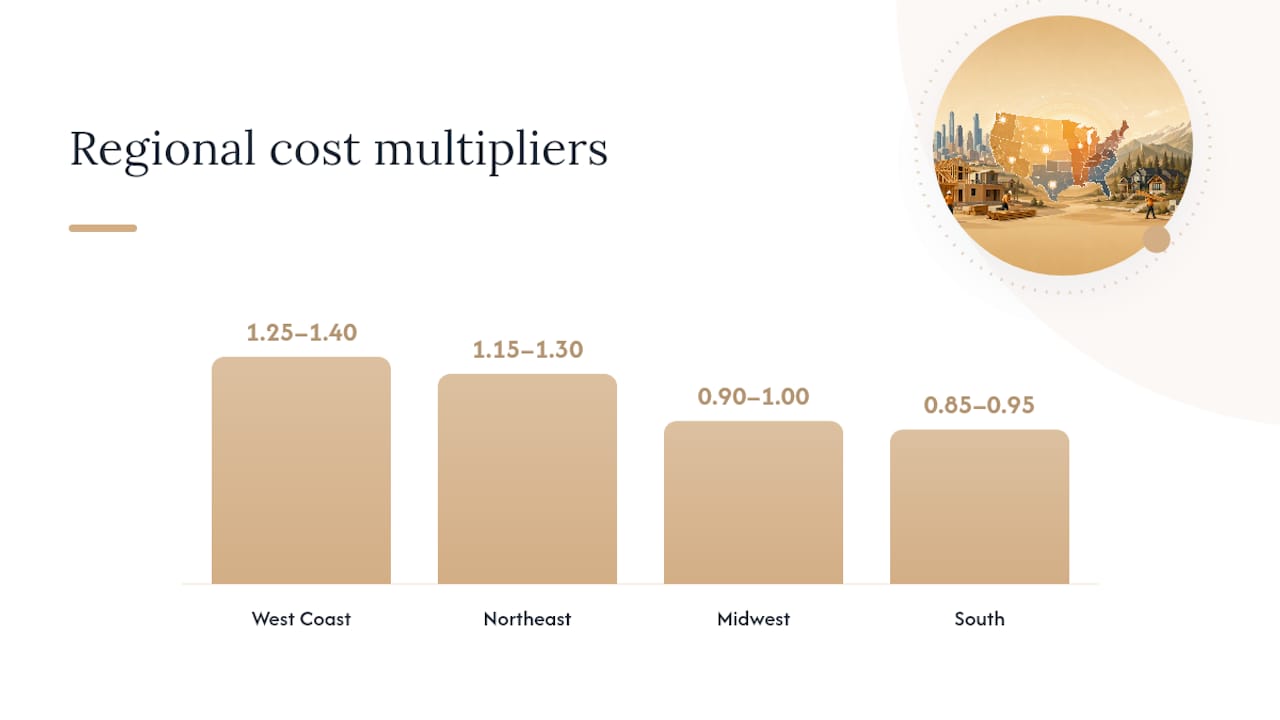
National averages are a starting point, not a quote. Regional multipliers swing the same house dramatically:
- West Coast (including Los Angeles): 1.25x to 1.40x the national average, driven by land scarcity, seismic codes, and permit backlogs
- Northeast: 1.15x to 1.30x, largely a labor-cost story
- Midwest: 0.90x to 1.00x, close to the national baseline
- South: 0.85x to 0.95x, the most affordable region on average
Buildability matters as much as location. A lot of requiring seismic retrofitting, deep frost-line footings, or high wind-zone bracing adds cost regardless of the zip code. Permit turnaround time compounds this. A jurisdiction that takes four months to approve plans effectively adds four months of carrying cost before a shovel touches dirt. According to ProjectCostRange’s 2026 Construction Cost Report, labor availability is the single biggest driver of state-to-state cost variance, more than materials or permitting fees alone.
The only way to get a real number for your address: pull three itemized bids from local contractors and one current material quote from a regional supplier. Divide your local quote by the national average and you’ve got your own multiplier, more accurate than any chart.
Financing the Build: Loans, Carry Costs, and Contingency
Construction loans work differently than a standard mortgage. Lenders typically fund 80% to 85% of the total project cost (loan-to-cost), and you cover the rest as a down payment or through your finished lot equity. Funds get released in draws tied to inspection milestones, not as one lump sum upfront.
Interest during construction, often called “carry cost,” accrues only on funds actually drawn, but it still adds up. On a $450,000 draw schedule over nine months at a typical construction-loan rate, carry can easily run $12,000 to $20,000. Stretch that timeline to fourteen months because of permit delays or backordered materials, and carry costs climb accordingly. Timeline delays aren’t just annoying, they’re a direct line item.
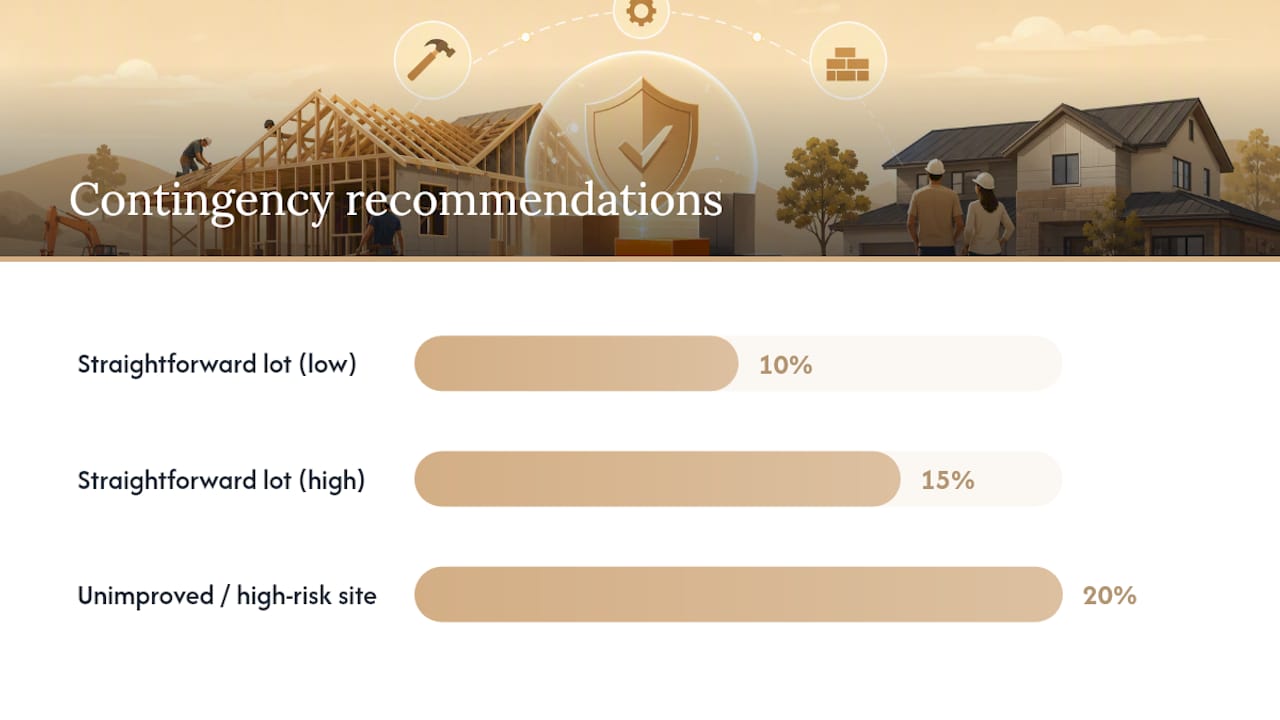
Contingency isn’t optional padding. Here’s how to size it:
- Budget a 10% to 15% contingency on any build with known soil conditions and a straightforward lot.
- Increase to 20% contingency for custom homes on unimproved or high-risk sites, a standard recommended by BuildMat Insight’s 2026 cost guide.
- Keep contingency in a separate escrow line, not folded into your general budget, so it isn’t spent on upgrades before problems surface.
Pro Tip: Build your owner’s ledger before you sign anything: itemized trade bids, soils report costs, permit fees, long-lead item deposits (HVAC equipment, custom windows), contingency, and any owner-held allowances for finishes. If a bid doesn’t map cleanly to that ledger, ask why.
The 2026 Cost Drivers: Tariffs, Labor, and Regulation
Construction input prices have climbed roughly 43% since early 2020, and Construction Supply Magazine’s 2026 tariff and pricing analysis points to metals as the sharpest pressure point this year. Industry forecasts put baseline 2026 escalation at 4% to 6% on top of already-elevated prices, meaning a budget built on last year’s numbers is already out of date.
Tariff exposure is concentrated, not universal. Steel, aluminum, copper, and imported cabinetry carry the heaviest duties, and depending on how metal-intensive your design is, that exposure can add thousands of dollars to a typical new home. Asphalt shingles and standard framing lumber have been comparatively more stable.
You have real levers here:
- Lock in pricing on long-lead items (HVAC equipment, windows, custom cabinetry) early, before another escalation cycle hits.
- Ask your contractor about indexed or escalation-clause pricing rather than a fixed bid that expires before materials ship.
- Favor domestically sourced steel and aluminum where your builder can source it competitively.
- Simplify metal-heavy design elements, standing seam roofs, extensive railings, ornamental steel, if your budget is tight.
How to Turn a Per-Square-Foot Estimate Into an Actual Bid
- Lock your schematic design first. Measure heated, conditioned square footage precisely. Unfinished garages and covered porches shouldn’t be counted the same as living space.
- Itemize hard costs by trade category (foundation, framing, roofing, mechanical, electrical, plumbing) and multiply each by your square footage, then layer in soft costs and your finished lot value.
- Apply your regional multiplier and current escalation rate, then add contingency and estimated loan carry on top.
- Solicit three itemized bids using the same scope document, comparing line by line rather than bottom-line totals, and adjust design or procurement if one trade is wildly out of line with the others.
Pro Tip: Never compare lump-sum bids side by side. Require every contractor to break out pricing by CSI division so you’re comparing framing to framing and electrical to electrical, not just two different final numbers.
Field Notes From Ernie M: What Actually Surprises Homeowners
The surprises I see most often on real jobs: unexpected soil conditions that trigger a redesigned foundation, HVAC equipment on backorder for months, and a permit reviewer requiring a change that ripples through the whole plan. Ordering long-lead equipment early and choosing a buildable lot up front save more money than any single negotiation. If your project has unusual site conditions or a tight budget, bring in a professional estimator before you commit to a design.
— Ernie M
How Upright Construction & HVAC Helps Los Angeles Homeowners Budget With Confidence
Upright Construction & HVAC is the alternative to guessing your way through a build. With over 15 years serving Los Angeles homeowners, we build itemized budget development and cost analysis into every project before a single bid gets signed, so you know your real numbers before you’re locked into a contract.

Our team is licensed, insured, and available 24/7, and we handle everything from ADU construction to full custom home builds and the HVAC planning that goes with them, since mechanical systems are one of the most commonly under-budgeted line items on new construction. Whether you’re adding a detached ADU or building a new home from the ground up, getting your mechanical systems priced correctly the first time avoids the change orders that blow up budgets mid-project.
If you’re planning a build anywhere in the greater Los Angeles area and want a realistic number before you talk to lenders, schedule an on-site budget review or estimate with our team through our construction and remodeling services page.
Where These Numbers Come From
The regulatory cost figures in this guide come from the NAHB’s 2026 government regulation study. Material and tariff data draw from Construction Supply Magazine, regional and labor figures from ProjectCostRange’s 2026 report, and budgeting formulas from BuildMat Insight. For readers also budgeting move-in costs, deep cleaning pricing is worth a look too.
This article is general information, not a substitute for advice from a qualified financial advisor. Consult a qualified financial professional about your own circumstances before acting on anything here.
Sources
- Government regulation in the price of a new home: 2026 (NAHB)
- The 2026 Construction Cost Report | Project Cost Range
- How to Calculate Home Building Costs: Full 2026 Guide | BuildMat Insight
FAQ
What Is the Average New Construction Cost Per Square Foot?
Most new single-family homes in the U.S. cost $150 to $275 per square foot to build in 2026, depending on region, finish level, and labor availability. Coastal markets like Los Angeles run toward the higher end of that range due to permit timelines and land constraints, per ProjectCostRange’s 2026 data.
How Much of My Budget Goes Toward Permits and Regulation?
Regulatory costs, including permits, impact fees, and code compliance, average a significant portion of a new home’s final price, according to the NAHB. That share tends to be higher in jurisdictions with longer permit review cycles.
How Much Contingency Should I Budget for New Construction?
Budget a contingency percentage that increases based on site conditions, with higher amounts advised for unimproved or high-risk land, as recommended by BuildMat Insight’s 2026 guide. Keep contingency funds separate from your working budget so they aren’t spent early.
Does Upright Construction & HVAC Offer Budget Estimates for New Construction?
Yes. Upright Construction & HVAC provides budget development and cost analysis for Los Angeles homeowners planning new construction, ADU builds, or major remodels. Pricing for individual projects is provided after a consultation, since scope and site conditions vary.
Why Are Construction Costs Rising So Much in 2026?
Construction input prices have risen about 43% since early 2020, with tariffs on steel, aluminum, and copper adding fresh pressure this year on top of ongoing labor shortages, per Construction Supply Magazine.