- What Are the Main HVAC Financing Options?
- How Do You Compare HVAC Financing Offers?
- What Does Financing an HVAC System Actually Cost?
- What Financing Traps Should You Watch For?
- Ernie M’s Take From the Field
- Why Most Financing Advice Misses the Point
- Get a Written Estimate and Explore Your Financing Options
- Where to Verify Rates and Incentives
- Sources
- FAQ
- Recommended
If your furnace just quit in the middle of a cold snap, contractor or dealer financing gets you heat back fastest, but check the promo terms before you sign anything. If you’re planning ahead and want the lowest total cost, a home equity loan or HELOC usually wins, provided you’re comfortable using your house as collateral. Want predictable payments with no risk to your home? A fixed-rate personal loan is your answer. Short-term 0% offers only make sense if you can pay the full balance before the promo ends. Whatever route you pick, get a written estimate and a financing disclosure from your contractor first.
TL;DR:
- Contractor financing offers instant approval but may come with higher interest rates, so check the annual percentage rate before signing.
- Home equity loans and HELOCs typically provide the lowest rates but involve longer approval times and using your home as collateral.
- Borrowers should compare total interest and fees over the full loan term, not just monthly payments, to assess true affordability.
- Avoid deferred-interest plans unless fully paid off before the promo ends, as missed payments can cause retroactive interest charges.
- Leading with urgency, such as a furnace failure, favors fast contractor or dealer financing, while planned replacements should consider lower-cost options like personal loans or HELOCs.
What Are the Main HVAC Financing Options?
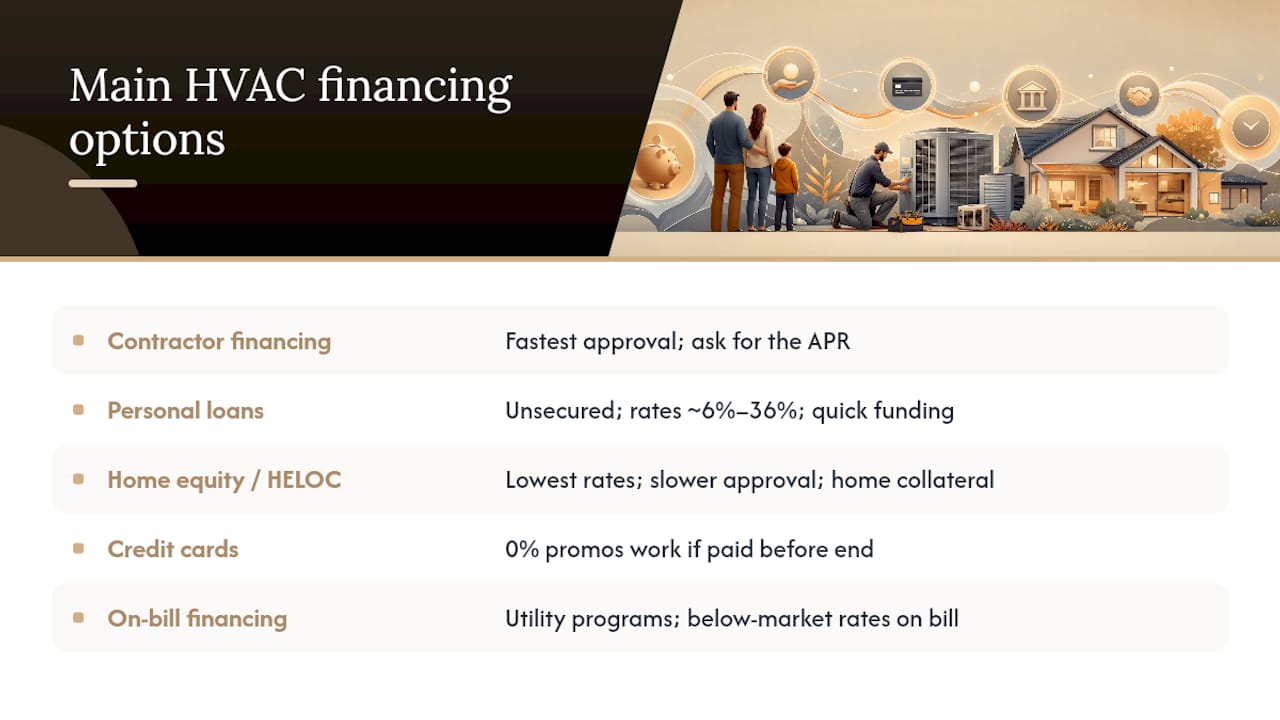
Most homeowners choose between five routes, and each one trades speed for cost in a different way.
Contractor and manufacturer financing is the fastest path to a working system. HVAC companies partner with lenders (or manufacturers like Carrier, Trane, or Lennox run their own credit programs) to approve you on the spot, sometimes while the technician is still standing in your kitchen. It’s convenient, but the rate isn’t always the best one available to you, so it pays to ask what the annual percentage rate actually is before you sign.
Personal loans are unsecured, meaning you don’t put your house up as collateral. Payments are fixed and predictable, and funding often lands the next business day after approval. Rates vary widely based on credit, commonly ranging from around 6% to 36%, which is a big enough spread that shopping around actually matters.
Home equity loans and HELOCs typically carry the lowest rates of the bunch, since your home backs the loan. The tradeoff is time. Approval can take weeks, not days, and your home is on the line if you default. If you plan to deduct the interest, talk to a tax professional first. The rules on deductibility depend on how the loan proceeds are used.
Credit cards and 0% promo offers work fine if you can pay off the balance in full before the promotional window closes. The risk shows up with deferred-interest plans, which are structured differently than true 0% APR cards.
Utility and municipal on-bill financing programs exist in many areas for energy-efficient upgrades, often with below-market rates tied to your utility bill rather than a separate loan payment. Worth checking with your utility before you assume you need a bank loan at all.
How Do You Compare HVAC Financing Offers?
The monthly payment is the number every ad wants you to look at. It’s also the number that hides the real cost.
- Calculate total interest over the full term, not just the payment. A lower monthly payment stretched over 10 years can cost more overall than a higher payment over 5 years.
- Check for origination fees. These commonly run 1% to 10% of the loan amount and get baked into the total cost even when they’re not obvious upfront.
- Ask directly whether the offer uses deferred interest. This is different from a true 0% APR loan, and the distinction matters more than almost anything else on this list.
- Confirm there’s no prepayment penalty. If you plan to pay the loan off early, this fee can erase your savings.
- Get prequalified before you apply anywhere. Many online lenders let you prequalify without a hard credit pull, so you can compare real rate ranges before committing to a formal application.
- Have your documents ready. Pay stubs, W-2s, and recent bank statements speed up approval regardless of which lender you use.
- Match the timeline to your urgency. A same-day contractor loan makes sense for a broken furnace in January. A HELOC does not, because it can take weeks to close.
As a quick exercise, run the same $12,000 project through two scenarios: a 5-year personal loan at a moderate rate versus a 10-year HELOC at a lower rate. Add up total interest plus fees for each, not just the monthly number. Often the HELOC wins on total cost but loses on speed and collateral risk. That tradeoff is the whole decision.
Pro Tip: Ask every lender for a plain-language amortization schedule before you sign. If they hesitate to give you one, treat that as a warning sign, not a technicality.
What Does Financing an HVAC System Actually Cost?
A full system replacement commonly falls in the $8,000 to $16,000 range depending on the size of your home, the equipment brand, and whether you’re replacing just the AC or the whole heating and cooling system together.
On a $10,000 project financed over 5 to 10 years, your monthly payment will vary a lot based on rate and term length. A shorter term means a bigger monthly bite but less total interest paid. A longer term does the opposite. There’s no universally “right” answer here. It depends on your monthly cash flow versus your tolerance for paying more over time.
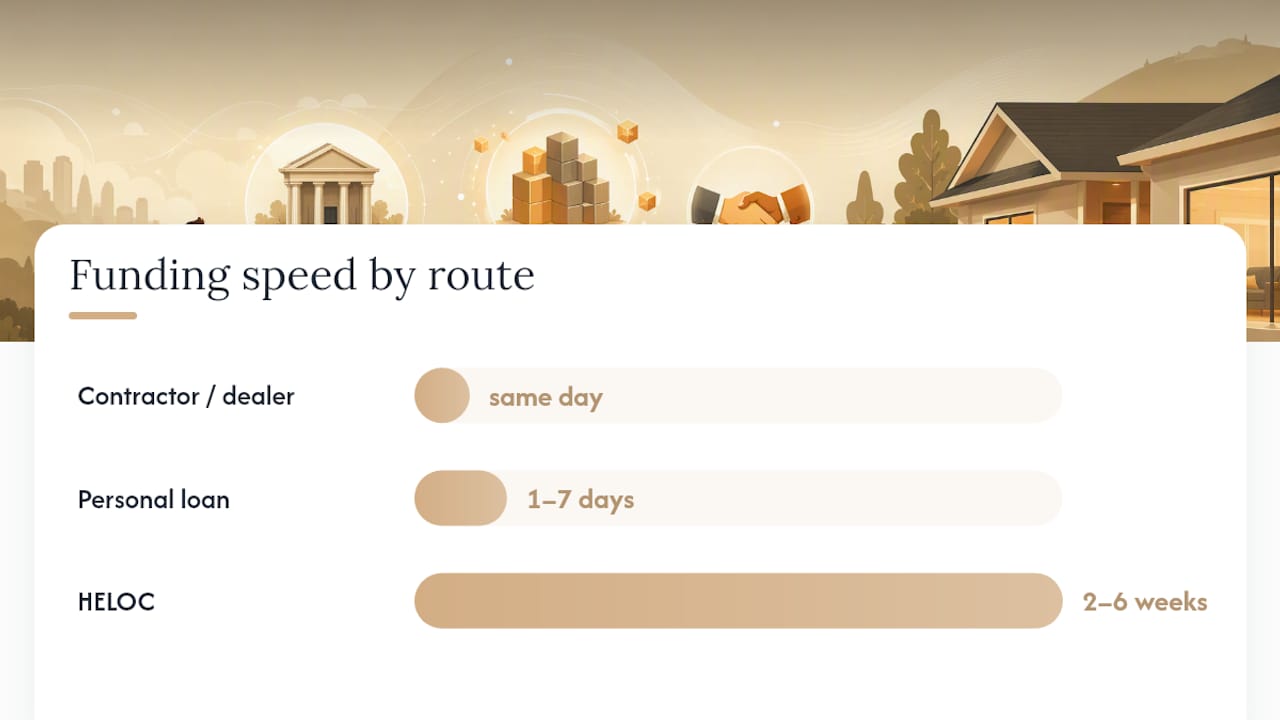
Funding speed differs sharply by route:
- Contractor or dealer financing: often approved and funded the same day.
- Personal loans: typically 1 to 7 days from application to funds in hand.
- HELOCs: commonly 2 to 6 weeks, given appraisal and underwriting steps.
- Manufacturer promotional financing: varies by brand and dealer, but usually fast if you’re approved.
If your system dies in July and a HELOC would take a month to close, that’s your answer right there. Interim repairs to get through the worst heat, paired with faster financing, usually beats waiting on slower approval.
What Financing Traps Should You Watch For?
Deferred interest is the single biggest trap in this entire category. On a deferred-interest plan, missing that deadline means the lender charges interest retroactively on the entire original balance, not just the remaining amount. That difference can turn a $10,000 job into a bill hundreds of dollars higher than you expected.
Watch for these red flags before you sign anything:
- Retroactive interest clauses buried in the fine print.
- Origination fees on the high end of that 1% to 10% range without clear disclosure.
- Vague language about what counts as a “minimum payment” during the promo period.
- Any clause that triggers immediate default or an interest penalty for a single late payment.
Ask the contractor point-blank: “Is this deferred interest or true 0% APR, and can you show me the amortization if I don’t pay it off in time?” Experts consistently point to this exact question as the one that surprises borrowers most when they skip it.
Pro Tip: Save a digital and printed copy of every promotional term you’re offered. Verbal promises from a salesperson don’t hold up if the written contract says something different.
Ernie M’s Take From the Field
I’ve sat across the kitchen table with a lot of homeowners trying to decide how to pay for a new system, and here’s what I tell every one of them. Start with an itemized written estimate, not a verbal number. Insist on seeing the actual financing or promotional terms in writing before you agree to anything. Confirm both the installation timeline and the funding timeline, because they don’t always match up. And ask whether a maintenance plan or warranty is bundled into the deal, since that changes the math on total value.
When it’s an emergency, we’ll walk you through contractor financing because it gets your family comfortable again fast. When it’s a planned replacement and you have time to shop, I’ll usually tell you to also check a bank or credit union personal loan, or a HELOC if you want the lowest long-term cost. With over 15 years serving Los Angeles homeowners and 24/7 emergency service, our job is to give you options, not push you into the first one on the table.
Why Most Financing Advice Misses the Point
Most guides on this topic hand you a checklist and call it done. What they miss is that the right financing choice isn’t about finding the “best” loan. It’s about matching the loan to your actual situation, which changes case by case.
The conventional advice treats a homeowner with a dead furnace in February the same as one planning a summer upgrade six months out. That’s backwards. Urgency should drive the decision more than the interest rate does, at least in the emergency case. A slightly higher rate on a same-day loan beats a slightly lower rate on a loan that takes three weeks to close while your pipes freeze.
The other blind spot: most articles undersell how often deferred-interest plans get misread as true 0% offers. I’d argue this single point of confusion causes more homeowner regret than any other financing decision in this category. If you take one thing from this article, prioritize understanding that distinction over chasing the lowest advertised rate. The rate on paper means nothing if you misunderstand how the promo actually works.
— Ernie M
Get a Written Estimate and Explore Your Financing Options
We provide homeowners with a written estimate and honest financing guidance before they sign a contract. With extensive experience, we explain the tradeoffs between contractor financing, personal loans, and home equity options, so you’re not guessing at fine print alone.

If your system is struggling or already down, request a written estimate through our HVAC repair page or explore AC installation options if you’re planning a full replacement. We’ll walk you through financing disclosures line by line, help you understand prequalification if you want to compare offers first, and schedule service on a timeline that matches your urgency, whether that’s today or next month. You can also learn more about how we structure HVAC financing in Los Angeles before you request your estimate. If your project also touches energy efficiency upgrades like replacing older doors and windows, pairing that work with your HVAC financing can lower your overall load, similar to how new interior doors improve energy efficiency in older homes. Call or request your estimate online, and we’ll take it from there.
Where to Verify Rates and Incentives
Before signing anything, check the Consumer Financial Protection Bureau for home equity loan guidance, HUD’s Title I program for federally insured home improvement loans, and your local utility’s website for rebate programs. Pull your free credit report at AnnualCreditReport.com before applying anywhere, so you know what rate range to expect.
This article is general information, not a substitute for advice from a qualified financial advisor. Consult a qualified financial professional about your own circumstances before acting on anything here.
Sources
- HVAC loans: Compare HVAC financing options – NerdWallet
- HVAC financing: what to know before you sign – FinanceBuzz
- What is a home equity loan? – CFPB
- HUD – Title I property improvement loan insurance
FAQ
What Is the $5,000 Rule for HVAC?
There’s no single official threshold in HVAC financing. Homeowners often consider contractor point-of-sale financing more sensible than credit cards for larger balances, since interest typically accumulates faster on revolving credit than on an installment loan.
What Is the Best Way to Finance a New HVAC System?
It depends on your situation. For urgent repairs, contractor or dealer financing gets you funded the fastest, while a HELOC or home equity loan usually costs less over time if you can wait weeks for approval and are comfortable using your home as collateral.
Is There a Tax Credit for HVAC in 2026?
Federal energy-efficiency tax credits have applied to qualifying high-efficiency HVAC equipment in recent years, but eligibility rules and credit amounts change and depend on the specific system installed. Confirm current eligibility with a tax professional or the IRS before assuming a credit applies to your purchase.
Is It Hard to Get Approved for HVAC Financing?
Approval difficulty depends on the financing type and your credit profile. Personal loans and contractor financing are often accessible even with average credit, though your rate will be higher, while HELOCs require more documentation and a longer approval process tied to your home equity and credit history.