
- Furnace Smells Like Gas: Your Immediate Safety Checklist
- What Causes a Gas Odor Near Your Furnace?
- Safe Checks You Can Do Yourself (and What to Never Touch)
- When to Call the Utility, 911, or a Licensed HVAC Technician
- Preventing Gas Odors Before They Start
- What 15 Years of Furnace Calls Have Taught Me
- A Few Resources Worth Bookmarking
- My Take: Why “Wait and See” Is the Wrong Instinct Here
- Sources
- FAQ
- Recommended
If your furnace smells like gas and the odor is strong, persistent, or paired with hissing, evacuate the house immediately and call 911 or your gas utility from outside. A faint whiff that lasts only a few seconds at startup can be normal. Anything beyond that is not something to wait out, and it’s not something to fix yourself.
TL;DR:
- A persistent gas smell paired with hissing or odor that intensifies requires immediate evacuation and emergency response from outside, not inspection or repair.
- Only a brief, one-time smell at startup that clears within seconds is generally normal, whereas recurring odors or hissing indicate a leak or failing component needing professional attention.
- Homeowners can perform safe checks by inspecting visible fittings and listening for hissing but should never attempt to tighten fittings, light pilot lights, or operate switches in a strong odor.
- Calling the gas utility or emergency services costs nothing and is essential when danger signs like continuous smell or dizziness are present, before any repairs are attempted.
- Regular maintenance, including annual tune-ups and installing gas and CO detectors, can prevent emergency leaks and help identify potential issues early.
Furnace Smells Like Gas: Your Immediate Safety Checklist
The first sixty seconds matter more than anything else you do. Get everyone out of the house, avoid anything that could spark, and call for help from somewhere safe.
Here’s the order that actually protects your family:
- Get out first. Leave through the nearest door without stopping to grab belongings, open windows for ventilation, or investigate the source. Gather everyone at a safe distance, like the sidewalk or a neighbor’s yard, well away from the house.
- Don’t touch anything electrical. Skip light switches, don’t use your phone until you’re outside, and don’t open the garage door with a wall-mounted opener. A tiny spark near accumulated gas is exactly the kind of thing that turns a leak into an explosion.
- Call from outside, not inside. Once you’re clear of the house, call 911 or your local gas utility’s emergency line. If you detect the classic sulfur-like, rotten-egg odor of mercaptan, treat it as a leak until a professional tells you otherwise.
- Let the professionals decide on the meter shutoff. If you know where your exterior gas meter is and can reach it without going back through the house, shutting it off is reasonable. If that means walking past the smell to get there, skip it and let the utility handle it.
Utilities generally send someone out for a suspected leak at no charge, and they’d rather make ten unnecessary trips than miss one real leak. Calling the gas company or 911 costs you nothing and takes the guesswork out of a situation where guessing wrong is dangerous. For a broader rundown of what responders and homeowners should each be doing in the first few minutes, this emergency gas guide covers the sequence well.
Pro Tip: Keep your gas utility’s emergency number saved in your phone right now, before you ever need it. Fumbling through a search engine while standing in your driveway wastes time you don’t have.
What Causes a Gas Odor Near Your Furnace?
Not every gas smell means the same thing, and figuring out which pattern you’re dealing with changes how urgently you need to act.
Brief startup odor. Some furnaces release a tiny puff of unburned gas in the split second before the burner catches. It should clear within seconds, and it happens because of how the ignition sequence briefly opens the gas valve before flame proves. If that’s genuinely all you’re smelling, once, occasionally, you’re likely fine. If it happens every single cycle, that’s a different story.
An actual gas leak. A cracked flex connector, a loose fitting, or a failing valve produces a smell that lingers, gets stronger over time, or shows up even when the furnace is off. Hissing near the gas line is a strong tell. So is a smell that seems to follow you around a specific spot in the utility closet no matter what the furnace is doing.
Failing ignition components. A worn ignitor, a dirty flame sensor, or a pilot assembly that’s degrading can cause repeated delayed ignition, sometimes with an audible “whoomph” when the burner finally lights a beat late. A recurring odor at every single cycle points to delayed ignition or a component failure rather than normal operation, and it’s a sign the unit needs service before it gets worse.
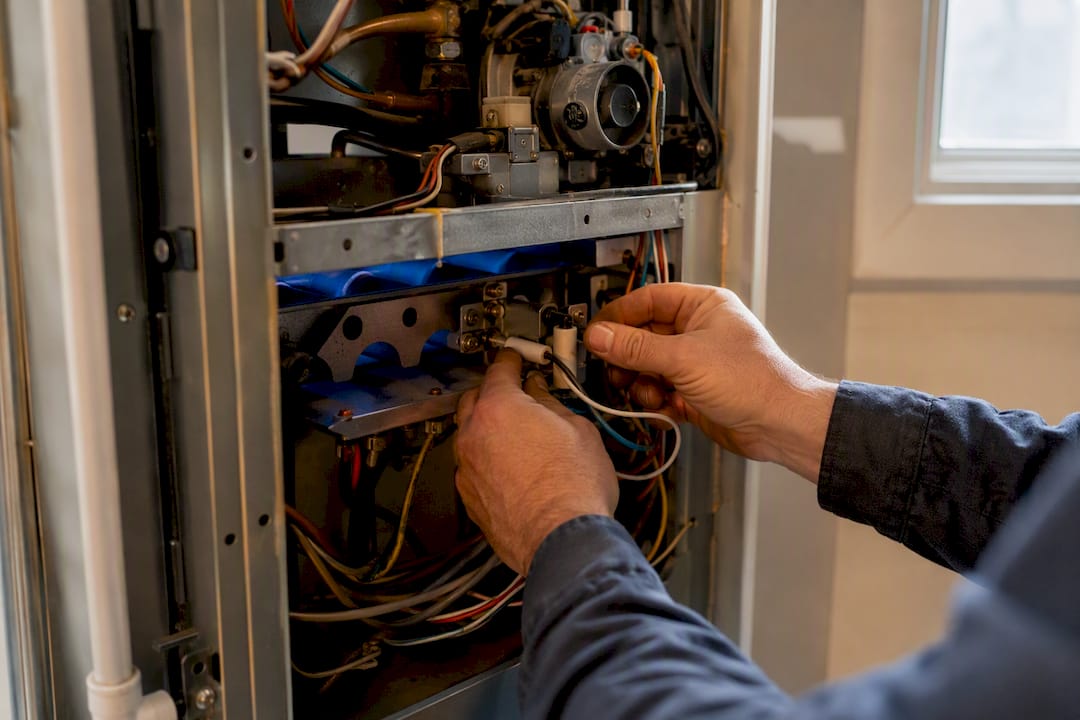
Venting and exhaust spillage. This one smells different, more acrid or musty than sulfur, and it points toward combustion gases escaping where they shouldn’t. A cracked heat exchanger can cause this kind of spillage, and it carries a carbon monoxide risk that has nothing to do with raw gas odor. CO is odorless, so a CO alarm is non-negotiable even on days when you smell nothing at all.
Something else entirely. Water heaters, stoves, and dryers on the same gas line can leak too, and the smell can drift toward the furnace closet simply because that’s where the air currents carry it. Dead or yellowing vegetation near an outdoor gas line is a classic outdoor sign worth checking if you have exposed piping.
- Propane behaves differently than natural gas: it’s heavier than air, so leaks tend to pool at low points like basements and crawlspaces, which changes where you’d place a detector.
- Natural gas rises, so combustible-gas detectors for it typically go higher on the wall, while propane detectors go low, near the floor.
- Utilities add mercaptan to gas specifically so leaks are detectable by smell, but odor fade can happen under certain conditions, meaning the absence of smell is not proof of safety.
Safe Checks You Can Do Yourself (and What to Never Touch)
There’s a narrow band of things a homeowner can safely check without any risk, and knowing that band matters as much as knowing the danger zone outside it.
- Note the pattern. Does the smell show up only at ignition, or is it constant? Does it get stronger in one specific area? Write it down. This detail is gold to whoever ends up diagnosing it.
- Check other gas appliances. Walk past your water heater, stove, and dryer if it’s gas. A leak on a shared line can smell like it’s coming from the furnace when it isn’t.
- Look, don’t touch. Visible corrosion, a disconnected flex connector, or a fitting that looks loose are all things you can spot with your eyes. Don’t tighten anything.
- Listen for hissing. A hiss near a pipe or connector is one of the more reliable signs that homeowners can rely on before smell, but it’s not something you should confirm by smell alone, since fatigue can dull your nose to a leak that’s actually there.
- Soapy water, exterior fittings only. Mix a little dish soap with water and brush it on an exposed, exterior gas fitting. Bubbling means gas is escaping. This works only on accessible outdoor connections, never on anything inside a wall or cabinet.
Turning off the furnace’s electrical service switch is reasonable if you can reach it without walking through a strong odor. If the smell is heavy near the unit, don’t linger there flipping switches. Leave and let a technician handle the diagnostics with the equipment built for it.
Never light a pilot light yourself if the smell is present. Never tighten a fitting hoping that solves it. Never operate a switch, a flashlight, or a phone inside a space where the odor is strong. None of these are worth the risk when a licensed technician can confirm the same thing in minutes with the right tools.
Pro Tip: If you’re not sure whether what you’re smelling counts as “strong,” treat it as strong. Homeowners almost always underestimate a real leak the first time they encounter one, because the smell is so unfamiliar.
When to Call the Utility, 911, or a Licensed HVAC Technician
A strong or persistent smell, hissing, or any physical symptom like dizziness or headache means 911 or your gas utility, immediately, from outside. Those responders check for gas concentration in the air, look for the source with combustible-gas meters, and make the site safe before anyone goes back in. That’s an emergency-response call, not a maintenance appointment.
Once the site is confirmed safe and any active leak is stopped, the repair itself falls to a licensed HVAC technician. Here’s what that visit actually involves:
- Combustible-gas meter sweeps to pinpoint exactly where gas is escaping, down to a specific fitting or joint.
- Pressure-drop leak testing, which isolates sections of pipe and uses a calibrated meter to catch leaks so small that soapy water alone won’t reliably find them.
- Combustion analysis to measure carbon monoxide output and confirm the burner is firing correctly, since a cracked heat exchanger shows up as a specific flue-gas pattern and takes the unit out of service until repaired.
- Ignitor and flame sensor inspection, replacing worn parts that cause delayed ignition.
- Valve and connector replacement where age or corrosion has compromised the seal.
Emergency response for an active leak typically happens the same day, often within hours. A scheduled repair for a component issue, once the site is confirmed safe, follows normal appointment timelines. Ask for documentation of every test result and, for gas line work, confirm any required permits were pulled. If you want a sense of what that emergency call might cost before you’re staring down a bill, this breakdown of emergency repair cost factors is worth a read ahead of time.
Preventing Gas Odors Before They Start
Most of the emergency calls I described above trace back to something that could have been caught during a routine visit months earlier.
An annual professional tune-up should include a burner cleaning, a gas pressure check, a test of the safety controls, and a heat-exchanger inspection. That last one matters more than most homeowners realize, since a hairline crack doesn’t announce itself until it’s a bigger problem. A gas heater maintenance visit covers all of this in one appointment.
Between professional visits, a few habits go a long way:
- Replace your furnace filter on schedule. A clogged filter stresses the whole combustion process, not just airflow.
- Keep the area around the furnace clear of boxes, chemicals, and clutter so you can actually see and smell what’s happening near the unit.
- Visually inspect flex connectors for cracking or corrosion, and replace them per code guidance when they show age, generally well before they’re the oldest thing in the closet.
- Install a combustible-gas detector (placed high for natural gas, low for propane) and CO alarms on every level of the home, especially near sleeping areas. Testing detector function regularly is as important as installing them in the first place. This breakdown of how CO detectors work explains sensor placement in more depth if you want to get it right the first time.
Pro Tip: Write the install date on your CO detector with a permanent marker. Most sensors have a five to seven year lifespan, and the unit will keep beeping green long after it’s stopped actually protecting you.
A homeowner maintenance checklist is a good reference to keep on the fridge, and if your furnace is already acting up in other ways, these common heating fixes cover issues beyond just odor.
What 15 Years of Furnace Calls Have Taught Me
I’ve walked into more utility closets than I can count, and the pattern is always the same: the homeowners who call early get a repair bill, and the ones who wait get an evacuation story. There’s no in-between that I’ve seen.
The biggest red flag I look for isn’t the smell itself, it’s a smell paired with a hiss or a smell that shows up even with the furnace off. That combination gets a shutoff and a replacement recommendation from me every time, not a patch job. A gas valve or flex connector that’s already failed once doesn’t get a second chance on my watch.
When you’re hiring anyone to look at this, ask three things: which tests did you run, what were the results, and what documentation can you give me? A technician who can’t answer clearly is one you should be wary of. If you’re ever unsure whether what you’re dealing with is a furnace issue at all versus a broader repair need, this rundown of common HVAC repair challenges is a solid place to start, and Upright Construction & HVAC runs 24/7 emergency response across the greater Los Angeles area for exactly these calls.
A Few Resources Worth Bookmarking
Save your utility’s natural gas safety page and NFPA fuel-gas code references for later reading, and keep a licensed HVAC contact on hand before you need one.
My Take: Why “Wait and See” Is the Wrong Instinct Here
The conventional advice on gas odors tends to hedge, offering a long list of maybe-this, maybe-that scenarios that leave homeowners standing in their kitchen trying to diagnose a leak by smell alone. That’s backwards. The research on odor fade and olfactory fatigue makes clear that your nose is not a reliable safety instrument, so the instinct to sniff around and decide for yourself is exactly the wrong first move.
What actually matters is speed of evacuation and speed of the call, not diagnostic accuracy in the moment. You don’t need to know whether it’s a cracked heat exchanger or a bad flex connector before you leave the house. That’s the technician’s job, with tools built for it. Your job is narrower and simpler: get out, don’t spark anything, call for help. Everything else, the soapy water check, the visual inspection, the pattern notes, comes after you’re safely outside and only if the situation allows it. Prioritize leaving over understanding, every time.
— Ernie M
Sources
- SoCalGas safety bulletin (natural gas leak guidance)
- Is it normal to smell gas from a furnace? — PICKHVAC
- What to do if you smell natural gas — Constellation
- Furnace smells like burning — Trane
FAQ
Is it okay to smell a little gas from a furnace?
A brief, faint smell at ignition that clears within seconds can happen and isn’t necessarily cause for alarm. Anything that lingers, recurs at every cycle, or comes with hissing is not normal and needs professional attention.
Is it normal to smell a small amount of gas?
A momentary whiff during startup, caused by a small amount of unburned gas before the burner lights, can be normal. A persistent or repeating smell points to a leak or a failing component instead.
Is it safe to run a furnace if it smells like gas?
No. If the smell is strong, persistent, or paired with hissing, evacuate and call 911 or your gas utility rather than running the furnace. Wait for a licensed technician to confirm the unit is safe before using it again.
How can you tell if your furnace is leaking gas?
Signs include a persistent odor even when the furnace is off, audible hissing near fittings or the gas line, dead vegetation near an outdoor line, and a smell that gets stronger over time rather than clearing. Licensed technicians confirm leaks with combustible-gas meters and pressure-drop testing, tools that catch leaks too small to detect by smell alone.