- What is AC repair certification and who legally needs it?
- What are the four types of EPA 608 certification?
- How does the AC repair certification process work?
- What additional certifications complement EPA 608?
- What are the real career benefits of getting certified?
- Key takeaways
- Why I tell every new technician to get Universal from day one
- Work with certified HVAC professionals in Los Angeles
- FAQ
- Recommended
TL;DR:
- AC repair certification, mandated under EPA Section 608, authorizes technicians to handle refrigerants legally in HVAC systems. It includes four categories—Type I, II, III, and Universal—each requiring passing specific proctored exams, with Universal covering all equipment types for maximum career flexibility. Earning and stacking certifications like NATE alongside EPA 608 enhances employment prospects, wage potential, and career advancement in the HVAC industry.
AC repair certification is the federally mandated credential that qualifies a technician to legally handle refrigerants in air conditioning and refrigeration systems under the Clean Air Act. Without it, you cannot legally touch refrigerant lines, attach manifold gauges, or perform recovery work on any AC system. The specific regulation is EPA Section 608, which requires passing an EPA-approved exam before performing any work that could release refrigerants into the atmosphere. Beyond the legal baseline, voluntary credentials like NATE (North American Technician Excellence) separate entry-level technicians from career professionals. If you are considering HVAC as a career or want to understand who should be working on your home’s system, this guide covers everything you need.
What is AC repair certification and who legally needs it?
AC repair certification, formally known as EPA Section 608 Technician Certification, is required for any technician who services equipment that could release refrigerants, as mandated by 40 CFR Part 82, Subpart F. That scope is broader than most people realize. The EPA’s rules cover not just major repairs but also routine tasks like attaching or detaching hoses, charging systems, and performing recovery. In practice, this means even a helper who connects a manifold gauge set to a residential AC unit must hold valid certification before doing so.
The penalty for ignoring this requirement is serious. Violating EPA refrigerant handling rules can result in fines up to $69,733 per day per violation. That number reflects how seriously the federal government treats refrigerant release as an environmental harm, since many refrigerants are potent greenhouse gases. For any homeowner hiring a technician or any person entering the HVAC trade, confirming EPA 608 certification is not optional. It is the legal floor.
What are the four types of EPA 608 certification?

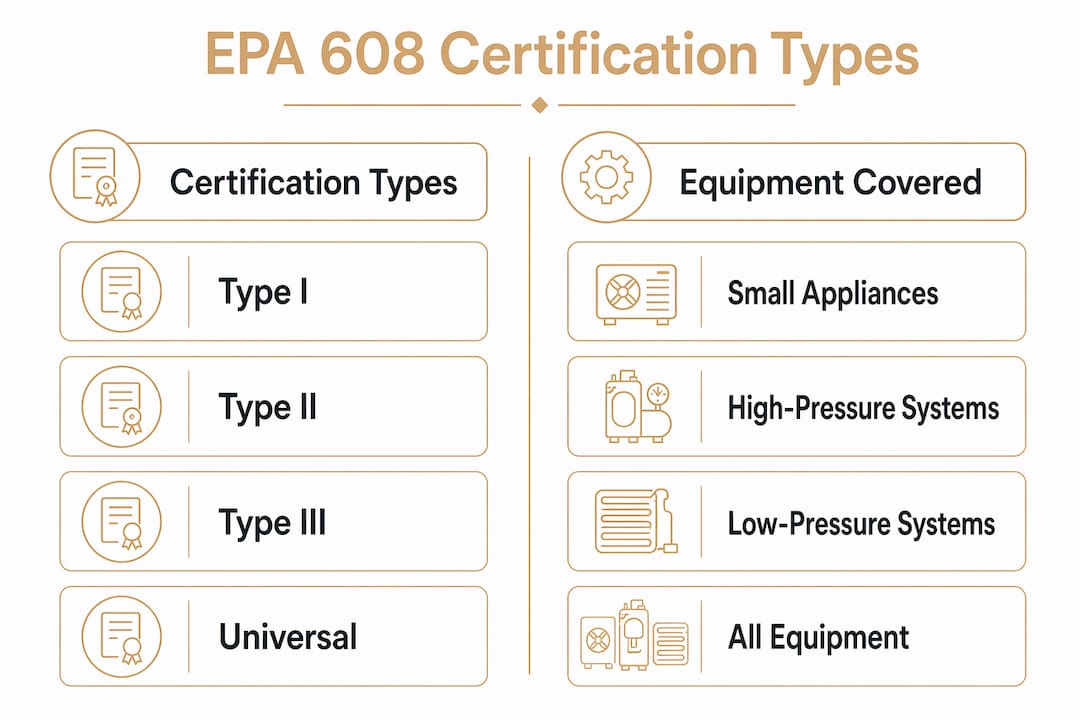
The EPA divides Section 608 certification into four distinct categories, each tied to the type of equipment a technician will service. Understanding the differences helps you choose the right path from the start.
| Certification type | Equipment covered | Pressure range |
|---|---|---|
| Type I | Small appliances (under 5 lbs of refrigerant) | Varies |
| Type II | High and very-high-pressure appliances | Above atmospheric |
| Type III | Low-pressure appliances (e.g., centrifugal chillers) | Below atmospheric |
| Universal | All equipment types (I, II, and III combined) | All ranges |
Type I, II, III, and Universal certifications each require passing specific exams tailored to their appliance categories. Universal certification is the most valuable because it covers all equipment types and is what most full-service HVAC employers require. To earn Universal, a technician must pass the Core exam plus all three specialty exams (Type I, II, and III).
One critical detail: the Core exam must be taken as a proctored test to count toward Universal certification. An open-book Core exam does not qualify you for Universal credentials, even if you pass it. Many candidates miss this and have to retest, which costs time and money.
Pro Tip: If you plan to work in residential and commercial HVAC, go straight for Universal certification. Limiting yourself to Type I or II may satisfy a first job requirement but will restrict your options as your career grows.
How does the AC repair certification process work?
The AC repair certification process follows a structured path from study to credentialing. Here is how it works step by step.
- Choose your certification type. Decide whether you need Type I, II, III, or Universal based on the equipment you expect to service. Most career-focused technicians target Universal from the start.
- Find an EPA-approved testing organization. Organizations like ESCO Group, Mainstream Engineering, and various trade schools administer EPA 608 exams. You register directly with the testing provider.
- Study the Core and specialty sections. The Core exam covers general refrigerant handling, safety, and environmental regulations. Each specialty exam covers the specific equipment type. Study materials are widely available through trade schools and online prep courses.
- Take the proctored Core exam. This is non-negotiable for Universal certification. The Core must be administered by an approved proctor. Specialty exams for Type I may be taken open-book, but the Core cannot.
- Pass the required exams. Passing scores vary slightly by testing organization but generally require 70% or higher on each section.
- Receive your certification card. Once you pass, the testing organization issues a certification card. This card is your legal proof of compliance and what employers and inspectors will ask to see.
- Keep your card accessible. EPA 608 certifications do not expire under current regulations. Technicians certified since 1991 retain lifelong certification without mandatory re-certification.
Pro Tip: Take a practice exam from the same provider you plan to test with. Each EPA-approved organization formats questions slightly differently, and familiarity with the format reduces test-day surprises significantly.
The certification card functions as your professional license for refrigerant work. Losing it does not void your certification, but you will need to request a replacement from the original testing organization. Keep a digital photo of it as a backup.
What additional certifications complement EPA 608?
EPA 608 is the legal minimum. What separates a technician who gets hired quickly from one who waits months is what they stack on top of it. The most recognized voluntary credential in the industry is NATE certification, offered by North American Technician Excellence, the largest nonprofit HVACR certification organization in the United States.
NATE exams test hands-on competency in areas that EPA 608 does not touch, including system diagnostics, installation best practices, and real-world troubleshooting scenarios. Passing a NATE exam signals to employers that you can do the work, not just handle refrigerant legally. Here is what a well-rounded certification profile looks like for a residential HVAC technician in 2026:
- EPA 608 Universal (mandatory legal credential)
- NATE Core Exam (foundational knowledge across HVACR systems)
- NATE Specialty Exam in Air Conditioning or Heat Pumps (role-specific competency)
- OSHA 10 or OSHA 30 (safety compliance, increasingly required by larger employers)
- State-level HVAC license (required in many states, separate from EPA certification)
NATE certification is a common differentiator on resumes, signaling advanced industry competency beyond the legal requirement. Employers who receive 50 applications for one technician role use NATE as a fast filter. Candidates without it often do not make the first interview round at larger HVAC companies.
Many technicians also pursue manufacturer-specific training through brands like Carrier, Trane, or Lennox. These programs are not certifications in the regulatory sense, but they demonstrate product knowledge that matters when servicing specific equipment in the field.
What are the real career benefits of getting certified?
The practical benefits of AC technician certification extend well beyond legal compliance. Here is what certification actually does for your career and your earning potential.
- Legal work eligibility. Without EPA 608, you cannot legally perform refrigerant-related tasks. This disqualifies you from the majority of HVAC job postings before an employer even reads your resume.
- Employer hiring filters. Employers treat EPA 608 as a minimum legal eligibility filter and use additional certifications to gauge skill and advancement potential. Universal certification plus NATE moves you past the first screening.
- Higher wages. Certified technicians command higher starting wages than uncertified helpers. NATE-certified technicians in particular report stronger negotiating positions when discussing compensation with employers.
- Career advancement. Certification opens doors to lead technician, service manager, and estimator roles that are closed to uncertified workers. Many HVAC companies require Universal certification before promoting anyone to a senior field role.
- Compliance and liability protection. Working without certification exposes both the technician and the employer to federal fines. Certified technicians protect their employers from regulatory risk, which makes them more valuable.
- State licensing alignment. Many states require HVAC contractors to hold specific state licenses in addition to EPA 608. California, for example, requires a C-20 HVAC contractor license for anyone operating an HVAC business. Certification is often a prerequisite for state licensing applications.
Industry guidance consistently favors stacking credentials for stronger job prospects. The sequence that works best for most new technicians is EPA 608 Universal first, then NATE, then any state-required licensing. Trying to pursue all three simultaneously while working an entry-level HVAC job is manageable but requires a realistic study schedule.
Key takeaways
AC repair certification is a federally required credential under EPA Section 608, and Universal certification combined with NATE credentials gives technicians the strongest legal and competitive position in the HVAC job market.
| Point | Details |
|---|---|
| EPA 608 is legally mandatory | Any technician handling refrigerants must hold valid EPA Section 608 certification before performing work. |
| Universal covers all equipment | Universal certification combines Type I, II, and III and is the most career-flexible option for HVAC technicians. |
| Core exam must be proctored | An open-book Core exam does not count toward Universal certification; plan for a proctored test from the start. |
| Certifications do not expire | EPA 608 credentials earned since 1991 remain valid for life under current federal regulations. |
| NATE boosts employability | Adding NATE certification signals advanced competency and moves candidates past employer screening filters. |
Why I tell every new technician to get Universal from day one
When someone asks me what AC repair certification they should pursue, my answer is always the same: go Universal, go proctored, and do not cut corners on the Core exam. I have seen technicians come through our doors at Upright Construction & HVAC who passed an open-book Core and then discovered they were ineligible for Universal certification. They had to retest, which cost them weeks and a job opportunity. That is a painful and completely avoidable mistake.
The other thing I want to push back on is the idea that EPA 608 is “enough.” It is enough to stay legal. It is not enough to stand out. In the Los Angeles market, where we operate, the competition for skilled HVAC technicians is real. Employers here are not just looking for someone who can legally touch a refrigerant line. They want someone who can diagnose a failing compressor, explain the issue to a homeowner clearly, and get the system running before the afternoon heat peaks. That requires NATE-level preparation, not just a certification card.
My honest advice: treat certification as the beginning of your professional education, not the finish line. The technicians who advance fastest are the ones who stack credentials deliberately, stay current with refrigerant regulations (especially as R-410A is being phased out), and invest in manufacturer training. The R-410A refrigerant transition alone is reshaping what certifications matter in 2026 and beyond. Get ahead of it now.
— Ernie M
Work with certified HVAC professionals in Los Angeles

At Upright Construction & HVAC, every technician on our team holds EPA 608 Universal certification and carries the credentials to back up the work we do. If your AC system needs attention, whether it is a refrigerant issue, a failing component, or a full system diagnosis, you deserve a technician who is legally qualified and genuinely skilled. We have served Los Angeles homeowners for over 15 years with transparent diagnostics and 24/7 availability. Check out our AC repair tips for practical guidance, or contact Upright Construction & HVAC directly to schedule service with a certified technician who knows your system inside and out.
FAQ
What is EPA Section 608 certification?
EPA Section 608 certification is the federally required credential for any technician who handles refrigerants in air conditioning or refrigeration equipment. It is mandated under the Clean Air Act and requires passing an EPA-approved exam.
Does EPA 608 certification expire?
No. EPA 608 certifications do not expire under current regulations. Technicians who earned certification in 1991 or later retain it for life without mandatory renewal.
How long does it take to get AC repair certification?
Most candidates complete EPA 608 exam preparation in two to four weeks of focused study. The exam itself takes a few hours, and certification cards are typically issued within days of passing.
What is the difference between EPA 608 and NATE certification?
EPA 608 is a legal requirement for refrigerant handling. NATE is a voluntary credential that tests broader technical competency in HVAC installation, maintenance, and troubleshooting. Most career-focused technicians pursue both.
Can I work in HVAC without EPA 608 certification?
You can perform tasks that do not involve refrigerant handling, such as duct work or electrical connections, without EPA 608. However, any task that could release refrigerants requires valid certification, and most HVAC employers require it for all field roles.