- How Los Angeles heat affects AC systems when temperatures climb above 95°F
- Common heat-related AC efficiency problems in Los Angeles homes
- How to prepare your AC to handle Los Angeles heat waves
- AC performance on normal days vs. extreme heat days in Los Angeles
- Key takeaways
- What 15 years of LA heat waves taught me about AC expectations
- How Upright Construction & HVAC keeps your AC ready for LA heat
- FAQ
- Recommended
TL;DR:
- Extreme outdoor heat significantly reduces AC efficiency in Los Angeles homes by forcing systems to work harder and run longer. Proper maintenance, including coil cleaning, refrigerant checks, and sealing duct leaks, can improve performance and reduce energy costs during heat waves. Understanding realistic indoor temperature expectations helps homeowners manage comfort and avoid unnecessary system repairs in extreme conditions.
Extreme outdoor heat is the single biggest factor reducing AC efficiency in Los Angeles homes, forcing systems to work harder, run longer, and deliver less cooling than homeowners expect. During a typical LA heat wave, your air conditioner faces conditions it was never designed to handle easily. Understanding how Los Angeles heat affects AC systems gives you the power to set realistic expectations, catch problems early, and avoid the kind of breakdown that hits hardest on the hottest day of the year. At Upright Construction & HVAC, we’ve seen this play out in thousands of homes across the city over the past 15 years.
How Los Angeles heat affects AC systems when temperatures climb above 95°F
Your AC system is built around a simple principle: move heat from inside your home to the outside air. When outdoor temperatures rise above 95°F, that process gets significantly harder. The condenser unit sitting outside your home has to push heat into air that is already scorching, and the hotter it gets outside, the less efficiently it can do that job.
Here’s what actually happens inside the system during extreme heat:
- Condenser coil strain. The condenser coil rejects heat by transferring it to outdoor air. When outdoor temps hit 100°F or higher, the temperature difference between the refrigerant and the outside air shrinks, making heat transfer far less efficient. The system compensates by running longer.
- Compressor overload. The compressor has to work at higher pressures to push refrigerant through the cycle. This increases compressor workload and system pressure, which raises energy consumption and accelerates wear.
- Compounding stress from dirty coils or low refrigerant. If your coils are coated in dust or your refrigerant is slightly low, those problems become critical during a heat wave. Dirty coils or low refrigerant during 95 to 110°F outdoor temps cause the system to run at peak capacity for extended periods, consuming significantly more energy.
- Longer run times as a normal response. A healthy AC system will often run for extended periods during heat waves as part of normal operation. Near-continuous operation on a 105°F day does not automatically mean something is broken.
Realistic indoor temperature expectations matter here. Residential AC systems in Los Angeles are typically sized to maintain indoor temperatures about 20°F cooler than outside under normal peak conditions. That means when it’s 95°F outside, expect around 74 to 76°F indoors. When it’s 105°F outside, 75 to 78°F is a realistic outcome with a properly functioning system. Expecting 68°F indoors when it’s 108°F outside is not realistic, and chasing that number by dropping your thermostat will only stress the system further.
Pro Tip: A quick way to check if your AC is actually performing well is to measure the Delta-T, the temperature difference between the air going into your return vent and the air coming out of your supply vent. A Delta-T between 16 and 22°F indicates good performance. If return air reads 80°F and supply air reads 60°F, your system is doing its job.
Common heat-related AC efficiency problems in Los Angeles homes
Heat waves expose weaknesses that are invisible on mild days. The most common heat-related AC problems in LA homes are not always inside the AC unit itself. They live in your walls, attic, and ductwork.
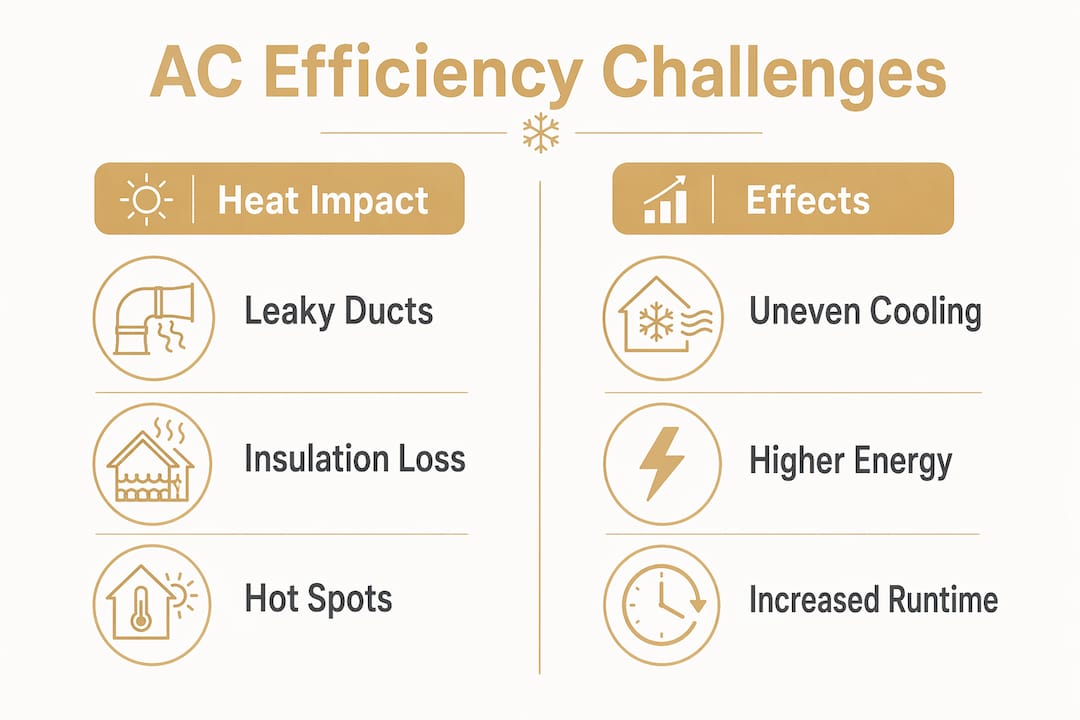
Leaky ductwork is one of the most widespread issues in older Los Angeles homes. When ducts run through unconditioned attic spaces that can reach 140°F or higher in summer, even small leaks dump cooled air directly into that superheated space. The result is longer run times, uneven cooling across rooms, and energy bills that keep climbing.
Deteriorated insulation compounds the problem. Attic insulation that has settled, gotten wet, or simply aged past its effective life allows radiant heat to pour through ceilings into living spaces. Your AC then has to fight heat coming from above while also dealing with extreme outdoor temperatures. This is why some LA homes feel stuffy and hot even with the AC running constantly.
Hot spots and uneven temperatures are a direct symptom of both duct leaks and insulation failures. One bedroom stays 10°F hotter than the rest of the house. The living room cools down fine, but the back rooms never quite get there. These are not random quirks. They are signs of a system working against a compromised building envelope.
The energy cost impact is real and measurable. Without proper maintenance, energy consumption during heat waves can increase by 20 to 40% for the same cooling performance due to inefficiencies and overworked components. That is a significant jump on your utility bill for no improvement in comfort.
| Problem | Symptom | Impact |
|---|---|---|
| Leaky ductwork | Uneven cooling, hot rooms | Higher run times, wasted energy |
| Poor attic insulation | Rooms stay hot despite AC running | Increased heat load on system |
| Dirty condenser coils | Longer cycles, warm air output | Reduced efficiency, higher bills |
| Low refrigerant | Weak airflow, ice on lines | Compressor strain, possible failure |
Fixing duct leaks and insulation can improve comfort and reduce AC energy use without replacing the system entirely. Many LA homeowners spend money on new equipment when the real problem is the building envelope around it.
How to prepare your AC to handle Los Angeles heat waves
Preparation before the heat arrives is far more effective than reacting after the system struggles. The steps below are straightforward, and most can be done or scheduled in early spring before temperatures climb.
- Change your air filter. A clogged filter restricts airflow, which reduces the system’s ability to move heat and forces the blower motor to work harder. Replace filters every 30 to 60 days during peak season, not just once a year.
- Clean the condenser coils. Outdoor coils collect dust, cottonwood, and debris over the winter and spring. A professional coil cleaning before summer significantly reduces the heat rejection problem described above.
- Check refrigerant levels. Low refrigerant is not a normal wear item. It indicates a leak. Have a licensed technician check levels and repair any leaks before the heat season starts. Running a system low on refrigerant during a heat wave is one of the fastest ways to destroy a compressor.
- Inspect and seal ductwork. A duct inspection, especially in attic runs, can identify leaks that are silently draining your cooling capacity. Sealing those leaks pays for itself quickly in reduced energy bills.
- Schedule a professional tune-up. Proper spring maintenance including coil cleaning, refrigerant checks, and filter replacement significantly reduces AC stress and lowers the risk of mid-season failure. A technician can also catch electrical issues, worn capacitors, and low airflow before they become emergencies.
Pro Tip: Set your thermostat to 76 to 78°F during peak heat hours rather than dropping it to 70°F. Every degree cooler increases energy consumption by 3 to 5%, and thermostat swings cause short cycling that strains the compressor. Pre-cool your home in the early morning when outdoor temps are lower, then hold a steady setpoint through the afternoon.
Pairing your AC with a ceiling fan can also reduce the burden on your system. Fans do not lower air temperature, but they create a wind-chill effect that makes 78°F feel like 74°F. That small shift lets you raise your thermostat setpoint without sacrificing comfort.
AC performance on normal days vs. extreme heat days in Los Angeles
Understanding the difference between what your AC delivers on a 90°F day versus a 108°F day helps you recognize when your system is operating normally and when something is actually wrong.
| Condition | Outdoor Temp | Expected Indoor Temp | Typical Run Time | Energy Use vs. Baseline |
|---|---|---|---|---|
| Normal peak day | ~95°F | 74 to 76°F | Cycles on and off | Baseline |
| Moderate heat wave | ~100°F | 75 to 77°F | Extended cycles | +10 to 15% |
| Extreme heat wave | ~105 to 110°F | 76 to 78°F | Near-continuous | +20 to 40% |
| Extreme heat, unmaintained | ~105 to 110°F | 80°F or higher | Continuous, struggling | +40% or more |
The most important takeaway from this comparison is that near-continuous operation on extreme heat days reflects design limitations, not automatic system failure. A maintained system running all day at 105°F is doing exactly what it should. An unmaintained system running all day at 105°F is burning through components and heading toward a breakdown.
The gap between a maintained and unmaintained system widens dramatically as temperatures climb. On a 90°F day, dirty coils might cost you a few extra dollars. On a 108°F day, those same dirty coils combined with low refrigerant can push energy use up by 40% while delivering noticeably worse cooling. That is the compounding effect that makes pre-season maintenance so valuable for common AC problems in LA homes.
Key takeaways
Los Angeles heat reduces AC efficiency by forcing condenser coils and compressors to work harder, and unmaintained systems can consume 20 to 40% more energy while delivering less cooling during heat waves.
| Point | Details |
|---|---|
| Realistic indoor temps | Expect 74 to 78°F indoors during heat waves, not 68°F, even with a healthy system. |
| Maintenance prevents failure | Coil cleaning, refrigerant checks, and filter changes before summer cut breakdown risk significantly. |
| Building envelope matters | Leaky ducts and poor insulation force your AC to fight heat from inside the home, not just outside. |
| Energy costs spike without upkeep | Unmaintained systems use 20 to 40% more energy for the same or worse cooling output. |
| Continuous runtime is normal | A system running all day during extreme heat is not broken. It is working as designed under stress. |
What 15 years of LA heat waves taught me about AC expectations
I’ve been inside thousands of Los Angeles homes during heat waves, and the most common frustration I hear is some version of “my AC is broken because it’s still hot inside.” Nine times out of ten, the system is not broken. It is simply hitting the physical limits of what it can do when it’s 108°F outside.
The misconception that air conditioning should always deliver ice-cold air regardless of outdoor conditions causes a lot of unnecessary panic and, honestly, a lot of unnecessary service calls. What I’ve learned is that managing expectations is just as important as managing the equipment. When you understand that your system is designed to keep you about 20°F cooler than outside, a 78°F indoor temperature on a 100°F day stops feeling like a failure and starts feeling like exactly what it is: the system doing its job.
What actually concerns me when I walk into a home during a heat wave is not the runtime. It’s the hot spots. It’s the rooms that are 10 degrees warmer than the rest of the house. It’s the utility bill that jumped 50% with no change in habits. Those are the signs that something is genuinely wrong, usually in the ductwork or insulation, not always in the equipment itself.
The homeowners who come through LA summers with the least stress are the ones who scheduled their AC maintenance in April, not the ones calling us in July when the system has already given out. Preventive care is not glamorous, but it is the single most effective thing you can do to protect your comfort and your wallet when the heat hits.
— Ernie M
How Upright Construction & HVAC keeps your AC ready for LA heat

When temperatures in Los Angeles push past 100°F, your AC system needs to be in its best condition before the heat arrives, not after it causes problems. Upright Construction & HVAC has spent over 15 years helping LA homeowners protect their systems with professional tune-ups, coil cleaning, refrigerant checks, duct inspections, and emergency repairs when the unexpected happens. Our team provides 24/7 support because heat waves do not follow business hours. If your system is struggling, running constantly, or delivering uneven cooling, get ahead of a breakdown now. Review our AC repair guidance and schedule an inspection with Upright Construction & HVAC before the next heat wave arrives.
FAQ
Why is my AC running constantly during a heat wave?
Near-continuous operation during extreme heat is normal behavior for a properly functioning system. Residential AC units are designed to maintain indoor temps roughly 20°F cooler than outside, so when outdoor temps exceed 100°F, the system runs longer to hold that gap.
What indoor temperature should I expect during an LA heat wave?
With a healthy, well-maintained system, expect indoor temperatures between 74 and 78°F when it’s 95 to 105°F outside. Temperatures below 68°F indoors are uncommon and unrealistic when outdoor temps exceed 105°F.
How much more energy does my AC use during a heat wave?
Without proper maintenance, energy consumption can increase by 20 to 40% during heat waves compared to normal operation. A maintained system uses significantly less energy for the same or better cooling output.
What are the signs my AC is actually struggling, not just working hard?
Hot spots in specific rooms, indoor temps climbing above 80°F despite constant runtime, ice forming on refrigerant lines, or a sudden spike in energy bills all indicate a real problem. These symptoms point to issues like low refrigerant, dirty coils, or duct leaks rather than normal heat-wave operation.
Does fixing ductwork actually help AC performance in LA?
Sealing duct leaks and improving insulation reduces the indoor heat load your AC has to fight, shortens run times, and improves comfort across all rooms. Many LA homeowners see measurable efficiency gains without replacing their equipment at all.
Recommended
- 4 Main Common AC Problems In Los Angeles Homes – Tips On Dealing With Them – Upright Construction & HVAC
- Boost AC Efficiency How Capacitors Transform Performance – Upright Construction & HVAC
- Proven Cost-Effective AC Repair Solutions – From Los Angeles HVAC Experts – Upright Construction & HVAC
- Do Window AC Units Bring Fresh Air Inside – Upright Construction & HVAC