- What are the essential steps in the HVAC installation process?
- How do professionals verify HVAC system performance after installation?
- What factors affect HVAC installation costs?
- How to prepare for installation day and what to expect
- Key takeaways
- What I’ve learned after 15 years of HVAC installations in Los Angeles
- Get expert HVAC installation from Upright Construction & HVAC
- FAQ
- Recommended
TL;DR:
- Proper HVAC installation involves precise load calculations, code-compliant equipment placement, and verified commissioning to ensure efficiency and comfort. Skipping steps like permits or thorough testing can lead to costly repairs, poor performance, and warranty issues. Homeowners should demand documentation and use licensed contractors to guarantee system longevity and optimal operation.
HVAC installation is the structured process of planning, sizing, physically installing, and commissioning heating, ventilation, and air conditioning equipment to deliver reliable comfort and efficiency in your home. Understanding how HVAC installation works helps you make smarter decisions, avoid costly mistakes, and hold your contractor accountable at every stage. The process covers everything from load calculations and permit filing to connecting air handlers, condensers, refrigerant lines, and smart thermostats. Done right, a proper installation determines how long your system lasts, how much energy it uses, and how comfortable your home feels year-round.
What are the essential steps in the HVAC installation process?
A phased HVAC installation follows a structured sequence that no reputable contractor skips. Each step builds on the last, and cutting corners at any stage creates problems that compound over time.
1. Load calculation and home evaluation
Before any equipment is selected, a technician performs a Manual J load calculation to determine exactly how much heating and cooling your home requires. This accounts for square footage, insulation levels, window placement, ceiling height, and your local climate zone. Relying on the old system’s size is a common mistake. Homes change over time through added insulation, new windows, or room additions, and those changes shift the load significantly.
2. Equipment selection
Once the load is calculated, the contractor selects equipment matched to those numbers. Efficiency ratings like SEER2 for cooling and HSPF2 for heat pumps factor into the choice. A higher-rated system costs more upfront but lowers monthly energy bills. The type of system matters too: ducted central systems, ductless mini-splits, and heat pumps each suit different home configurations.
3. Permit acquisition
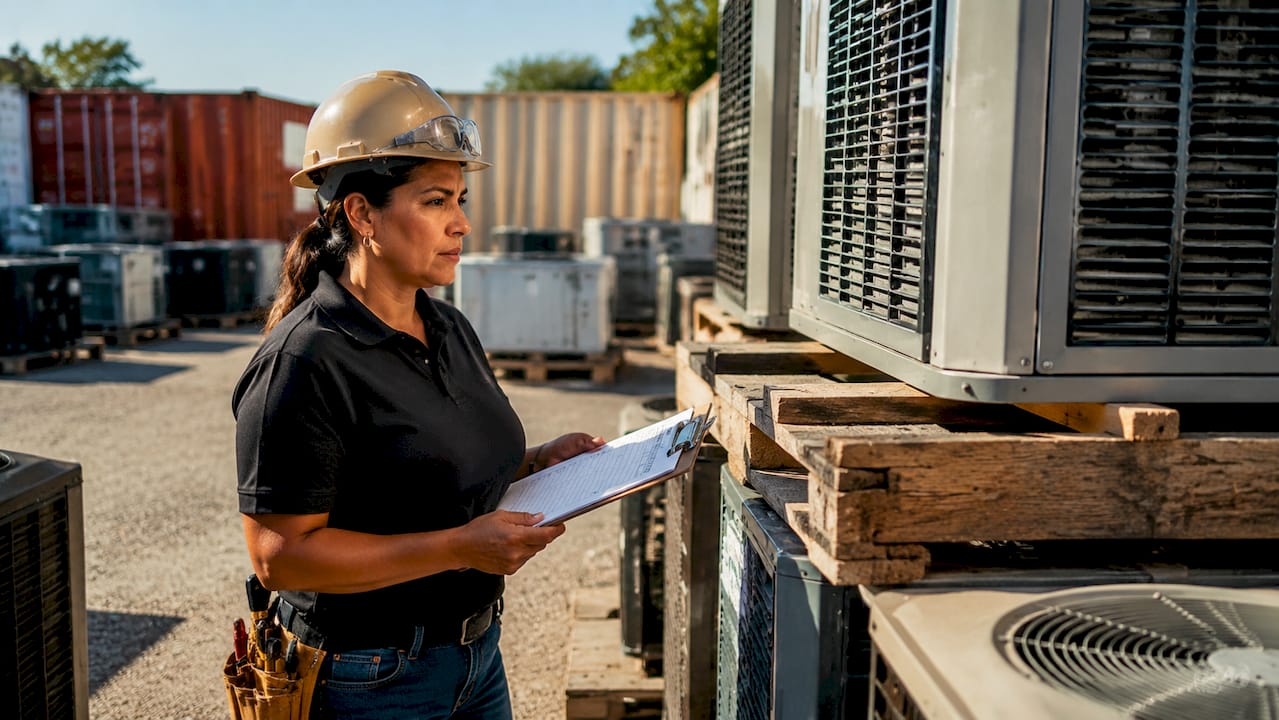
Pulling permits is not optional. Local building departments require permits for HVAC work to verify code compliance, protect your home’s resale value, and preserve equipment warranties. Skipping this step can void your manufacturer warranty and create legal headaches when you sell.
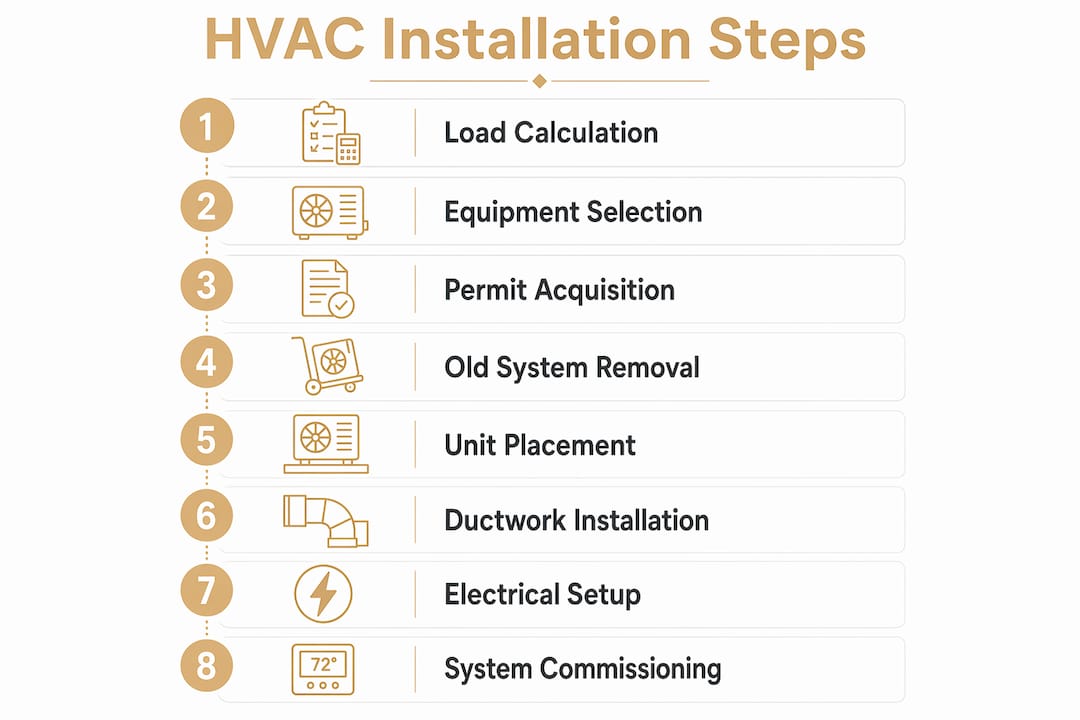
4. Old system removal
Removing the existing system requires EPA Section 608-certified technicians who use specialized tools to recover refrigerant safely. Releasing refrigerant into the atmosphere is a federal violation. This step also includes disconnecting electrical connections and removing old ductwork or line sets that will not be reused.
5. Indoor and outdoor unit placement
The air handler or furnace goes indoors, typically in a utility closet, attic, or basement. The condenser or heat pump sits outside on a level pad with adequate clearance for airflow. Placement affects both performance and noise levels, so positioning is deliberate, not arbitrary.
6. Ductwork and refrigerant line installation
New ductwork follows ACCA Manual D sizing standards to prevent airflow restrictions. All duct joints get sealed with mastic or UL-listed tape to stop conditioned air from leaking into unconditioned spaces. Refrigerant lines connect the indoor and outdoor units and must be properly insulated to prevent energy loss.
7. Electrical wiring and thermostat setup
All electrical work must comply with NEC 2023 requirements, including AFCI and GFCI protections where required. A smart thermostat like an Ecobee or Honeywell T6 Pro gets wired and programmed during this phase, giving you control over schedules and energy use from day one.
8. System startup and commissioning
The final step is commissioning, where the technician verifies that everything performs as designed. This is where most of the quality difference between contractors shows up.
Pro Tip: Ask your contractor for a copy of the signed commissioning sheet before they leave. If they cannot produce one, the installation is not complete.
How do professionals verify HVAC system performance after installation?
Commissioning is the verification phase that separates a professional installation from a rushed one. It is not a formality. It is the process that confirms your system actually delivers what it was designed to deliver.
A thorough commissioning process covers several critical checks:
- Temperature differential testing: The technician measures the temperature difference across the evaporator coil. A healthy differential of 14°F to 22°F confirms proper refrigerant charge and airflow. A reading outside that range signals a problem.
- Airflow balancing: Target airflow is 350 to 400 CFM per ton of cooling capacity. Too little airflow causes the coil to freeze. Too much reduces dehumidification and comfort.
- Static pressure checks: Duct systems that are too restrictive force the blower to work harder, raising energy consumption and shortening motor life.
- Refrigerant subcooling and superheat verification: These measurements confirm the refrigerant charge is correct. An overcharged or undercharged system runs inefficiently and damages the compressor over time.
- Electrical load testing: Measuring voltage drop and amp draw during startup identifies charging or airflow problems before they cause equipment failure.
- Documentation: A complete commissioning sheet records static pressure, subcooling, superheat, and amperage readings. Without it, there is no proof the system was verified.
One technique worth knowing: quality technicians use triple-evacuation with nitrogen breaks to pull moisture and non-condensables out of the refrigerant circuit before charging. This protects the compressor and metering devices from contamination that shortens system life.
Pro Tip: Learn what HVAC commissioning involves before your installation day. Our guide on commissioning standards walks you through exactly what to expect and what questions to ask.
Improperly installed systems fail to deliver their advertised efficiency ratings regardless of how high the SEER2 number is on the label. The installer’s skill is the variable that determines whether you actually get what you paid for.
What factors affect HVAC installation costs?
Installation costs vary widely based on your home’s characteristics, the system type you choose, and the complexity of the work involved. Here is a breakdown of the main cost drivers:
| Cost factor | What it means for your project |
|---|---|
| System type | Ductless mini-splits cost more per zone but eliminate duct installation costs; central ducted systems suit homes with existing ductwork |
| Home size and load complexity | Larger homes with poor insulation or unusual layouts require more equipment capacity and longer installation time |
| Permits and code compliance | Permit fees vary by city; skipping them risks fines, failed inspections, and voided warranties |
| Electrical upgrades | Older homes may need panel upgrades or dedicated circuits to meet NEC 2023 requirements |
| Duct modifications | Sealing, resizing, or replacing ductwork adds labor and material costs but pays back in efficiency |
| Equipment efficiency tier | Higher SEER2 and HSPF2 ratings carry a higher purchase price but reduce operating costs over the system’s life |
Hidden costs catch many homeowners off guard. Condensate management errors are a leading cause of costly post-install repairs, and correct drain slope, trap sizing, and float switches add to labor time. Line-set length between the indoor and outdoor units also adds material cost that quotes sometimes understate.
Choosing a licensed HVAC contractor protects you from these surprises. Licensed contractors pull permits, follow code, and carry liability insurance. That matters when something goes wrong, and it matters even more when you sell your home and a buyer’s inspector starts asking questions.
Homeowners who skip permitting often discover the real cost later: failed home inspections, warranty claims denied by manufacturers, and safety risks that were never caught by a code inspector.
How to prepare for installation day and what to expect
Typical HVAC installations take between one and three days depending on system complexity and home conditions. A straightforward replacement of an existing system in a single-family home often wraps up in one full day. New construction or systems requiring duct modifications take longer.
Here is how to prepare so the process goes smoothly:
- Clear a path from your front door to the indoor unit location. Technicians carry large equipment and need unobstructed access.
- Move furniture, storage, or belongings away from the indoor unit area and any duct access points.
- Confirm that someone is home for the full installation day. You will need to be present for the final walkthrough and thermostat training.
- Ask your contractor in advance about the permit inspection schedule so you know when the inspector will visit.
- Write down questions before the crew arrives. Good questions include: How do I change the filter and how often? What does the thermostat’s error code mean? What maintenance should I schedule in the first year?
Safety during installation is handled by the crew, but you should know that refrigerant recovery and electrical disconnection happen early in the process. Keep children and pets away from work areas throughout the day.
Understanding what an HVAC contractor does during each phase helps you have a more productive conversation with your installation team and catch anything that looks out of place.
Key takeaways
A proper HVAC installation requires precise load calculations, code-compliant equipment placement, and verified commissioning to deliver the efficiency and comfort the system is rated for.
| Point | Details |
|---|---|
| Load calculation first | Manual J sizing prevents oversized or undersized equipment that wastes energy and fails early. |
| Permits protect you | Skipping permits risks warranty voidance, failed inspections, and safety hazards at resale. |
| Commissioning is non-negotiable | A signed commissioning sheet with temperature, airflow, and refrigerant data confirms the system works correctly. |
| Hidden costs are real | Condensate drainage, line-set length, and electrical upgrades add cost that basic quotes often miss. |
| Installer skill determines results | High-efficiency equipment produces no real gains when installation quality is poor. |
What I’ve learned after 15 years of HVAC installations in Los Angeles
I have seen homeowners spend good money on high-efficiency equipment and then wonder why their energy bills barely moved. Almost every time, the answer is not the equipment. It is the installation.
The single biggest mistake I see is contractors who skip the Manual J calculation and just match the old system’s tonnage. That might have worked 20 years ago when the home was the same as it was built. But most homes in Los Angeles have been modified, re-insulated, or had rooms added. The old tonnage number is often wrong, and an oversized system short-cycles, which means it never runs long enough to properly dehumidify the air. You end up with a cold but clammy house.
The other thing I tell every homeowner: do not let anyone touch your refrigerant without asking for their EPA 608 certification. This is not bureaucratic box-checking. Refrigerant handling done wrong damages the compressor, contaminates the system, and creates liability. I have seen systems fail within two years because the refrigerant charge was off from day one and nobody caught it because commissioning was skipped.
My honest advice is to treat the commissioning sheet the same way you treat a receipt. If the contractor cannot hand you documentation showing temperature differential, airflow, subcooling, and superheat readings, the job is not done. A quality installation is verifiable. Demand the paperwork.
— Ernie M
Get expert HVAC installation from Upright Construction & HVAC
At Upright Construction & HVAC, we have spent over 15 years installing, commissioning, and servicing HVAC systems across Los Angeles. Every installation we complete follows current 2026 code requirements, includes a full Manual J load calculation, and closes with a documented commissioning sheet you keep for your records.

Whether you are replacing an aging system or installing HVAC in a new space, our licensed technicians handle permits, equipment selection, and system verification from start to finish. We also offer air conditioner repair guidance for homeowners dealing with existing system issues. Call us or schedule a consultation online. We will walk you through every step before the first tool comes out of the truck.
FAQ
What is HVAC installation?
HVAC installation is the complete process of sizing, placing, connecting, and commissioning heating, ventilation, and air conditioning equipment in a home. It includes load calculations, permit filing, equipment installation, and system verification.
How long does HVAC installation take?
Most residential HVAC installations take one to three days. A straightforward system replacement typically finishes in a single day, while new construction or duct modifications extend the timeline.
Why can’t I install HVAC myself?
DIY HVAC installation is not legal for refrigerant work without EPA Section 608 certification. Handling refrigerants without certification violates federal law and voids most manufacturer warranties.
What is a Manual J load calculation?
Manual J is the industry-standard method for calculating exactly how much heating and cooling a home needs. It accounts for insulation, windows, square footage, and climate to prevent oversized or undersized equipment.
How do I know if my HVAC installation was done correctly?
Ask for a signed commissioning sheet showing temperature differential readings, airflow measurements, refrigerant subcooling and superheat values, and amp draw. A properly commissioned system will have all of these documented.