- Key Takeaways
- What HVAC commissioning really means
- The HVAC commissioning process, step by step
- Benefits of HVAC commissioning for homeowners
- Common mistakes and misconceptions to avoid
- How to engage commissioning for your property
- My honest take on HVAC commissioning
- Get expert HVAC support from Upright Construction & HVAC
- FAQ
- Recommended
TL;DR:
- HVAC commissioning verifies that your system performs according to its original design, not just that it turns on.
- It begins during design review and continues through post-occupancy testing, offering significant energy savings and fault detection.
Most homeowners assume that once a new HVAC system is installed and turned on, the job is done. That assumption costs money. What is HVAC commissioning? It’s a systematic process of verifying that your HVAC system actually performs the way it was designed to perform, not just that it runs. The industry standard term is “commissioning,” and it goes far beyond flipping a switch. When done right, it catches faults before they become costly repairs, trims energy bills, and keeps your home genuinely comfortable year-round.
Key Takeaways
| Point | Details |
|---|---|
| More than a startup | Commissioning verifies your system meets design specifications, not just that it powers on. |
| Starts before installation | The process begins during design review and continues through post-occupancy testing. |
| Real financial returns | Case studies show up to 29% energy savings and significant cost avoidance after commissioning. |
| Catches hidden faults | Functional performance testing finds control and equipment errors that routine inspections miss. |
| Worth the investment | Commissioning pays for itself within one to three years through energy and repair savings. |
What HVAC commissioning really means
The HVAC commissioning definition, as the U.S. Department of Energy describes it, is the thorough verification that a system’s installation and operation match its original design and engineering criteria. That’s a technical way of saying: someone qualified confirms your system does exactly what it was specified to do, under all the conditions it will actually face.
This is fundamentally different from a standard startup or an annual service visit. When a technician starts up a new system, they typically check that the equipment runs and that basic temperatures are hit. That’s it. Commissioning goes several layers deeper.
Here’s what sets commissioning apart from routine service:
- Startup: Equipment is powered on, basic operation is confirmed, and the technician leaves.
- Annual inspection: Filters are checked, refrigerant levels are tested, and obvious issues are flagged. You can read more about what this covers in our guide on annual HVAC inspections.
- Commissioning: Every control sequence, setpoint, airflow rate, and operating mode is verified against the original design documents.
Commissioning is typically led by a commissioning authority (CxA). This is either an independent third party or a qualified facilities professional whose job is to provide impartial verification that the owner’s project requirements are actually met.
Pro Tip: Ask your contractor upfront whether commissioning is included in your installation quote. Many homeowners find out after the fact that it wasn’t, and adding it later costs more.
The HVAC commissioning process, step by step
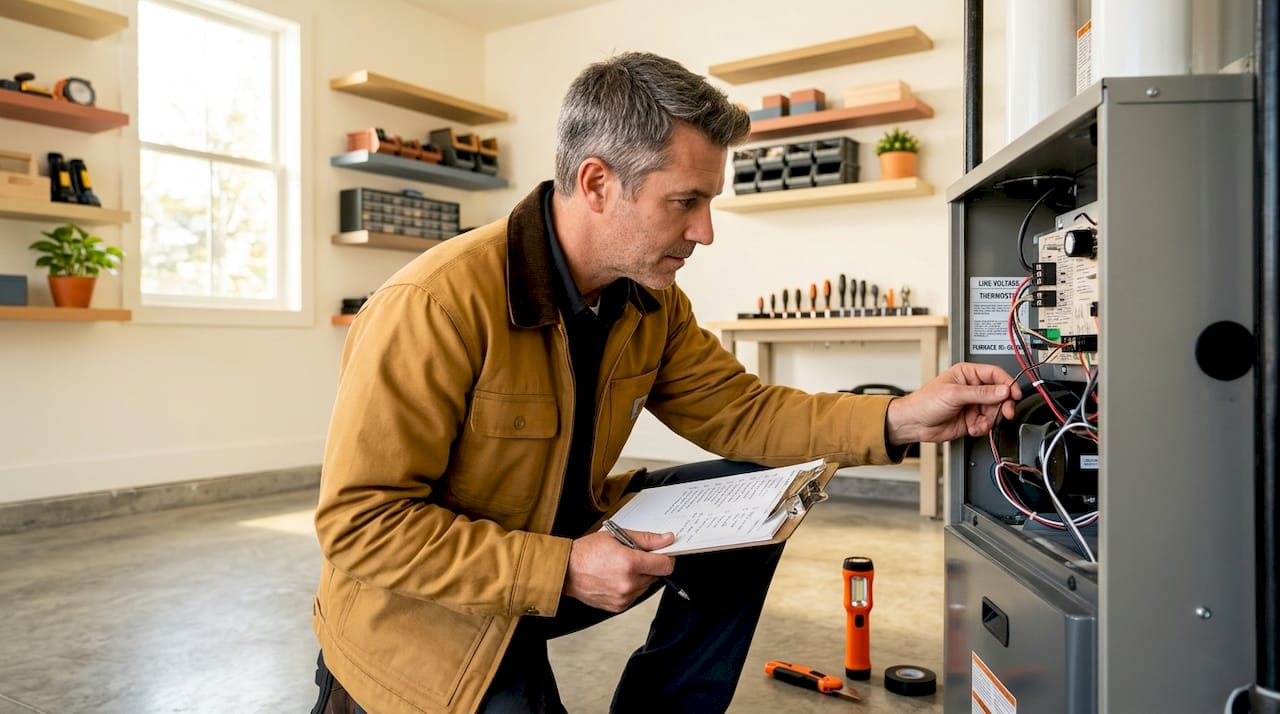
Understanding how HVAC commissioning works helps you set the right expectations before any work begins. The biggest misconception is that it happens at the end. In reality, commissioning starts early and continues long after move-in.
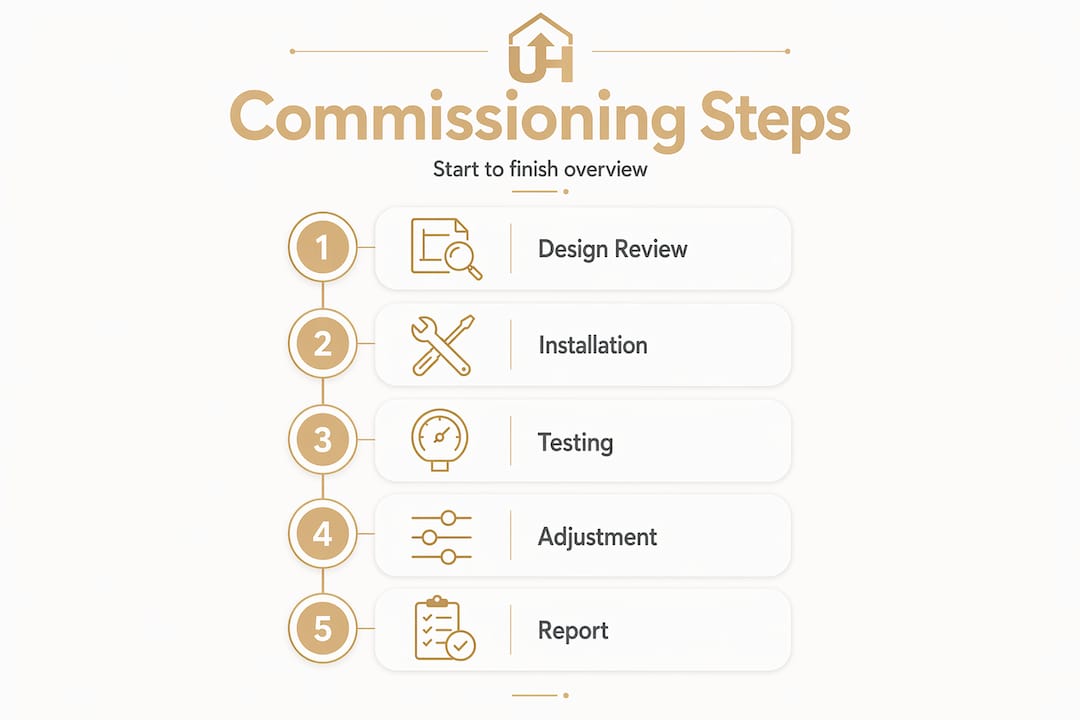
Here’s a simplified look at the phases:
Pre-design and design review. The commissioning authority reviews design documents, control sequences, and specifications before a single piece of equipment is ordered. This is where gaps get caught cheaply. Poor design documents that lack sensor placements or test access points lead to expensive field corrections down the line.
Construction phase verification. During installation, the CxA reviews submittals, checks equipment against specifications, and verifies that ductwork, controls, and sensors are installed correctly. Installation checklists are used to document progress at each step.
Functional performance testing (FPT). This is the technical core of the entire process. FPT confirms that equipment and controls work correctly under all required operating modes, not just at one setting on a mild day. That means testing occupied and unoccupied schedules, economizer transitions, demand-controlled ventilation, alarm responses, and more.
Balancing verification. Airflow rates are confirmed room by room. Testing and balancing (TAB) is part of commissioning, but it’s not sufficient on its own. Many systems pass TAB flow tests but fail when control sequences are put through their paces.
Post-occupancy and seasonal testing. Some faults only show up in summer heat or winter cold. Seasonal reviews catch performance drift and issues that weren’t apparent during initial testing.
Documentation and owner training. The commissioning process wraps up with a formal report and hands-on training so you actually understand how to operate your system correctly.
Here’s a quick reference for what gets verified at each phase:
| Phase | What gets checked |
|---|---|
| Design review | Control sequences, sensor locations, specifications |
| Installation | Equipment placement, ductwork, wiring, controls |
| Functional testing | All operating modes, schedules, alarms, airflow |
| Seasonal testing | Cold-weather heating, warm-weather cooling, economizer |
| Documentation | Final report, training, warranty records |
Pro Tip: Request a copy of the commissioning report for your records. If you ever sell the property or need a repair, that documentation is worth its weight in gold.
Benefits of HVAC commissioning for homeowners
The financial case is strong. DOE case studies have documented up to 29% annual energy savings and over $226,000 in cost avoidance from commissioning projects. For a homeowner, that translates to lower monthly utility bills and fewer emergency repair calls.
Beyond the numbers, here’s what commissioning actually delivers:
- Better indoor air quality. Commissioning catches faults in outside-air dampers, CO2 sensors, and ventilation controls that directly affect what you breathe. Poorly calibrated controls can dramatically reduce fresh air delivery without any visible warning sign. Improving your indoor air quality has real health benefits that go beyond comfort.
- Consistent comfort. Verified setpoints and control sequences mean every room reaches the temperature it should, instead of having hot and cold spots caused by unbalanced airflow or misconfigured controls.
- Longer system lifespan. A system running within its designed parameters puts less stress on components. That means fewer breakdowns and a longer life for your equipment.
- Documented proof of performance. For property managers, that commissioning report is a business asset. It shows tenants and insurers that the system was verified and performing correctly from day one.
“Commissioning isn’t a luxury add-on. It’s the difference between assuming your system works and actually knowing it does.” — Ernie M, Upright Construction & HVAC
The payback period for commissioning is typically one to three years, making it one of the better-returning investments you can make in a home or rental property.
Common mistakes and misconceptions to avoid
A lot of homeowners and even some contractors treat commissioning as something optional or interchangeable with other services. That’s where problems start.
Watch out for these frequent errors:
- Treating TAB as commissioning. Testing and balancing confirms airflow volumes. It does not verify that your control sequences, economizer, or demand-controlled ventilation actually work. Operational sequence failures happen regularly even after TAB is completed.
- Skipping seasonal testing. An HVAC system might pass every test in October but fail when July heat pushes it to maximum capacity. Skipping seasonal reviews means those faults stay hidden until they cause a breakdown.
- Incomplete design documents. When the original design lacks full control sequences or sensor placements, commissioning stalls in the field. This delays the project and drives up costs.
- Overlooking economizer and DCV testing. Economizer modes and demand-controlled ventilation require specific testing scenarios. Skipping these leaves energy-saving features either non-functional or actively wasting energy.
- Using a non-independent reviewer. When the installing contractor also handles commissioning, there’s an inherent conflict of interest. An independent CxA gives you impartial results.
Pro Tip: If a contractor tells you commissioning isn’t necessary because they’re “thorough,” ask them specifically how they test economizer mode transitions and occupied versus unoccupied control sequences. The answer will tell you a lot.
How to engage commissioning for your property
If you’re planning an HVAC installation or managing a property that needs better performance, here’s how to approach commissioning the right way.
Bring it up early. Include commissioning requirements in your project specifications before any contractor is hired. Early engagement during design yields far better results than trying to layer it on after installation.
Confirm the scope in writing. Ask your contractor to spell out exactly what the commissioning plan covers: which systems, which modes, which test scenarios. Vague answers are a red flag.
Request the documentation. A legitimate commissioning process ends with a written report. Ask for it. Review it. Keep it on file with your warranty records.
Consider retro-commissioning. If you own or manage an existing property with high utility bills or comfort complaints, retro-commissioning applies the same verification process to an already-installed system. It often finds years of accumulated drift and misconfiguration. Our guide on HVAC inspection basics is a good starting point for understanding what to look for.
Treat it as an investment, not a cost. The upfront expense of commissioning pays back through energy savings, reduced repairs, and a system that performs as promised. For property managers, it also reduces tenant complaints and turnover driven by comfort issues.
My honest take on HVAC commissioning
I’ve been in people’s homes for over 15 years, and I can tell you this: the calls I dread most are from homeowners who just had a system installed six months ago and are already having problems. Nine times out of ten, nobody verified the system beyond a basic startup.
I’ve walked into properties where the economizer damper was stuck open all summer, quietly driving up electricity bills by hundreds of dollars a month. The homeowner had no idea. The system “worked” in the sense that it produced cold air. But it was never commissioned, so nobody caught the fault.
What I’ve learned is that commissioning is usually underestimated because its value is invisible until something goes wrong. When it’s done right, everything works and nobody notices. When it’s skipped, the problems show up months later and the connection to the original installation is easy to miss.
My advice: treat commissioning the way you’d treat a home inspection before a purchase. You could skip it. But you’d be taking on risk that’s entirely avoidable. For homeowners investing in new systems, and for property managers who need reliable performance across multiple units, commissioning is how you protect that investment.
— Ernie M
Get expert HVAC support from Upright Construction & HVAC
If you’re planning a new installation or want to verify that your existing system is actually performing the way it should, Upright Construction & HVAC is ready to help. With over 15 years serving homeowners and property managers across Reseda, Encino, Van Nuys, and the greater Los Angeles area, we know what proper HVAC verification looks like and what it takes to get your system running at its best.

Our team brings honest diagnostics, detailed documentation, and the kind of transparency that makes commissioning feel like a clear, manageable process instead of a mystery. Whether you’re dealing with a brand-new installation or an existing system that’s never been properly verified, we can walk you through every step. If heating problems are on your list, start with our resource on fixing heating problems with home furnaces. And if you’re in the area, connect with our Reseda HVAC team or reach us for service across our Van Nuys service area to get started.
FAQ
What is the HVAC commissioning definition?
HVAC commissioning is the process of verifying that an installed system meets its original design and engineering criteria. It covers equipment, controls, airflow, and operating sequences, not just whether the system powers on.
How long does HVAC commissioning take?
The timeline depends on system complexity, but commissioning typically spans the entire project lifecycle, from design review through post-occupancy testing. For a residential installation, functional testing alone may take one to several days.
What does HVAC commissioning involve for a homeowner?
It involves a qualified professional reviewing installation, testing all operating modes, verifying airflow and control sequences, and delivering a written report with documentation. Homeowners should also receive training on proper system operation.
Is commissioning the same as testing and balancing?
No. Testing and balancing (TAB) confirms airflow volumes at registers and terminals. Commissioning verifies that the entire system, including controls, schedules, and sequences, operates as designed. TAB is one part of commissioning, not a replacement for it.
When should I consider retro-commissioning?
Retro-commissioning makes sense when an existing system has high energy bills, comfort complaints, or has never been formally verified. It applies the commissioning process to an already-installed system and frequently uncovers years of accumulated faults and drift.