
- How Much Does Furnace Replacement Cost by Fuel Type and Home Size?
- What Does an Installed Furnace Invoice Actually Include?
- What Factors Push a Furnace Quote Higher or Lower?
- When Should You Repair a Furnace Instead of Replacing It?
- How Can You Lower the Net Cost of a New Furnace?
- An Owner’s Take on Getting a Fair Furnace Quote
- Get an Accurate Furnace Replacement Quote in Los Angeles
- Sources
- FAQ
- Recommended
Most homeowners pay between $3,800 and $12,000 for a fully installed replacement furnace, with the majority of gas furnace jobs landing between $4,500 and $8,000. Fuel type, AFUE efficiency, and how complicated the installation is drive most of that spread. The next section breaks down pricing by fuel type and home size so you can see where your project likely falls.
TL;DR:
- The cost of replacing a furnace in Los Angeles generally ranges from $4,500 to $8,000 for gas units, with oil and electric options often costing more or less respectively.
- Ductwork condition, site access, and permit requirements significantly influence installation costs, especially in older or remodelled homes.
- A typical invoice includes equipment, labor, permits, venting, duct repairs, electrical upgrades, and optional controls, with venting for high-efficiency furnaces being a major cost factor.
- Furnace prices increase with higher AFUE ratings, staging capabilities, and variable-speed blowers, which also improve long-term efficiency and comfort.
- Repair costs exceeding half of a new unit’s price or ongoing repairs over 15 years favor replacement, especially if safety hazards like cracked heat exchangers are involved.
How Much Does Furnace Replacement Cost by Fuel Type and Home Size?
The fuel type your furnace burns sets the baseline, and it changes the math more than most homeowners expect. A gas furnace typically runs $4,500 to $8,000 installed, electric furnaces usually come in cheaper, and oil furnaces cost the most due to additional tank and burner components because of the added tank and burner components. This Old House reports the national average around the mid-range with costs varying widely depending on system size and efficiency.
Home size matters, but not the way most people assume. A 2,000 square foot home in a moderate climate generally needs somewhere around 60,000 to 100,000 BTUs of heating capacity, depending on insulation, ceiling height, and window count. That usually points to a mid-tier cabinet size, which keeps the equipment cost in the middle of the range. A poorly insulated older home the same size might need a bigger unit, pushing both equipment and installation cost higher.
Where you live changes the labor line significantly. Homeowners in Los Angeles and other high-cost-of-living markets should expect labor rates on the higher end of national averages, since licensed HVAC technicians in Southern California command higher wages than the national median.
A few things consistently widen or narrow that range:
- Fuel type available at the property. Switching from oil to gas, or adding gas service where none exists, adds thousands beyond the furnace itself.
- Existing ductwork condition. Ducts that need sealing or replacement add to the invoice separately from the furnace.
- Access to the mechanical space. Attic and crawlspace installs take longer than a straightforward closet swap.
- Permit requirements. Los Angeles County jurisdictions require permits for furnace replacement, and fees vary by city.
What Does an Installed Furnace Invoice Actually Include?
A furnace quote is never just the price of the box in the truck. Understanding the line items helps you spot a lowball bid that’s missing scope, and a padded one that’s charging for work you don’t need.
Here’s how a typical installed furnace invoice breaks down:
- Equipment. The furnace unit itself, usually 40% to 60% of the total bill depending on the AFUE tier and cabinet size.
- Labor. Installation, removal, and disposal of the old unit, typically making up 30% to 45% of the total.
- Permits and inspection fees. Required in most Los Angeles County jurisdictions, generally a few hundred dollars.
- Venting and condensate work. Condensing furnaces need PVC venting and a condensate drain, which adds cost that a standard-efficiency furnace doesn’t require.
- Ductwork repairs. Sealing leaks or replacing damaged sections, priced separately from the furnace itself.
- Electrical upgrades. Occasionally needed for two-stage or variable-speed blower motors that draw more power.
- Thermostat and controls. A smart thermostat upgrade is almost always optional, not required for the furnace to run.
Statistic to know: Trane’s cost-factor guidance confirms that condensing furnaces rated 90% AFUE or higher often require additional venting and condensate routing that standard 80% AFUE units skip entirely, which is one of the biggest reasons two furnaces with similar sticker prices can end up with very different installed totals.
Extended warranties and thermostat upgrades are negotiable extras. Venting, a correctly sized coil, and matched ductwork are not. Skimping on those to save money upfront usually costs more in comfort and repairs later.
What Factors Push a Furnace Quote Higher or Lower?
AFUE rating is the single biggest lever on both upfront cost and long-term fuel bills. A condensing furnace at 90% AFUE or above costs more upfront and needs the extra venting mentioned earlier, but it can pay back that premium over several years depending on local fuel prices, which the Energy Information Administration tracks for regional comparison.
Staging matters almost as much as AFUE. A single-stage furnace runs at full blast or not at all. A two-stage unit runs at a lower setting most of the time, cutting noise and improving comfort. A modulating furnace adjusts output in small increments and pairs with a variable-speed blower for the smoothest performance, but that technology adds real cost to the quote. We’ve covered the trade-offs between single-stage and two-stage systems in more detail if you’re weighing that upgrade.
A few more factors that swing the price:
- Duct condition. Leaky or undersized ducts choke airflow no matter how good the furnace is, so sealing or resizing them is sometimes non-negotiable.
- Blower type. Variable-speed blowers cost more but reduce cycling and improve air filtration.
- Site access. Multi-story runs, tight attic crawl spaces, and awkward closet placements all add labor hours.
Pro Tip: Ask your contractor to walk the ductwork with you before quoting. A furnace that’s perfectly sized on paper still underperforms if the trunk line feeding it is two sizes too small.
When Should You Repair a Furnace Instead of Replacing It?
Age is the first thing to check. Most furnaces last 15 to 20 years, and industry guidance generally points toward replacement once a unit passes the 15-year mark, especially if repairs are becoming more frequent.
Three rules of thumb make the decision easier:
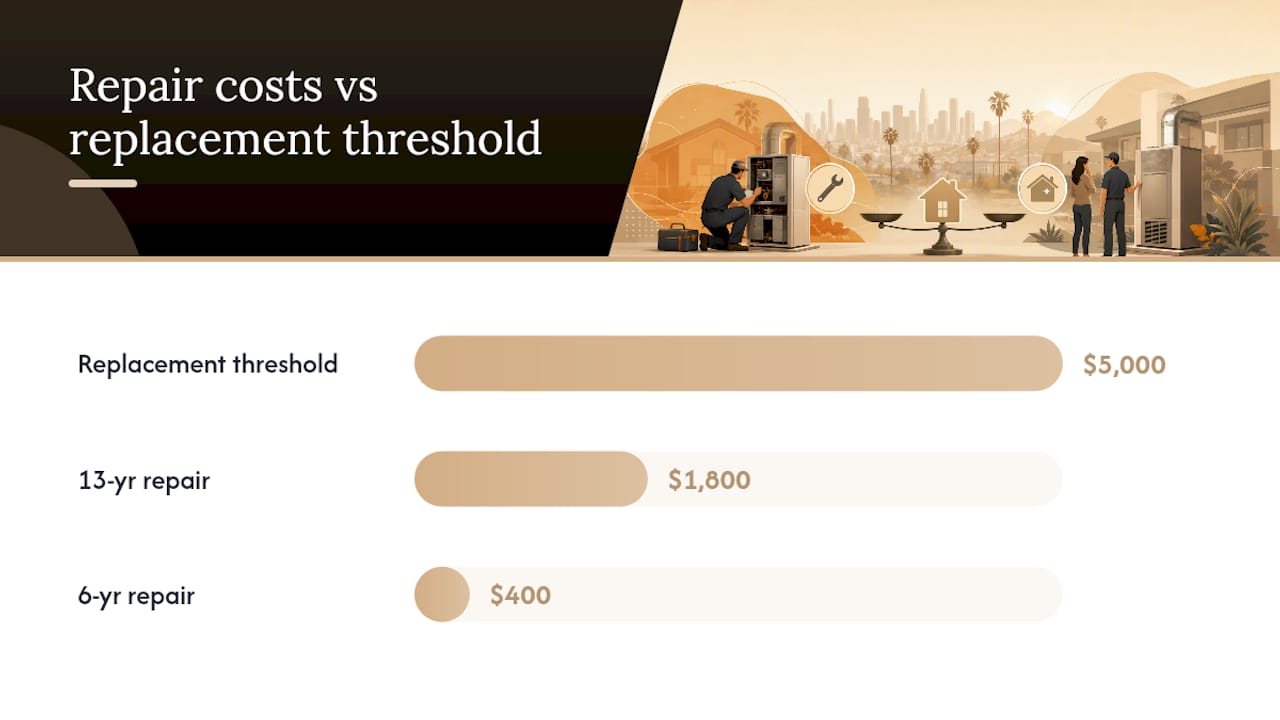
- The age times repair-cost rule. Multiply the furnace’s age by the estimated repair cost. If that number exceeds roughly $5,000, replacement usually makes more financial sense than another repair.
- The 50% rule. If a single repair costs more than half the price of a new installed furnace, most technicians recommend replacing rather than repairing.
- The safety rule. Certain failures mandate replacement outright, no math required.
That third rule matters most. A cracked heat exchanger, repeated carbon monoxide alarm events, or major structural corrosion inside the cabinet are not repair situations. Those are safety hazards, and no responsible technician should patch around them.
Here’s how the math plays out in practice: a $1,800 repair on a 13-year-old furnace, on top of two prior service calls that year, almost always favors replacement over another patch job. A $400 igniter swap on a 6-year-old unit is a straightforward repair. For a broader list of warning signs, our guide on signs your HVAC needs replacement walks through the details, and our full repair-versus-replacement framework covers the decision math step by step.
How Can You Lower the Net Cost of a New Furnace?
Financing spreads the cost, but the terms matter more than the monthly payment.
Rebates and incentives can meaningfully reduce your net cost before financing even enters the picture. ENERGY STAR notes that ENERGY STAR-qualified furnaces run about 15% more efficient than baseline models and often qualify for rebates through state energy offices or local utility programs. Check with the Los Angeles Department of Water and Power or your specific utility provider before you sign a contract, since program terms change yearly.
A few ways to bring the net cost down:
- Bundle furnace and AC replacement. Combining the two jobs often saves $500 to $1,000 in shared labor and access costs, and ensures the coil and blower are properly matched.
- Compare at least three furnace replacement quotes. Ask each contractor for the exact equipment model number, AFUE rating, warranty terms, and a line-item permit fee breakdown.
- Calculate a real payback period. Jumping from 80% to 96% AFUE on a $600 annual gas bill saves roughly $100 a year, which means the efficiency premium pays for itself over time depending on the specific cost difference.
If you’re already planning an AC swap, our Los Angeles AC replacement cost guide shows what to expect on that side of a bundled job.
An Owner’s Take on Getting a Fair Furnace Quote
I’ve been doing this in the Los Angeles market for over 15 years, and the biggest surprise for most homeowners isn’t the sticker price. It’s the ductwork. A furnace can be perfectly sized on paper and still underperform because the return air path or trunk line is undersized for the space, and that’s something you can’t catch from a phone quote.
We diagnose that on-site, every time, before we ever write a number down. Our installed quotes include the equipment, permit fees, disposal, and standard venting up front, with any duct repairs or electrical work itemized separately so you know exactly what you’re paying for and why. Older homes in neighborhoods like Burbank and Beverly Hills often have condensate routing quirks from decades of remodels, and that’s usually where a generic online estimate falls apart.
If you’re ready for an accurate number, have your furnace’s age, any recent repair invoices, and a few photos of the mechanical closet or attic access ready. It cuts the diagnostic time in half and gets you a real quote faster.
— Ernie M
Get an Accurate Furnace Replacement Quote in Los Angeles
Online calculators give you a range. What you actually need is a technician standing in your mechanical closet who can tell you why your last furnace died and what it’ll take to avoid the same problem twice. Upright Construction & HVAC is the direct alternative to guessing off a national average: we send licensed technicians who diagnose the ductwork, venting, and electrical situation on-site, then hand you a line-item quote instead of a rough estimate.

We’ve handled furnace replacements across Los Angeles, Burbank, and Beverly Hills long enough to know which neighborhoods tend to have duct sizing issues and which permit offices move fast versus slow. That local knowledge means fewer surprises mid-install and a quote that actually holds up once the walls are open. We also handle AC replacement, so if you’re bundling both systems to save on shared labor, one crew can do the whole job in a single visit.
If your furnace is showing its age or a recent repair bill has you wondering whether it’s worth it, book a visit through our HVAC repair and replacement page and get a real number instead of a guess.
Sources
- Furnace Replacement Cost Calculator: 2026 Gas, Oil & AC | Tallyard
- How Much Does a New Furnace Cost? (2026)
- Top 8 Furnace Replacement Cost Factors – Trane®
- Replace | ENERGY STAR
- Furnace Repair vs Replacement: How to Make the Call | Eco
FAQ
How much does it cost to replace a furnace for a 2,000 sq ft house?
Most 2,000 square foot homes need a furnace in the 60,000 to 100,000 BTU range, which typically installs for $4,500 to $8,000 for a gas unit, depending on efficiency tier and ductwork condition.
Should a 25-year-old furnace be replaced?
Yes. A furnace that old is well past the typical 15 to 20 year lifespan, and continuing to repair it usually costs more over time than replacing it, especially if any safety issues like a cracked heat exchanger show up.
Are furnace prices going up in 2026?
Equipment and labor costs have trended upward in recent years due to material and wage increases, which is part of why getting multiple current quotes matters more than relying on outdated price guides.
What is the most expensive part of a furnace to replace?
The heat exchanger is typically the most expensive component to repair or replace, and a cracked one is a safety failure that usually means replacing the whole furnace rather than just that part.