
- The 3-minute checklist you can safely run through
- Common causes and how to diagnose each one
- Safe homeowner maintenance you can try with the power off
- When to call a licensed HVAC technician
- Preventive maintenance to keep the fan running
- From Ernie M: field notes on condenser fan failures
- My honest take on fan troubleshooting advice
- How Upright Construction & HVAC helps when the fan won’t spin
- Authoritative resources on refrigerant rules and diagnostics
- Sources
- FAQ
If your condenser fan isn’t spinning, first confirm power and thermostat settings. If those check out, a failed run capacitor is the most common culprit, and that’s your cue to stop before touching any electrical components. Most cases trace back to one of a few simple causes, but a few are safety risks you shouldn’t handle alone.
TL;DR:
- A faulty run capacitor, often indicated by a humming sound and a bulged top, is the primary cause of an outdoor fan that won’t start.
- Homeowners can safely perform quick checks such as inspecting power, clearing debris, and manually spinning the blade with the power off.
- Electrical faults, burning smells, or repeated breaker trips should prompt immediate professional inspection to prevent compressor damage.
- Regular maintenance, including cleaning coils and inspecting electrical connections, can prevent most fan failures before they become emergencies.
- Replacing a failed capacitor or motor requires a licensed technician due to stored electrical charge and precise testing procedures.
The 3-minute checklist you can safely run through
Before assuming the worst, rule out the easy stuff. These checks take a few minutes and carry no electrical risk.
- Confirm the thermostat is set to “cool,” with the fan on auto or on, and the temperature set well below room temperature.
- Check your indoor electrical panel for a tripped breaker and inspect any fuses tied to the outdoor unit.
- Walk out to the condenser and look, without touching anything, for leaves, grass clippings, bent fins, or branches blocking the fan.
- If the breaker keeps tripping or you smell burning, shut off power at the outdoor disconnect and stop there.
Once you’ve confirmed power is reaching the unit and nothing is obviously jammed, the problem is likely inside the cabinet, and that’s where things get more technical.
Common causes and how to diagnose each one
A few components fail more often than others, and each leaves its own clues.
- Run capacitor: a humming sound from the unit with the fan not moving, or a top that looks bulged or domed instead of flat, usually points to a failed capacitor, the single most common reason an outdoor fan won’t start.
- Fan motor: with power fully disconnected, try spinning the blade by hand; if it feels stiff, gritty, or frozen, the bearings have likely seized and the motor needs replacing.
- Contactor or wiring: a burning smell, a buzzing contactor, or a system that runs intermittently points toward an electrical fault rather than a mechanical one.
- Debris and dirty coils: caked dirt or clipped grass on the coil fins restricts airflow and can cause the evaporator coil to freeze, which then masks the real problem.
Checking a capacitor’s actual output under load uses a formula of 2650 times amps divided by volts to confirm its microfarad rating, a method ACCA’s diagnostic guidance describes as an advanced test best left to trained technicians, since it requires live electrical readings.
Whatever the cause, a condenser fan that won’t spin stops the system from rejecting heat properly. The compressor keeps running while the coil can’t cool down, and that mismatch drives up head pressure and can shorten the compressor’s life if it continues for more than a short time.
Safe homeowner maintenance you can try with the power off
A handful of tasks are genuinely safe for a homeowner, as long as the unit is fully powered down first.
- Shut off power at the outdoor disconnect box, then confirm the breaker is also off before touching anything.
- Gently brush or hose off the condenser fins from the outside in, avoiding high pressure that can bend them.
- With the blade exposed and power confirmed off, spin it by hand to check for stiffness or a wobble that suggests a loose connection to the motor shaft.
- Clear any visible debris from around the base and top grille.
Pro Tip: A fan blade that spins freely but won’t start on its own almost always points to the capacitor, not the motor, which is useful information to share with a technician before they arrive.
What’s off limits: opening the electrical compartment, testing or replacing a capacitor, or touching motor wiring. These involve stored electrical charge and live voltage, and Building America’s guidance on fault diagnosis notes that these major components typically require a professional for safe, accurate repair.
When to call a licensed HVAC technician
Some situations are worth handling yourself. Others aren’t, and pushing past that line risks injury or a bigger repair bill.
- Any burning smell, scorch marks, or a breaker that trips repeatedly means an electrical fault that needs a licensed technician.
- A capacitor or motor replacement involves stored charge and precise electrical testing, not a weekend project.
- Suspected refrigerant issues fall under EPA Section 608 rules, which prohibit intentionally venting refrigerant and require a certified technician for any refrigerant-related work.
- A compressor that’s been running without proper cooling for an extended period needs evaluation before it’s damaged further.
A technician will typically check the sequence of operation, measure amp draw at the motor, test the capacitor under load, inspect the contactor, and confirm the motor shaft turns freely before settling on a repair. Diagnosis usually happens in a single visit, while parts like a motor may take longer to source.
Preventive maintenance to keep the fan running
A little seasonal attention goes a long way toward avoiding a repeat failure.
- Clean the condenser coil and clear debris from around the unit at the start of each cooling season.
- Replace or clean your air filter on a regular schedule to keep airflow steady across the whole system.
- Have capacitors and electrical connections inspected during an annual tune-up, since early wear rarely shows obvious symptoms until it fails outright.
- Keep at least two feet of clearance around the outdoor unit so airflow isn’t restricted by plants or stored items.
Consistent airflow and clean coils protect the compressor from the extra strain that a struggling fan creates, which is the expensive part of the system to replace. A maintenance plan that includes these checks twice a year catches most of this before it becomes an emergency call.
From Ernie M: field notes on condenser fan failures
In our service calls, bad capacitors and debris-choked coils account for most no-spin fan complaints, especially during the first real heat wave of the season. When we get the call, the priority is always to stop further strain on the compressor, then diagnose. Fifteen-plus years of emergency HVAC calls across Los Angeles has shown us that fast, honest diagnosis beats guesswork every time.
Most of the panic calls we get turn out to be a fifteen-dollar capacitor, not a dead system, but you won’t know which one you have until someone checks it safely.
— Ernie M
My honest take on fan troubleshooting advice
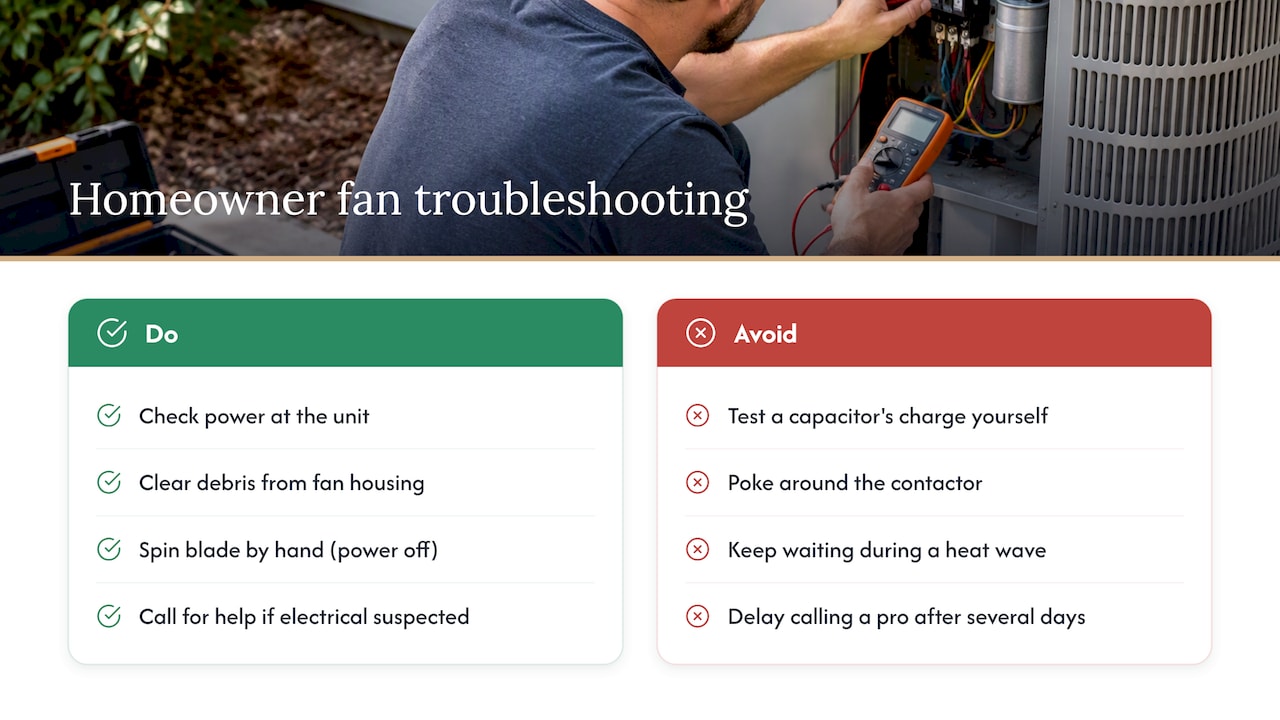
Most online guides oversell how much a homeowner should attempt. Checking power, clearing debris, and spinning the blade by hand with the power off is genuinely useful and low risk. Testing a capacitor’s charge or poking around a contactor is where good intentions turn into a burn or a bigger bill, regardless of how confident a video tutorial makes it look.
The part homeowners underestimate is time. A fan that won’t spin for a day in mild weather is an inconvenience. The same fault during a heat wave, with the compressor running flat out against a hot coil, is how a fifteen-dollar capacitor problem turns into a compressor replacement. Prioritize the safe checks first, then call for help the moment you suspect anything electrical, not after a few more days of a hot house.
How Upright Construction & HVAC helps when the fan won’t spin
We offer emergency HVAC repair with licensed technicians, transparent pricing, and 24/7 response when a condenser fan failure can’t wait. 
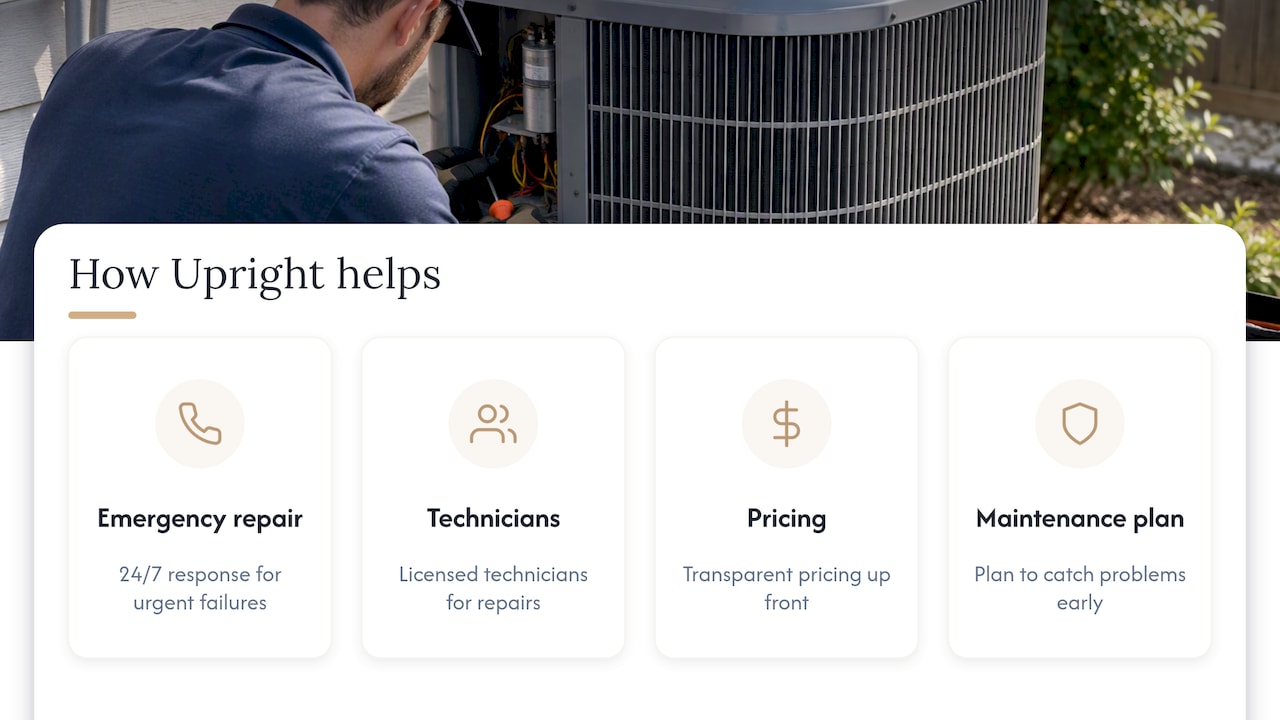
Call us for a fast diagnosis, or ask about a maintenance plan to catch problems before they strand you without cooling.
Authoritative resources on refrigerant rules and diagnostics
- EPA Section 608 covers refrigerant handling rules and technician certification requirements.
- DOE Building America guidance details AC fault diagnosis and efficiency impacts.
- For a homeowner’s quick-check perspective, see this AC fan checklist from a fellow HVAC provider.
Sources
- Section 608 — HVAC technician certification and refrigerant handling | US EPA
- Air-Conditioning Diagnostics and Fault Detection — DOE / Building America
- Matt, what are the common signs of a capacitor failing, and how does this affect system performance? | ACCA HVAC Blog
FAQ
Will an AC system work without a condenser fan?
No, not for long. Without the fan moving air across the condenser coil, the system can’t release heat properly, and the compressor will overheat and can suffer permanent damage if it keeps running.
Should a condenser fan spin freely when off?
Yes, with the power fully disconnected, the blade should turn smoothly by hand with little resistance. Stiffness, grinding, or a complete lock suggests worn motor bearings that need replacement.
How do I reset an air conditioner’s fan motor?
There’s no standard “reset” for a condenser fan motor itself; most fixes involve the breaker, thermostat, or a failed component like the capacitor. If flipping the breaker off and back on doesn’t restore spinning, the issue is mechanical or electrical and needs diagnosis.
What are the signs a condenser fan motor is failing?
Common signs include a fan that hums but doesn’t start, blades that feel stiff or gritty when spun by hand with power off, or a burning smell from the unit. A bulging capacitor often accompanies or causes these symptoms, since it’s the more frequent root cause.