
- What Does Ductwork Replacement Cost Per Foot?
- How Home Size Affects Your Total Ductwork Cost
- What Factors Push Ductwork Replacement Cost Higher?
- Should You Seal Your Ducts Instead of Replacing Them?
- How Long Does Ductwork Replacement Take, and What Else Adds to the Bill?
- How Do You Get an Accurate Ductwork Installation Estimate?
- A Los Angeles Contractor’s View on Ductwork Costs
- What to Do Next and How to Budget for Surprises
- A Note From Ernie
- How Upright Construction & HVAC Handles Your Duct Project
- Where to Verify These Numbers Yourself
- Sources
- FAQ
- Recommended
Most homeowners spend between $1,400 and $7,000 for a full ductwork replacement, with the national average landing near $3,500. Per-foot pricing runs roughly $7 to $62 depending on material, and a typical 2,000-square-foot home usually falls somewhere between $2,500 and $6,700 once labor, access, and material choices are factored in. Larger homes or ones with tight attics and crawlspaces can push past $10,000.
TL;DR:
- Larger homes with complex access conditions, such as tight crawlspaces or high labor costs, can push duct replacement expenses well above $10,000.
- Rigid sheet metal ducts, though more costly upfront, can last over 25 years, while flexible ducts typically require attention within 15 to 20 years.
- Sealing leaks with mastic or Aeroseal offers a cost-effective alternative for sound ductwork, potentially saving thousands compared to full replacement.
- Accurate bids should include detailed load calculations, linear-foot material costs, labor hours, sealing methods, and permit fees to avoid surprises.
- Homeowners should budget a 15% to 20% contingency for unexpected issues like asbestos, drywall repair, or permit delays when planning ductwork upgrades.
What Does Ductwork Replacement Cost Per Foot?
Contractors price most duct jobs by the linear foot, not by a flat number, because the length and material you need swings the total more than almost anything else. Understanding that math lets you sanity check any bid that lands in your inbox.
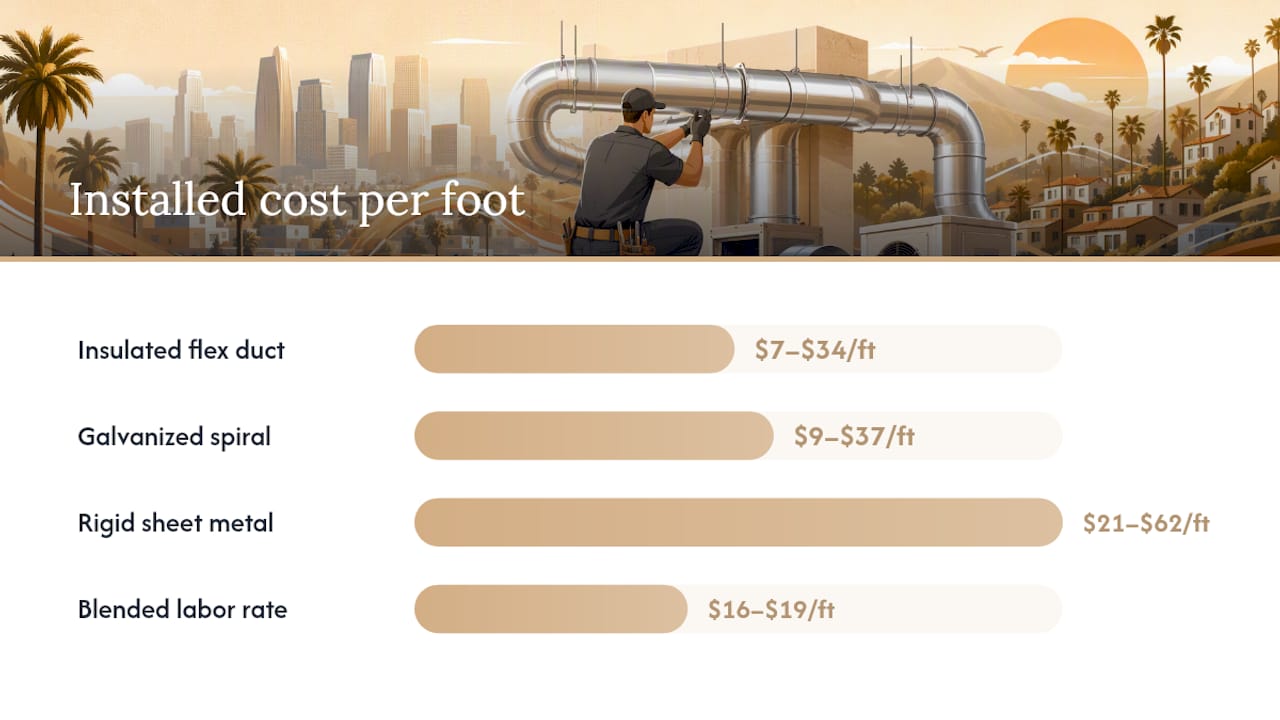
Insulated flex duct runs about $7 to $34 per installed foot, galvanized spiral duct runs $9 to $37, and rigid sheet metal, the priciest and longest-lasting option, runs $21 to $62. Duct board falls in a similar range to flex, but handles heat and moisture less gracefully over time. This Old House reports many real-world jobs averaging $16 to $19 per foot once labor is blended in, which is a useful middle number when you don’t yet know your material preference.
Labor typically eats 40% to 60% of the total bill, with crews billing $80 to $150 an hour depending on your market. Los Angeles tends to sit at the higher end of that range because of labor costs and permit complexity.
Here’s how the math plays out at different footages, using a blended $16 to $19 per foot rate:
| Linear Feet | Estimated Total Cost |
|---|---|
| 100 ft | $1,600 to $2,900 |
| 200 ft | $3,100 to $5,700 |
| 300 ft | $3,100 to $5,700 |
A few things that shift these numbers in either direction include higher costs for sheet metal trunk lines due to durability, more expensive labor for tight access points, and potential additional testing in older homes with asbestos-wrapped ducts.
How Home Size Affects Your Total Ductwork Cost
Square footage is the first number any contractor asks for, and for good reason. It determines how much duct you need and roughly what your final bid should look like.
A 1,000 to 1,500-square-foot home typically needs 100 to 150 linear feet of ductwork, landing most projects between $1,600 and $2,900. A 2,000 to 2,500-square-foot home, the most common size in Los Angeles suburbs, usually needs 200 to 300 feet, putting the total around $3,100 to $5,700. Homes above 3,500 square feet, especially two-story layouts, can require 400 feet or more and often cross the $7,000 mark.
Scope matters just as much as size. A few distinctions worth knowing:
- Spot repair or single-run replacement: fixing one damaged branch line, usually $300 to $1,500.
- Partial replacement: swapping out the worst sections while keeping sound ductwork in place, often 30% to 50% of a full-system cost.
- Full-system replacement: tearing out and replacing every trunk and branch line, the scenario behind most of the ranges above.
Zoned systems, extra return runs, or a house with two separate HVAC systems can increase costs substantially because of the added complexity and work involved.
What Factors Push Ductwork Replacement Cost Higher?
Two houses of identical size can get wildly different quotes, and access is usually the reason. Working in an open, walkable attic is fast. Snaking new ductwork through a two-foot crawlspace, a finished ceiling, or an in-wall chase is slow, physical work, and slow work costs more.
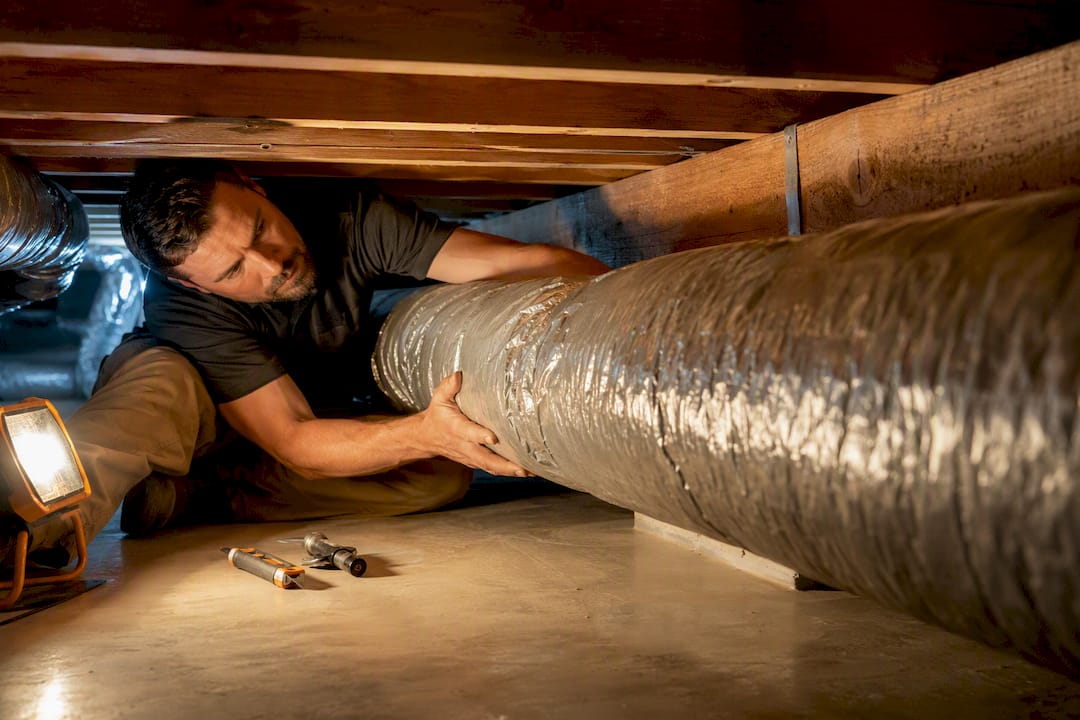
Material choice matters too, though it’s a trade-off rather than a simple upgrade path. Flex duct is cheap and quick to install but tends to sag, kink, and lose efficiency faster, often needing attention within 15 to 20 years. Rigid sheet metal costs more upfront but can last 25 years or longer with proper sealing.
Then there are the costs nobody budgets for until a contractor finds them mid-job:
- Asbestos testing and abatement on ducts installed before the 1980s
- Mold remediation if there’s been moisture intrusion in the system
- Drywall or ceiling patching after removing old ductwork
- Disposal fees for hauling out old metal and insulation
Regional labor rates, permit requirements, and seasonal demand (summer and early fall are peak season for HVAC crews in Southern California) all nudge pricing too.
Pro Tip: Get your asbestos test done before you request bids, not after. A contractor who has to stop mid-quote to schedule testing will pad the estimate to cover the unknown. One that already has the results can price precisely.
Should You Seal Your Ducts Instead of Replacing Them?
Not every leaky duct system needs to come out. The Department of Energy estimates that typical ductwork loses 20% to 30% of the conditioned air moving through it, and a good chunk of that leakage is fixable without ripping anything out.
Manual sealing with mastic or UL-181 foil tape runs $350 to $1,000 and handles accessible leaks at joints and connections. Aeroseal, an internal sealing process that coats the inside of the ductwork, runs $1,500 to $4,000 and reaches leaks you can’t physically get to. Isolated spot repairs land at $300 to $1,500.
Replacement becomes the only real answer when you’re dealing with:
- Structural damage or crushed, collapsed sections
- Mold or contamination inside the duct material itself
- Confirmed asbestos in older ductwork
- Ducts that were undersized from the original install and can’t handle your system’s airflow
If your ducts are sound but leaky, sealing is frequently the more cost-effective option for improving comfort, and upgrading components like new interior doors can improve energy efficiency in older homes.
How Long Does Ductwork Replacement Take, and What Else Adds to the Bill?
A single-run repair or spot sealing job usually wraps in a day. Full-system replacement in an average home takes 2 to 4 days from demo to final connection, longer if the crew hits surprises behind walls or in the attic.
Budget for these commonly missed line items:
- Permit fees: typically $50 to $500 depending on your city and project scope, and required for most full-system replacements in Los Angeles County.
- Asbestos abatement: $1,500 to $4,500 if testing comes back positive on older duct insulation or wrap.
- Drywall or ceiling repair: $1,000 to $4,000 when ducts run through finished spaces that need to be opened and patched.
- Disposal and haul-away: often bundled into labor, but confirm it’s included before signing anything.
Inspections add a day or two to the timeline but they’re not optional. Skipping them to save time is how homeowners end up with failed final inspections and rework bills later.
How Do You Get an Accurate Ductwork Installation Estimate?
The single biggest mistake homeowners make is accepting a quote that’s just a number with no breakdown behind it. A real estimate should show you exactly what you’re paying for.
Ask every contractor for:
- Manual J and Manual D calculations, not a guess based on square footage alone. ASHRAE treats proper sizing as foundational, and skipping Manual D on a trunk-and-branch system can cause high static pressure that shortens equipment life.
- Linear-foot pricing, broken out by material, so you can compare bids apples to apples.
- Labor hours and crew size, which tells you how the contractor arrived at the labor portion of the bid.
- Insulation R-value specs and sealing method (mastic or UL-181, never cloth duct tape, which fails within a few years).
- Permit handling spelled out as included or separate.
Watch for red flags: no load calculation anywhere in the paperwork, vague language like “we’ll price it once we’re on site,” or a bid that’s suspiciously lower than two others with no explanation.
Pro Tip: Get three written bids before you sign anything. If one comes in dramatically lower than the other two, ask specifically what material and sealing method it assumes. That’s usually where the corners get cut.
A Los Angeles Contractor’s View on Ductwork Costs
Fifteen-plus years of pulling permits and crawling through Los Angeles attics has taught me that the biggest cost driver isn’t material. It’s the house itself. Older homes in neighborhoods like Van Nuys or Burbank often have ducts tucked into tight crawlspaces or original 1950s chases that were never meant to be reopened, and that access problem shows up in every bid you get.
When a reputable contractor quotes a duct replacement, the estimate should include the load calculation, linear-foot pricing, permit handling, and financing options up front. Homeowners shouldn’t have to guess what a number covers.
We also factor in Title 24 compliance and local inspection requirements from the start, so there’s no surprise fee halfway through the job. For homeowners dealing with a failed system in the middle of a heat wave, we treat that differently than a planned upgrade and prioritize getting air moving safely first.
What to Do Next and How to Budget for Surprises
If your ducts are structurally sound but leaky, seal them first. If they’re damaged, undersized, or contaminated, replacement is the right call and worth budgeting for properly rather than patching around the problem.
Three steps to take this week:
- Schedule a visual inspection or leakage estimate to find out which category you’re in.
- Request three written bids that each include linear-foot pricing and a load calculation.
- Build in a contingency of 15% to 20% above your lowest bid to cover permit fees, drywall repair, or an asbestos test that comes back positive.
That cushion is the difference between a project that stays on budget and one that blows past it the moment a crew opens up your attic.
A Note From Ernie
I’ve built this business on quotes homeowners can actually understand. No vague line items, no pressure to sign before you’ve compared bids. If your project involves asbestos, mold, or anything structural, hire a licensed professional for that piece specifically. It’s not worth the risk to your family or your home to cut that corner.
— Ernie M
How Upright Construction & HVAC Handles Your Duct Project
Upright Construction & HVAC is the local alternative to guessing your way through a duct project with a stranger’s lowball bid. We handle duct replacement, sealing, load calculations, permit coordination, and drywall touch-up under one roof, so you’re not chasing three different contractors to get one job done right.

Every professional quote should include itemized linear-foot pricing, a clear permit and inspection timeline, and financing options for bigger projects. If your ducts are original to a home built before the 1980s, or you’re just not sure whether you need sealing or a full replacement, our team can walk your attic and give you a straight answer instead of an upsell. If your system is acting up right now, our HVAC repair team in Los Angeles offers same-day service so you’re not stuck without air while you plan the bigger fix. Reach out to get a written estimate started this week.
Where to Verify These Numbers Yourself
For deeper background on air quality and duct performance, the EPA’s guidance on duct cleaning and indoor air and ENERGY STAR’s sealing and insulating program are both solid starting points, and the latter also lists rebate programs worth checking before you commit to a project. For contractor vetting, look for NATE certification and ACCA-trained technicians, which signal proper Manual J and Manual D practices rather than guesswork.
Sources
- Air Duct Replacement Cost in 2026: By Foot, By Home Size, and When to Seal Instead | Home Energy Decisions
- Should you have air ducts in your home cleaned? | EPA
- How Much Does Air Duct Replacement Cost? (2026 Pricing) | This Old House
- Seal and Insulate | ENERGY STAR
FAQ
How much does it cost to replace ductwork in a 2,000-square-foot house?
Most 2,000-square-foot homes need 200 to 300 linear feet of ductwork, putting the total between roughly $3,100 and $5,700 depending on material and access.
Should I replace 20-year-old ductwork?
Not automatically. If it’s flex duct nearing the end of its 15 to 20 year lifespan and showing sagging or leaks, replacement makes sense; if it’s sheet metal in good shape, sealing may be all you need.
Is it expensive to replace ductwork?
A full replacement typically runs $1,400 to $7,000, with harder-access or larger homes reaching $10,000 to $20,000, but sealing alternatives starting around $350 often solve the same comfort problems for far less.