
- What Does a Bathroom Remodel Cost? Quick Numbers
- What Drives Bathroom Remodel Cost the Most?
- How Much Does a Bathroom Remodel Cost by Size?
- What Do Individual Line Items Cost?
- Does Bathroom Remodel Cost Vary by City?
- How Should You Budget for a Bathroom Remodel?
- Which Bathroom Upgrades Actually Pay Off at Resale?
- How Long Does a Bathroom Remodel Take?
- What Should You Ask a Contractor Before Signing?
- What Does a Bathroom Remodel Look Like With Upright Construction & HVAC?
- Ernie’s Take: What Actually Matters Before You Sign
- Get a Straight Answer on Your Bathroom Remodel Cost
- Sources
- FAQ
- Recommended
A full bathroom remodel in Los Angeles runs about $16,500 on average in 2026, with most homeowners landing somewhere between $8,000 and $45,000 depending on size and finish level. A small cosmetic refresh can come in under $10,000, while a gut renovation with layout changes and high-end materials easily climbs past $50,000. Size, plumbing changes, and material quality are what move the number most.
TL;DR:
- Moving plumbing fixtures or making layout changes can add between $2,000 and $5,000 per fixture, significantly increasing overall costs.
- Small bathrooms often cost more per square foot than larger ones because fixed costs like demolition, permits, and setup are spread over fewer square feet.
- A typical bathroom remodel in Los Angeles ranges from $15,000 to $45,000, with labor, materials, and permit costs accounting for the majority of the budget.
- A contingency fund of 10% to 15% is essential to cover hidden problems like water damage, mold, or outdated plumbing discovered during demo.
- For resale, midrange upgrades with updated tile and fixtures offer a higher return than luxury finishes or custom elements.
What Does a Bathroom Remodel Cost? Quick Numbers
Before you call a contractor, it helps to know which tier your project falls into. Bathroom remodel cost breaks into four rough categories: cosmetic refresh, midrange, high-end, and luxury. Midrange projects, which cover most homeowners, typically run $15,000 to $30,000, with per-square-foot pricing landing between $120 and $280. Budget-conscious refreshes can start near $80 per square foot, and true luxury builds with imported stone or custom millwork can push past $400 per square foot.
That table uses a standard 5×8 (40 square foot) bathroom as the reference point, which is the most common size in Los Angeles single-family homes and condos.
Here’s what different budgets actually buy you:
- $10,000: New vanity, updated toilet, retiled floor, fresh paint, and upgraded lighting. No plumbing relocation.
- $25,000: Full midrange remodel. New tub-to-shower conversion, tile surround, quality fixtures, and a heated floor option.
- $50,000: Layout changes, moved plumbing, custom tile work, glass shower enclosure, and higher-end vanity and countertop materials.
The jump between tiers isn’t just about nicer tile. It’s about how much of the room you’re touching versus rebuilding from the studs out.
What Drives Bathroom Remodel Cost the Most?
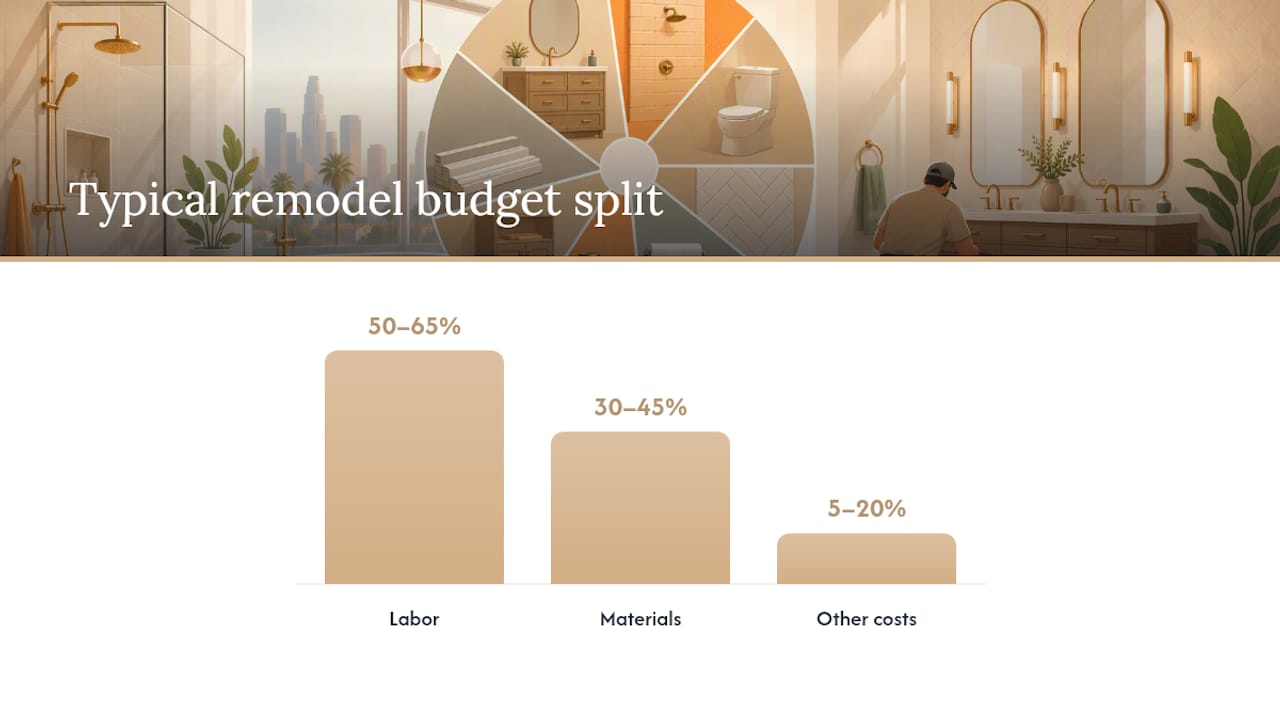
Labor eats the biggest slice of most budgets. On a typical midrange remodel, labor runs 50% to 65% of the total, materials account for 30% to 45%, and the rest covers permits, disposal, and general contractor markup. The higher the finish level, the more that split shifts toward materials, since premium tile and stone fabrication cost far more than the labor to install cheaper alternatives.
Layout changes are the single biggest lever homeowners underestimate. Keeping your toilet, sink, and shower in their existing footprints keeps plumbing costs contained. Move one fixture and you’re adding real money.
Statistic to remember: Relocating a single toilet or sink commonly adds $2,000 to $5,000 in plumbing costs alone, and a full layout change involving multiple fixtures often adds $5,000 or more before you’ve bought a single tile.
Other cost drivers worth budgeting for:
- Permits and inspections, required for most plumbing and electrical work in Los Angeles County
- Demolition and disposal, which scales with how much of the room gets gutted
- General contractor markup, usually built into the bid rather than itemized separately
- A contingency fund of 10% to 15% for the surprises nobody can quote in advance
Hidden costs are where budgets blow up. Older Los Angeles homes, especially anything built before the 1970s, often hide problems behind the walls. Subfloor repair runs $3.75 to $7 per square foot, joist sistering costs $300 to $1,500 per joist, mold remediation ranges from $500 to $6,000, and swapping out old galvanized or cast iron plumbing typically adds $1,500 to $4,000.
Pro Tip: Ask your contractor to include a moisture inspection before demo starts, not after. Finding water damage on day one changes your budget conversation. Finding it on day five changes your timeline, too.
How Much Does a Bathroom Remodel Cost by Size?
Bathroom size and type change the math more than most homeowners expect. A powder room, guest bath, and primary suite each carry a different cost profile even at the same finish level.
- Powder room (under 20 sq ft): $4,000–$12,000. No shower or tub means lower total dollars, but fixed costs still apply.
- Guest bath (5×8, roughly 40 sq ft): $8,000–$25,000 depending on tier, covering tub or shower, vanity, and toilet.
- Primary bathroom (80+ sq ft): $20,000–$60,000+, often including a walk-in shower, double vanity, and sometimes a soaking tub.
Per-square-foot pricing looks like this across tiers: budget work runs roughly $80 to $150 per square foot, midrange $120 to $280, and high-end $280 to $400 or more.
Here’s the part that surprises people: small bathrooms often cost more per square foot than large ones. Demolition, waterproofing, permit fees, and contractor setup time don’t shrink just because the room is small. Spreading those fixed costs across fewer square feet drives the per-foot number up, which is part of why a tiny powder room remodel can feel disproportionately expensive compared to a primary bath overhaul on paper.
What Do Individual Line Items Cost?
Reading a contractor’s itemized bid gets a lot easier once you know what each line should roughly cost. Here’s a breakdown of common line items in a typical Los Angeles remodel:
| Line item | Typical range |
|---|---|
| Demolition | $1,500–$4,000 |
| Plumbing rough-in (no relocation) | $500–$1,500 |
| Moving a toilet or sink | $2,000–$5,000 |
| Tile labor (per sq ft) | $10–$25 |
| Shower pan | $500–$1,500 |
| Glass shower door | $300–$1,500 |
| Vanity (stock to semi-custom) | $500–$4,000 |
| Countertop (laminate to quartz) | $300–$2,000 |
| Fixtures (faucet, showerhead, toilet) | $500–$1,500 |
| Electrical updates | $500–$2,000 |
| Heated floors | $300–$1,500 |
Tile labor and vanity work tend to be where costs swing hardest, since tile, shower, vanity, flooring, and lighting represent roughly 62% of a typical remodel budget and offer the strongest return when done well. Some line items lean heavily on labor (tile installation, plumbing rough-in), while others are material-driven (countertops, fixtures, glass). Knowing which is which helps you spot where a contractor’s bid has room to flex.
Big swings usually come from a handful of choices: custom cabinetry instead of stock vanities, natural stone instead of porcelain tile, and steam shower systems instead of a standard enclosure. Any one of these can add $3,000 to $10,000 to an otherwise midrange project. If you’re weighing tile and vanity upgrades, our vanity and tile work team can walk you through where the money actually shows up in the finished room, and our shower and tub installation crew handles everything from a standard pan swap to a full glass enclosure build.
Does Bathroom Remodel Cost Vary by City?
Yes, significantly. National guides tracking 152 metros show full bathroom remodels ranging from $8,101 to $57,186, with a national median near $21,794. San Francisco and San Jose sit among the highest-cost metros in the country, driven by labor rates, permit friction, and material logistics.
Los Angeles tracks close to the higher end of that national range, though typically below San Francisco pricing. Labor costs, stricter permit requirements, and the sheer density of construction demand across the metro all push prices up compared to smaller markets.
If you want a real number instead of a national estimate, two things help:
- Check your city or county permit office for current plumbing and electrical permit fees, which vary by jurisdiction even within Los Angeles County.
- Get quotes from at least two local contractors who quote current trade labor rates rather than pulling from a national average calculator.
A national average is a starting point, not a quote. Your actual cost depends on what’s happening in your specific zip code right now.
How Should You Budget for a Bathroom Remodel?
A few rules of thumb make budgeting far less stressful than staring at a blank number.
- Cap primary bathroom spend at 3% to 5% of your home’s value. A $700,000 Los Angeles home suggests a primary bath budget of roughly $21,000 to $35,000 before you risk over-improving for the neighborhood — a concept explained more in our Home Valuation resource.
- Set aside 10% to 15% for contingency. This isn’t optional padding. It’s the fund that absorbs the subfloor repair or old plumbing swap nobody could see before demo.
- Match your scope to your budget tier honestly. A $10,000 project should mean cosmetic updates, not a full layout change. Trying to stretch a small budget across a gut renovation is how projects stall halfway through.
Here’s what that looks like in practice:
- $5,000: Paint, new fixtures, toilet swap, and minor tile repair. No new tub or shower.
- $10,000: New vanity, retiled floor, updated lighting, and a toilet replacement, all within the existing layout.
- $25,000: Full midrange remodel with a new tub-to-shower conversion, tile surround, and quality fixtures throughout.
- $50,000: Layout changes, moved plumbing, custom tile, and a glass enclosure, the kind of project that touches nearly every surface in the room.
For projects above $15,000, financing is worth exploring rather than draining savings outright. Home equity lines of credit, personal loans, and contractor-offered financing plans are the three most common paths homeowners use, and larger projects should also budget for permit costs, which in Los Angeles typically run a few hundred dollars depending on the scope of plumbing and electrical work involved.
Pro Tip: Before you set a final number, walk your neighborhood. If most homes nearby have midrange bathrooms, a luxury remodel in your house won’t return dollar for dollar at resale, even if it feels great to live with.
Which Bathroom Upgrades Actually Pay Off at Resale?
Midrange remodels consistently outperform luxury remodels on a percentage basis. Data from Zillow shows midrange bathroom remodels return the highest percentage of cost in every U.S. region, even though ROI varies by how much regions differ in home values.
The number that matters here: midrange bathroom remodels recoup roughly 71% to 80% of their cost at resale, and universal-design refreshes, which add features like grab bars and curbless showers, can recoup around 78%, making them one of the strongest returns of any home improvement category.
Upscale, luxury-tier remodels tell a different story. They return a lower percentage of cost even though the absolute dollar recovery can be higher on an expensive home. Spending $60,000 on a primary bath in a neighborhood full of $400,000 homes is a classic over-improvement mistake.
The upgrades that protect resale value most reliably:
- Updated tile work, especially in the shower and on the floor
- A modern vanity with updated countertop
- Updated lighting fixtures
- A refreshed shower or tub surround
Lower-ROI splurges include freestanding soaking tubs, which look great in photos but rarely justify their cost at resale, and ultra-custom finishes that only appeal to a narrow buyer taste. Zillow also found that 29% of sellers make some bathroom improvement before listing, which tells you resale-focused remodeling is common practice, not a fringe strategy. Pacific region homes tend to see above-average ROI on midrange work compared to the national picture, which is good news if you’re remodeling in the Los Angeles market with resale in mind.
How Long Does a Bathroom Remodel Take?
Timeline depends almost entirely on scope. Here’s what to expect:
- Cosmetic refresh (1 to 2 weeks): Paint, fixtures, and minor tile work with no plumbing changes.
- Midrange remodel (3 to 6 weeks): New tub-to-shower conversion, tile surround, and vanity replacement within the existing layout.
- Full layout change (6 or more weeks): Moved plumbing, structural adjustments, and custom tile or cabinetry work.
Permitting and inspections add time on top of construction, and condo or co-op buildings often require separate HOA or building approval before work can even start. Ordering long-lead materials, like custom tile or a specific vanity, before demo begins is one of the simplest ways to avoid a stalled project sitting half-finished for weeks.
What Should You Ask a Contractor Before Signing?
A good bid answers questions before you have to ask them. A vague one is a warning sign.
Before signing anything, confirm the contractor is licensed and insured, ask for a clear payment schedule tied to project milestones rather than a large upfront deposit, and get written warranties on both labor and materials. Ask specifically how change orders are handled, since that’s where budgets quietly balloon mid-project.
Red flags worth walking away from:
- Vague scope language like “bathroom update” with no line-item breakdown
- Requests for more than 10% to 30% upfront before any work begins
- No itemized materials list or allowance figures
- Slow or inconsistent communication before you’ve even signed
When comparing multiple bids, make sure each contractor quoted the exact same scope and the same material allowances. A bid that looks cheaper often just excludes something another contractor included, and you won’t know until change orders start piling up. Our guide on contractor red flags covers more of the warning signs worth watching for across any home project, not just bathrooms.
Pro Tip: Ask every contractor for the same three numbers: total cost, payment schedule, and what happens if hidden damage is found. If one dodges any of the three, that’s your answer.
What Does a Bathroom Remodel Look Like With Upright Construction & HVAC?
Upright Construction & HVAC has spent over 15 years handling remodeling projects across the greater Los Angeles area, and bathrooms are one of the most requested projects on our schedule. A few things set the process apart for homeowners planning a budget:
- We build contingency planning into every estimate upfront, rather than treating hidden damage as a surprise change order later.
- Our team communicates realistic timelines before demo starts, including how permitting and inspections will affect your schedule.
- We offer both standard remodeling and high-end bathroom transformations for homeowners chasing a specific finish level.
- 24/7 support means questions during your project don’t wait until Monday morning.
If you’re weighing a $10,000 refresh against a $40,000 layout change, the honest answer depends on your home, your neighborhood, and how long you plan to stay. That’s exactly the conversation we have on-site before writing a number down. Request a local, itemized estimate and you’ll know what your specific project actually costs, not just what the national averages suggest.
Ernie’s Take: What Actually Matters Before You Sign
Here’s the one thing I tell every homeowner before they sign a bathroom remodel contract: get the itemized breakdown in writing, including allowances for tile, fixtures, and vanity, before a single wall comes down. A bid that just says “$22,000 bathroom remodel” tells you nothing about what happens when you want a nicer faucet or the subfloor turns out rotten.
The tension I see most often is comfort versus resale. If you’re staying in the house for years, build the bathroom you actually want to use every morning. If you’re remodeling to sell within a couple of years, stick close to midrange finishes that match your neighborhood, since that’s where the percentage return lives.
Get at least two itemized bids for the same exact scope. It’s the single fastest way to spot a contractor who’s padding the number, and it costs you nothing but an afternoon.
— Ernie M
Get a Straight Answer on Your Bathroom Remodel Cost
Every homeowner reading this far already knows the range: national averages tell you what’s possible, not what your specific bathroom will cost. Upright Construction & HVAC gives Los Angeles homeowners something the averages can’t: a walk-through estimate that accounts for your home’s age, your plumbing, and your actual finish preferences before you commit a dollar.

We handle everything from a $10,000 cosmetic refresh to a full high-end bathroom transformation, and every estimate comes itemized so you can see exactly where labor, materials, and permits land. Financing options are available for larger projects, so a layout change or full gut renovation doesn’t have to wait until you’ve saved the entire amount. If you’re ready to see real numbers for your own bathroom, request an estimate through our bathroom remodeling page and we’ll schedule a walk-through built around your home, not a national average.
Sources
This guide draws on current 2026 remodeling cost data, including national pricing from Block Renovation, metro-level variance across 152 tracked markets from Remodeling Intelligence, ROI figures from Haven Cost Guide, and resale trend data from Zillow. Additional sizing insight comes from HouzzWire.
- Remodeling Intelligence — bathroom remodel cost (152 metros tracked)
- Bathroom Remodel ROI 2026 — Highest Recoup of Any Remodel
- Bathroom Remodeling ROI: What the 2026 Data Actually Shows
FAQ
Is $10,000 enough for a bathroom remodel?
Yes, for a cosmetic refresh. $10,000 typically covers a new vanity, updated toilet, retiled floor, and lighting upgrades, but it won’t stretch to a tub-to-shower conversion or any plumbing relocation.
What is a realistic budget for a bathroom remodel?
Most homeowners land between $15,000 and $30,000 for a midrange remodel, while the national average sits around $16,500 with common ranges reaching $8,000 to $45,000 depending on size and finish.
What does a $10,000 bathroom remodel look like?
A $10,000 remodel typically includes a new vanity, replaced toilet, retiled floor, fresh paint, and updated lighting, all within the existing layout with no fixtures moved.
How much does a bathroom remodel cost in Los Angeles specifically?
Los Angeles remodels track near the higher end of the national range, generally landing between $15,000 and $40,000 for midrange work, due to labor rates and permit requirements common across Los Angeles County.