
- How does the AC repair timeline work for common repair types?
- How do parts availability and system age affect the AC repair duration?
- What are the steps in the professional AC repair process?
- How does seasonal demand affect the overall AC repair timeline?
- Key Takeaways
- Why I think most homeowners misread the repair clock
- Get fast, transparent AC repair from Upright Construction & HVAC
- FAQ
- Recommended
TL;DR:
- Most AC repairs take between one and eight hours depending on the problem’s complexity. Parts availability often causes delays, adding one to five days to the repair timeline. Proper preparation and scheduling preventive maintenance can help reduce overall repair time and avoid emergency delays.
How the AC repair timeline works is straightforward once you know the framework: simple repairs take under an hour, moderate repairs run 2–4 hours, and major jobs like compressor replacement can take 4–8 hours or more. Parts availability is the biggest wildcard, adding 1–5 business days to total repair time in a significant share of cases. At Upright Construction & HVAC, we walk every customer through this framework before we touch a single wire. Knowing what to expect makes the whole experience less stressful and helps you plan your day around the visit.
How does the AC repair timeline work for common repair types?
The air conditioning repair process follows a predictable pattern based on problem complexity. Most AC repairs take 1–3 hours, with simple fixes on the shorter end and major component replacements stretching the day considerably.
Here is a breakdown of the most common repair types and their realistic durations:
- Capacitor or contactor replacement: 30–60 minutes. These parts are small, inexpensive, and almost always stocked on a technician’s truck.
- Thermostat replacement or recalibration: 30–60 minutes. This is often the first thing a technician checks when cooling is inconsistent.
- Air filter replacement and airflow correction: 15–30 minutes. Many cooling failures that seem serious trace back to a clogged filter.
- Fan motor replacement: 2–3 hours. The motor itself takes time to swap, and the system needs a full test cycle afterward.
- Refrigerant leak detection and repair: 2–4 hours minimum. EPA regulations require a full leak search and evacuation before any refrigerant recharge, so this is never a quick top-off job.
- Evaporator or condenser coil repair: 3–6 hours. Coil work involves careful disassembly and reassembly of major system components.
- Compressor replacement: 4–8 hours or more. This is the most labor-intensive repair in residential AC service.
| Repair type | Typical duration |
|---|---|
| Capacitor or thermostat replacement | 30–60 minutes |
| Fan motor replacement | 2–3 hours |
| Refrigerant leak repair | 2–4 hours |
| Coil repair | 3–6 hours |
| Compressor replacement | 4–8+ hours |
Pro Tip: If a technician quotes you under 30 minutes for a refrigerant recharge without mentioning a leak search, ask why. Proper refrigerant work takes time by law, and skipping steps leads to repeat failures.
How do parts availability and system age affect the AC repair duration?
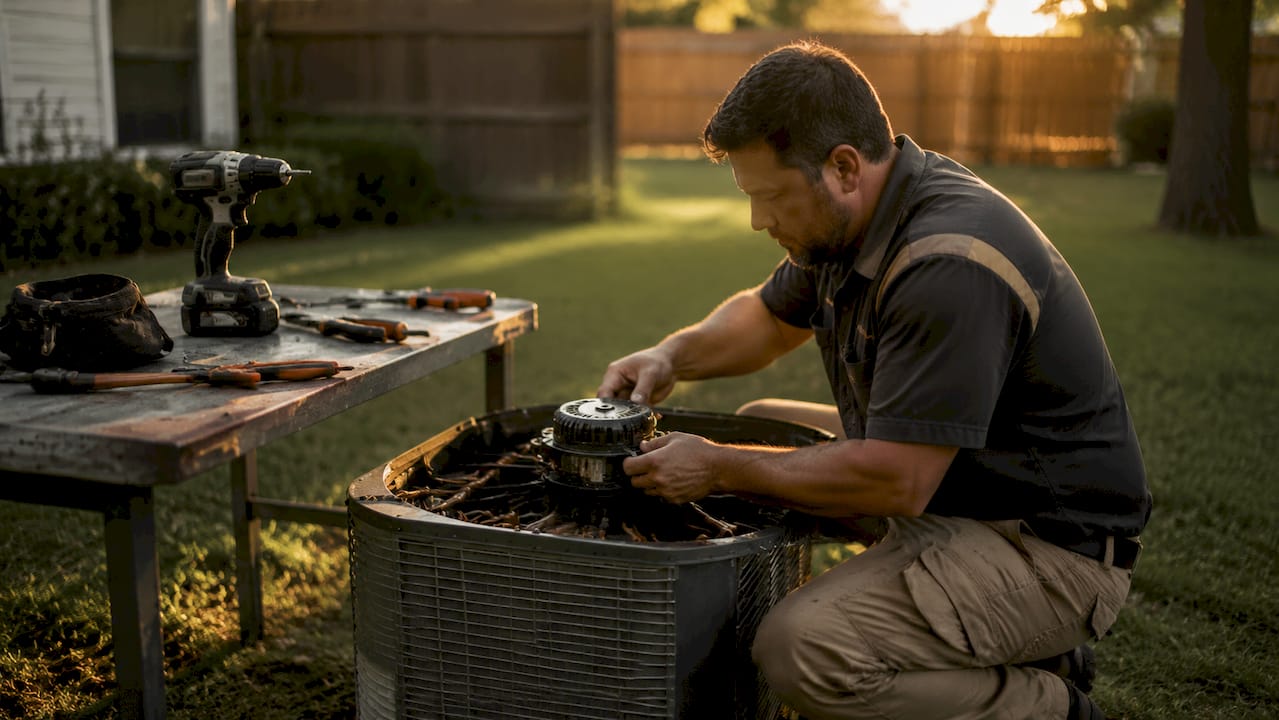
Parts availability is the primary variable that turns a same-day repair into a multi-day wait. When parts are stocked on the service vehicle, repairs complete the same day. When they need to be ordered, you are looking at 1–5 business days added to the total ac repair time estimate.
Technicians at Upright Construction & HVAC stock the most common components, including capacitors, contactors, run capacitors, and basic motors. That covers the majority of straightforward calls. The challenge comes with older or less common systems.
Here is what affects parts availability most:
- System age: Systems over 10 years old represent a large share of residential ACs in Los Angeles and often require parts that are no longer carried on trucks or even in local warehouses.
- Brand and model specificity: Some manufacturers use proprietary components that only ship from regional distributors.
- Discontinued models: Parts for discontinued units sometimes require sourcing from specialty suppliers, adding days to the process.
You can speed things up before the technician even arrives. Knowing your system’s make, model, and serial number lets the dispatcher check parts availability in advance. If you have a service history or recent repair records, bring those out too. That information helps narrow the diagnosis and sometimes allows the technician to arrive with the right part already on the truck.
Pro Tip: Take a photo of your unit’s data plate, which is usually on the side of the outdoor condenser, and save it in your phone. You will have it ready the next time you call for service.
If you are dealing with an older system and wondering whether repair or replacement makes more sense, the repair vs. replacement decision often comes down to parts cost and availability as much as labor.
What are the steps in the professional AC repair process?
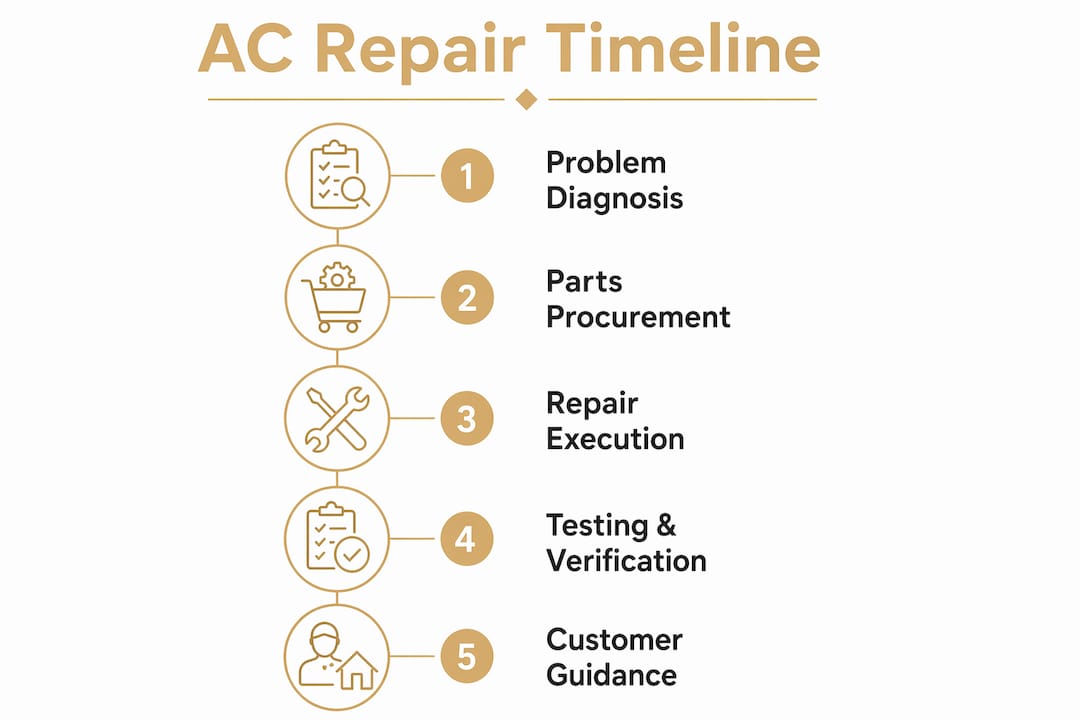
The standardized AC repair process follows five clear phases. Professional AC repair follows a five-step process: interview, inspection, explanation, repair, and testing. Each phase serves a purpose, and skipping any one of them increases the risk of misdiagnosis or repeat failure.
Client interview. The technician asks about recent symptoms, unusual sounds, power outages, or any recent changes around the unit. Knowing about recent landscaping or power events can accelerate diagnosis by ruling out unrelated causes immediately.
Systematic inspection. The technician checks both the indoor air handler and the outdoor condenser. This phase takes anywhere from 5–60 minutes depending on how obvious the problem is. Electrical readings, refrigerant pressure, airflow measurements, and visual checks all happen here.
Explanation of findings. Before any work begins, a good technician explains what they found, what caused it, and what the repair options are. This is where you approve the work and understand the cost. Never skip this conversation.
Authorized repair work. The actual repair happens here, following manufacturer specs and local code requirements. This is the phase that varies most in duration, from 20 minutes for a capacitor swap to several hours for a compressor job.
Post-repair testing. After the repair, the technician verifies airflow, checks the temperature differential between supply and return air, and confirms the system cycles on and off correctly. Standardized diagnostics and testing protocols are critical to avoid misdiagnosis and secondary damage that could extend future repair timelines.
One thing I always tell homeowners: be present for the full visit if you can. Repairs generally require access to both the indoor air handler and the outdoor condenser, and decisions sometimes come up mid-repair that need your approval on the spot.
How does seasonal demand affect the overall AC repair timeline?
Scheduling is a factor that most homeowners overlook when thinking about ac service duration. The actual repair might take two hours, but getting a technician to your door during peak summer demand in Los Angeles can add days to the total elapsed time.
Peak season causes scheduling waits of 1–3 days even for repairs that only take two hours. That gap between “I called for service” and “the repair is done” is the part that catches people off guard.
Here is what shapes scheduling timelines:
- Emergency vs. non-emergency priority. A system that is completely down in 95-degree heat gets prioritized. A system that is cooling but not quite right may wait longer.
- Time of year. June through September in Southern California is peak demand season. Scheduling windows tighten significantly during heat waves.
- Maintenance history. Customers with HVAC service contracts typically get priority scheduling, which shortens the gap between call and repair.
- Geographic density. Technicians route their day by location. If you are in a densely served area, same-day slots open up more often.
The most practical advice I can give: schedule your AC tune-up in march or april, before the heat hits. Annual preventive maintenance is the most effective way to avoid emergency repairs and the scheduling delays that come with them. A system that gets checked before summer rarely fails in the middle of it.
Key Takeaways
The AC repair timeline is predictable when you understand the three core variables: problem complexity, parts availability, and scheduling demand.
| Point | Details |
|---|---|
| Repair duration by complexity | Simple fixes take under 1 hour; moderate repairs run 2–4 hours; major jobs take 4–8+ hours. |
| Parts availability is the biggest delay | Ordered parts add 1–5 business days; stock your system info to help technicians prepare. |
| Five-step repair process | Every professional repair includes interview, inspection, explanation, repair, and post-repair testing. |
| Peak season adds scheduling time | Summer demand in Los Angeles can add 1–3 days before a technician arrives, even for short repairs. |
| Preventive maintenance shortens timelines | Annual tune-ups reduce emergency calls and give you priority scheduling access. |
Why I think most homeowners misread the repair clock
I have been doing HVAC work in Los Angeles for over 15 years, and the single biggest source of frustration I see is not the repair itself. It is the gap between what a homeowner expects and what actually happens.
Most people assume the repair clock starts when they call. It does not. It starts when the technician arrives, and by then, scheduling may have already added a day or two. Then the diagnosis takes time. Then parts may need to be ordered. The actual hands-on repair is often the shortest part of the whole process.
I have also seen homeowners make things harder on themselves without realizing it. Not knowing the system’s model number, not being home when the technician arrives, or not having cleared the area around the outdoor unit all slow things down. Small preparation steps genuinely matter.
The other misconception I run into constantly: assuming a cooling problem means low refrigerant. Many cooling failures actually trace back to tripped breakers or clogged filters, not refrigerant at all. A proper diagnosis always comes before any repair decision. When a technician skips straight to adding refrigerant without checking, that is a red flag worth paying attention to.
My honest advice is to treat your AC system the way you treat your car. You would not skip oil changes and then wonder why the engine fails in August. The same logic applies here. A spring checkup is the best investment you can make against a summer emergency.
— Ernie M
Get fast, transparent AC repair from Upright Construction & HVAC

At Upright Construction & HVAC, we stock the most common repair parts on every truck so we can complete most jobs the same day we arrive. Our technicians follow the full five-step repair process on every call, including a thorough post-repair test before we leave your home. We explain what we found, what it costs, and why, before we start any work. If you want to get ahead of summer demand and avoid emergency scheduling delays, our AC repair tips and preparation guide is a great place to start. You can also explore our HVAC maintenance plans to get priority scheduling and keep your system running through the hottest months of the year.
FAQ
How long does a typical AC repair take?
A typical AC repair visit lasts 1–4 hours from arrival to completion. Simple fixes like capacitor replacement finish in under an hour, while compressor replacements can take a full day.
What causes AC repairs to take longer than expected?
Parts availability is the most common cause of extended repair timelines. If a part needs to be ordered, total repair time increases by 1–5 business days beyond the actual labor.
Do I need to be home during the AC repair?
Yes. Technicians need access to both the indoor air handler and the outdoor condenser, and repair decisions sometimes require your approval mid-visit. Plan to be present for the full duration.
Why does refrigerant repair take so long?
Refrigerant leak repair takes 2–4 hours minimum because EPA regulations require a full leak search and system evacuation before any recharge. A quick top-off without these steps is not compliant and will not fix the underlying problem.
How can I shorten my AC repair timeline?
Schedule preventive maintenance in the spring before peak season, keep your system’s model and serial number handy, and clear access to both units before the technician arrives. These steps reduce diagnosis time and help technicians arrive prepared.