
- Why AC repair is urgent: the issues you cannot ignore
- How does delaying AC repair worsen damage and costs?
- When can minor AC repairs wait and when are they urgent?
- How to prepare for and respond to urgent AC repair needs
- Key takeaways
- What 15 years of heat wave calls taught me about urgency
- Get urgent AC help from Upright Construction & HVAC
- FAQ
- Recommended
TL;DR:
- Urgent AC repairs involve electrical faults, refrigerant leaks, or cooling failures during hot weather that pose safety risks or system damage within hours. Delaying these repairs can lead to cascade failures, higher costs, and health hazards, especially during heat waves when service backlogs grow rapidly. Promptly recognizing symptoms and calling professional technicians immediately can prevent costly damage and ensure safety.
Urgent AC repair is defined as any air conditioning service that must happen within hours, not days, because the problem poses a safety risk, threatens system failure, or creates dangerous indoor conditions. A refrigerant leak, ice forming on your evaporator coil, a burning smell from the unit, or a breaker that keeps tripping are not issues you schedule for next week. The U.S. Department of Energy and energy.gov HVAC guidance make clear that certain AC faults escalate fast, and during a heat wave, the window to act before technician backlogs form is very short. Knowing why AC repair is urgent, and which symptoms demand a same-day call, is the difference between a manageable repair bill and a full system replacement.
Why AC repair is urgent: the issues you cannot ignore
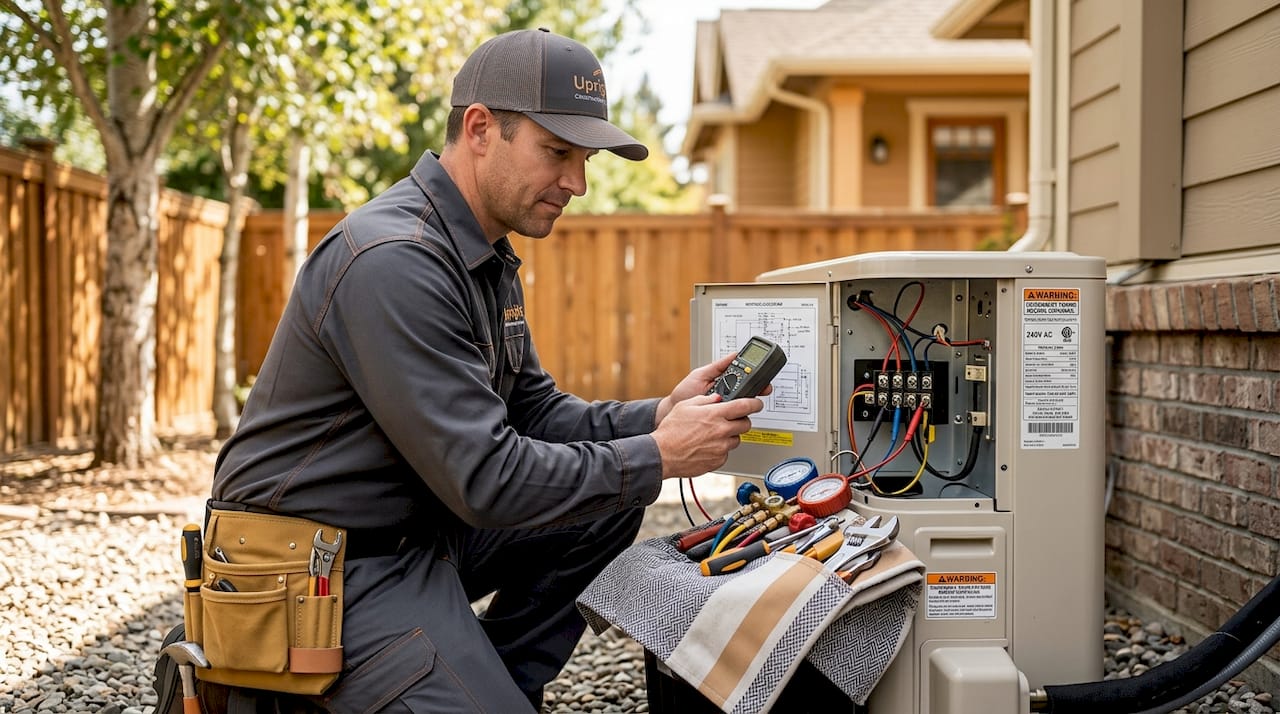
Some AC problems are genuinely dangerous, not just inconvenient. Refrigerant leaks, ice on coils, and electrical faults all belong in the urgent category, and each one can turn a fixable problem into a catastrophic failure if you wait.
Here is what each urgent symptom actually means for your system:
- Refrigerant leak: Your AC does not consume refrigerant. If the level is low, there is a leak. Low refrigerant forces the compressor to work harder than it was designed to, and compressor damage from refrigerant loss is one of the most expensive failures in residential HVAC. Refrigerant exposure also carries health risks, particularly in enclosed spaces.
- Ice on the evaporator coil: Ice formation signals restricted airflow or a refrigerant problem. Either way, the coil cannot absorb heat properly, and running the system in this state drives heat stress into surrounding components. Shut the system off and call a technician the same day.
- Burning smell or repeated breaker trips: These are fire-risk indicators. Electrical faults in an AC system can cascade into larger failures across the control board, the capacitor, and the compressor. A professional technician checks electrical control sequences, refrigerant status, and airflow before replacing any parts, which is exactly the systematic approach these symptoms require.
- No cooling during a heat wave: Indoor temperatures above 90°F create real health risks, especially for children, elderly residents, and anyone with cardiovascular conditions. This is not a comfort issue. It is a safety issue.
Pro Tip: If your AC stops cooling and the outdoor temperature is above 95°F, do not wait to see if the system recovers on its own. Call for emergency air conditioning service immediately and move vulnerable household members to a cooler space while you wait.
How does delaying AC repair worsen damage and costs?
The most expensive AC repairs are almost always the result of a smaller problem that was ignored. This is not speculation. It is a mechanical reality that the DOE documents clearly.
- Dirty filters restrict airflow. Clogged filters reduce airflow and allow dirt to accumulate directly on the evaporator coil. A dirty coil cannot transfer heat efficiently, so the system runs longer cycles, consumes more energy, and builds up heat stress on every connected component. What starts as a $20 filter problem becomes a coil cleaning job, and if left long enough, a premature system failure.
- Airflow restriction triggers a cascade. Reduced airflow causes heat buildup on components, turning minor performance issues into potential system failures. The compressor, the capacitor, and the electrical controls all absorb that extra stress. One restricted filter can eventually produce refrigerant faults and electrical failures that have nothing to do with the original problem.
- Refrigerant leaks compound over time. A small leak that causes weak cooling today will destroy the compressor within one or two seasons if left unaddressed. Compressor replacement typically costs several times more than leak detection and recharge.
- Heat wave backlogs eliminate your options. HVAC phone lines ring off the hook during heat waves, and same-day appointments disappear fast. Homeowners who call on day three of a heat wave often wait two to four days for service, spending that entire time in dangerous indoor heat.
- Energy bills climb before the system fails. An inefficient system running longer cycles to compensate for a fault drives up electricity costs every day the repair is delayed. You pay for the problem twice: once in higher bills, once in the repair itself.
The costs of neglecting AC repairs are not theoretical. They compound daily, and the compounding accelerates during the hottest weeks of the year when demand for emergency HVAC technicians is at its peak.
When can minor AC repairs wait and when are they urgent?
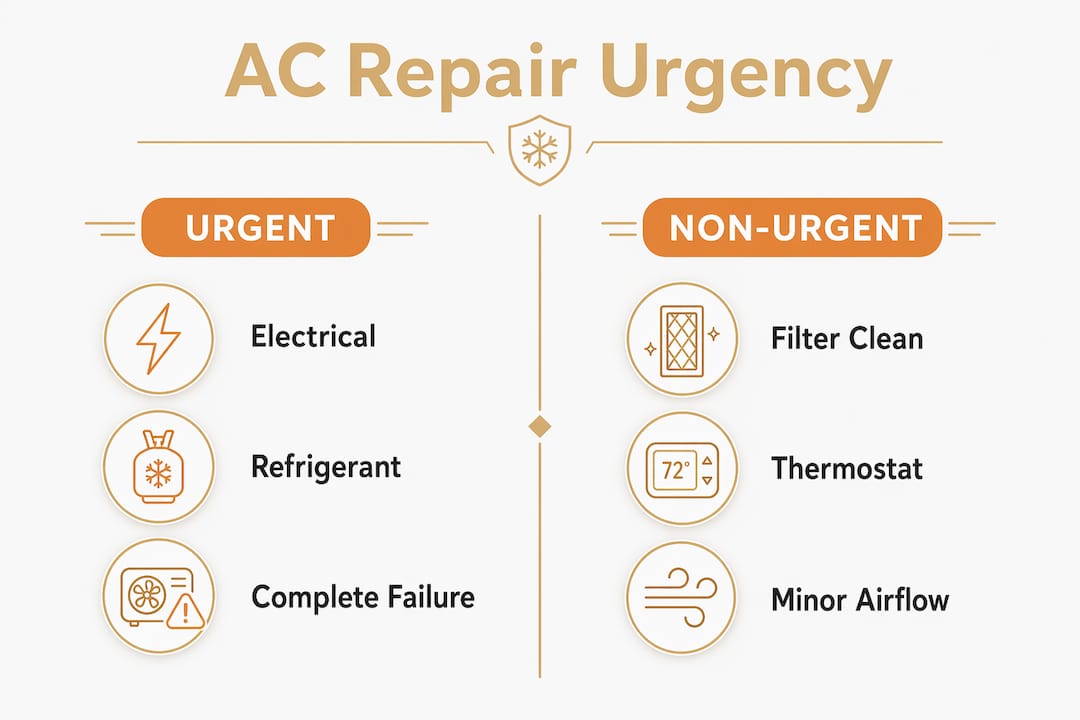
Not every AC problem requires a same-day call. Knowing how to prioritize AC repair correctly saves you money and prevents unnecessary panic, but it also keeps you from making the opposite mistake of waiting too long.
| Situation | Urgency level |
|---|---|
| Burning smell, sparks, or repeated breaker trips | Urgent. Call today. Electrical faults carry fire risk. |
| No cooling during temperatures above 90°F | Urgent. Call today. Health risk for occupants. |
| Ice visible on coils or refrigerant lines | Urgent. Call today. Shut system off and call immediately. |
| Weak cooling with no other symptoms | Schedule within 48 hours. Common causes include dirty coils or low refrigerant. |
| Slightly uneven cooling between rooms | Schedule within a week. May be a duct or thermostat issue. |
| Routine filter replacement or annual tune-up | Schedule at your convenience. Not an emergency. |
The overriding rule is simple: any symptom that involves electrical behavior, refrigerant, or a complete loss of cooling during hot weather is urgent. Safety and health override every other consideration.
Pro Tip: Set a phone reminder to check your air filter every 30 days during summer. A clean filter is the single lowest-cost action you can take to prevent urgent AC problems from developing in the first place.
Minor thermostat issues and slightly reduced airflow from a dirty filter can wait a short time, but only if outdoor temperatures are moderate and no one in the home is medically vulnerable. The moment conditions change, that window closes.
How to prepare for and respond to urgent AC repair needs
When something goes wrong with your AC, how you respond in the first 30 minutes matters. A clear, fast response reduces damage and gets you to the front of the technician’s schedule.
- Recognize the warning signs early. The signs your AC needs repair include unusual noises like grinding or squealing, burning or chemical smells, visible ice on any part of the system, warm air from the vents, and breakers that trip when the AC runs. Any one of these warrants a call.
- Turn off the system if you smell burning or see ice. Running a damaged system accelerates the damage. Shut it off at the thermostat and at the breaker if you smell burning.
- Call a professional HVAC technician right away. Technicians perform checks that homeowners cannot safely replicate, including refrigerant charge measurement, leak detection, airflow testing, and electrical component inspection. Do not attempt refrigerant work yourself. It is illegal without EPA certification and dangerous without the right equipment.
- Give the technician specific information. Tell them when the problem started, what symptoms you noticed first, whether the breaker has tripped, and what the outdoor temperature has been. Symptom reporting speeds diagnosis and reduces the time between arrival and stabilization.
- Use temporary measures while you wait. Close blinds on sun-facing windows, use portable fans to circulate air, move to the lowest floor of the home where it is cooler, and keep hydrated. These steps reduce heat stress on occupants while you wait for service.
- Invest in preventative maintenance after the repair. Calling early during heat waves yields better health and comfort outcomes. A scheduled spring tune-up before peak season is the most reliable way to avoid being caught without AC when temperatures spike.
Pro Tip: Save your HVAC technician’s number in your phone before you need it. During a heat wave, the homeowners who get same-day service are the ones who call at 7 a.m., not the ones who search for a technician at noon.
Key takeaways
Urgent AC repair is not optional when symptoms involve electrical faults, refrigerant loss, or complete cooling failure during hot weather because each of these conditions escalates into costly damage or health risk within hours.
| Point | Details |
|---|---|
| Electrical and refrigerant faults are urgent | Burning smells, tripped breakers, and ice on coils require same-day professional service. |
| Delayed repairs cost more money | Clogged filters and ignored leaks trigger cascade failures that multiply repair costs. |
| Heat waves shrink your window to act | Technician backlogs form fast during peak demand, so early calls get better outcomes. |
| Not every issue is an emergency | Weak cooling from a dirty filter can wait briefly if no health risks are present. |
| Preventative maintenance prevents emergencies | A spring tune-up is the most cost-effective way to avoid urgent summer repairs. |
What 15 years of heat wave calls taught me about urgency
I have been running Upright Construction & HVAC in Los Angeles for over 15 years, and every summer I see the same pattern. Homeowners notice something off with their AC, they decide to wait and see, and then they call us on day four of a heat wave when every technician in the city is already booked solid.
The hesitation is understandable. Nobody wants to spend money on a repair that might resolve itself. But in HVAC, problems almost never resolve themselves. A refrigerant leak does not seal on its own. Ice on a coil does not melt and fix the underlying airflow problem. An electrical fault does not reset itself safely.
What I have learned is that the homeowners who fare best are not the ones with the newest systems. They are the ones who call fast and communicate clearly. When a customer tells me exactly when the problem started, what they heard or smelled, and whether the breaker tripped, my team can diagnose and stabilize the system in a fraction of the time. That specificity saves money and gets the home cool again faster.
My honest advice: treat a burning smell or a complete loss of cooling the same way you would treat a gas smell in your kitchen. Do not wait. Do not test it. Call a professional immediately. The cost of a same-day service call is a fraction of what a compressor replacement runs, and it is nothing compared to the health risk of leaving elderly parents or young children in a home that hits 95°F indoors.
— Ernie M
Get urgent AC help from Upright Construction & HVAC
When your AC fails in Los Angeles heat, you need a team that picks up the phone and shows up fast.

Upright Construction & HVAC has served Los Angeles homeowners for over 15 years with 24/7 emergency air conditioning service, expert diagnostics, and a commitment to transparency on every job. Whether you are dealing with a refrigerant leak, a system that stopped cooling overnight, or electrical symptoms you cannot explain, our technicians arrive prepared to stabilize your system and give you a clear picture of what it will take to fix it. Read our AC repair tips to understand what to expect before we arrive, or contact us directly to schedule urgent service. For homeowners in the Reseda area, our local HVAC team is ready to respond.
FAQ
What makes an AC repair truly urgent?
An AC repair is urgent when it involves electrical faults, refrigerant leaks, ice on the coils, or a complete loss of cooling during hot weather. These conditions carry health risks and cause rapid system damage if not addressed the same day.
How much does delaying AC repair actually cost?
Delayed repairs allow small faults to trigger cascade failures across the compressor, electrical controls, and refrigerant system. A repair that costs a few hundred dollars today can become a compressor replacement costing several times more if ignored for even one season.
When should I call for emergency air conditioning service?
Call for emergency service immediately if you smell burning from the unit, the breaker trips when the AC runs, you see ice on the coils, or the system stops cooling entirely during temperatures above 90°F. These are not wait-and-see situations.
Can I do anything while waiting for a technician?
Turn off the system at the thermostat and breaker if you smell burning or see ice. Close sun-facing blinds, use portable fans, move to lower floors, and stay hydrated. Never attempt refrigerant work yourself, as it requires EPA certification and specialized equipment.
How do I avoid urgent AC repairs in the future?
Schedule a professional tune-up every spring before peak heat season. Replace or clean your air filter every 30 days during summer. Routine maintenance prevents the airflow restrictions and component stress that turn minor issues into emergencies.