
- Key takeaways
- How AC repair costs are determined: the pricing formula
- What actually drives the price up or down
- Repair vs. replacement: knowing when to stop paying for fixes
- How timing affects what you pay
- How to read a quote and avoid surprises
- My take on AC repair pricing after 15 years in the field
- Get clear, honest AC repair pricing in Los Angeles
- FAQ
- Recommended
TL;DR:
- Homeowners often find AC repair bills confusing due to a combination of diagnostic fees, labor, parts, and refrigerant charges. Costs vary based on timing, system age, parts availability, and refrigerant use, with the 50% rule guiding replacement decisions when repairs become too costly. Requesting detailed, itemized quotes beforehand helps ensure transparency and fairness in AC repair expenses.
Most homeowners are caught off guard the first time they see an AC repair bill. The number feels arbitrary, and the line items are confusing. Understanding how AC repair costs are determined takes the mystery out of that invoice and puts you back in control. Whether you’re dealing with a capacitor that failed on a Tuesday afternoon or a refrigerant leak discovered in the middle of a July heat wave, the price you pay follows a clear logic. This guide breaks that logic down completely.
Key takeaways
| Point | Details |
|---|---|
| Repair costs follow a formula | Every bill is built from diagnostic fees, labor, parts, and sometimes refrigerant charges stacked together. |
| Timing changes the price | After-hours and weekend calls can double or triple what you’d pay during regular business hours. |
| The 50% rule saves money | If a repair costs more than half the price of a new system, replacement is usually the smarter financial move. |
| Itemized quotes protect you | Always request a full breakdown before approving work to catch hidden fees like truck charges or priority scheduling. |
| System age drives up costs | Older units cost more to repair because parts are harder to find and warranties rarely cover labor. |
How AC repair costs are determined: the pricing formula
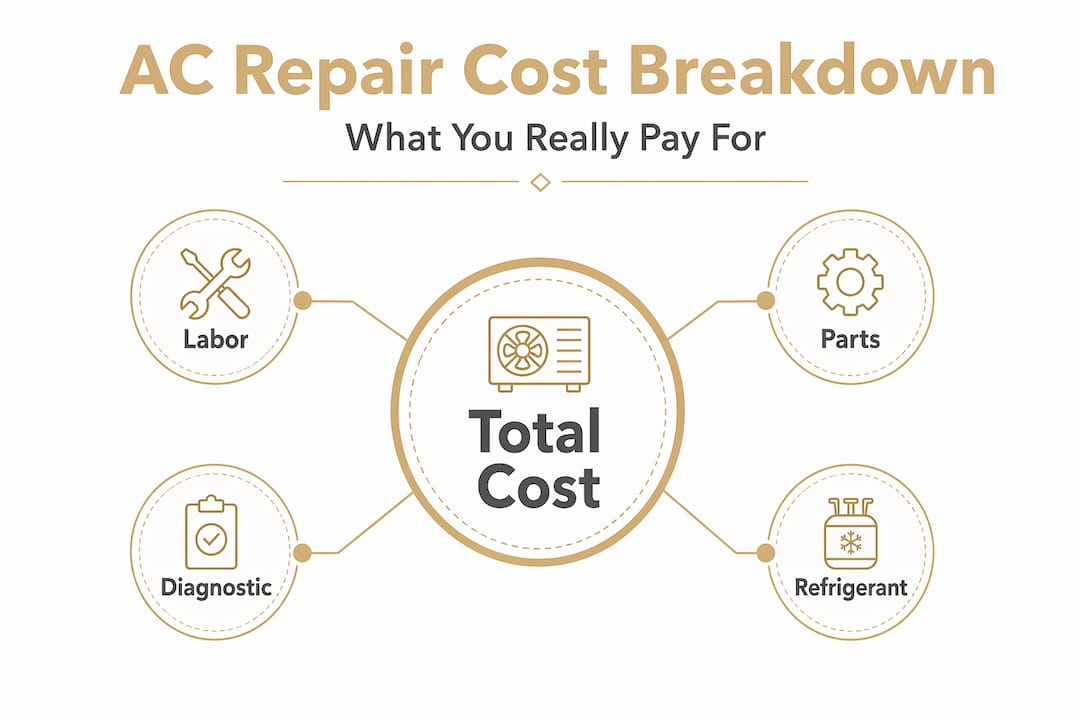
Before you can evaluate any quote, you need to understand what goes into it. AC repair pricing is not a flat fee. It is a stack of individual charges that add up to the total. Repair quotes are built from diagnostic fees, hourly labor, parts, and refrigerant charges billed separately. The same repair can cost significantly different amounts depending on how each layer is priced.
Here is what that stack looks like in practice for common repairs in 2026:
| Repair type | Typical cost range |
|---|---|
| Capacitor replacement | $150 to $400 |
| Blower motor replacement | $400 to $1,000 |
| Refrigerant recharge | $250 to $700 |
| Compressor replacement | $1,500 to $3,500 |
These 2026 repair cost ranges reflect parts and labor combined, but they do not always include the diagnostic fee or refrigerant costs billed by the pound. That is where the confusion starts for most homeowners.
A capacitor swap is a quick job. A technician can complete it in under an hour. A compressor replacement is a multi-hour project that may require refrigerant recovery, new components, and a full system retest. The price difference reflects real differences in time, skill, and materials.
Pro Tip: Ask your technician upfront whether the diagnostic fee is included in the repair quote or billed separately. Many companies credit the diagnostic fee toward the repair total if you approve the work.
What actually drives the price up or down
Understanding the factors affecting AC repair costs is where most homeowners gain the most clarity. There are four main drivers.
Diagnostic and service call fees
Most HVAC companies charge a fee just to show up and assess your system. In 2026, diagnostic fees typically run between $75 and $150 on weekdays, with weekend and after-hours visits pushing toward $119 to $249 or more. The good news is that many companies apply that fee toward your repair total once you approve the work. This matters when you are comparing quotes. Two companies may charge different diagnostic fees, but if both credit it toward the repair, the total cost after credit is what you should compare.
Labor rates and complexity
Hourly labor rates for residential HVAC work generally fall between $75 and $150 per hour. A simple thermostat replacement might take 30 minutes. A refrigerant leak diagnosis and repair can take three or four hours across multiple steps. Labor complexity is one of the biggest variables in what influences AC repair prices from one job to the next.
Parts availability and system age
Older AC units cost more to repair for a straightforward reason: the parts are harder to find. A 15-year-old unit may require a component that is no longer stocked locally, which means sourcing delays and higher prices. Warranties on older systems sometimes cover parts but almost never cover labor, so you end up paying the hourly rate regardless.
Refrigerant charges
This is the line item that surprises homeowners the most. Refrigerant is not just a single charge. A full refrigerant job includes leak detection, line repair, system evacuation, recharge, and the refrigerant itself billed by the pound. Total refrigerant repair costs can reach $1,200 to $2,000 or more when all steps are included. Always ask the price per pound before approving refrigerant work. Costs associated with air conditioning repair spike fast when refrigerant is involved.
Repair vs. replacement: knowing when to stop paying for fixes
One of the most practical tools for homeowners is the 50% rule. It works like this: if the cost of the repair exceeds 50% of what a new system would cost, replacement is the better financial decision. A $3,500 repair on a $6,000 system crosses that threshold and signals it is time to replace.
Here is a simple comparison to put that in context:
| Scenario | Repair cost | New system cost | Recommendation |
|---|---|---|---|
| Capacitor on a 5-year-old unit | $250 | $6,000 | Repair |
| Compressor on a 12-year-old unit | $2,800 | $6,000 | Replace |
| Refrigerant leak on a 10-year-old unit | $1,500 | $6,000 | Evaluate carefully |
System age matters beyond just the math. A unit that is 10 or more years old is likely to develop additional problems even after you fix the current one. If you have paid for two or three repairs in the past two years, that pattern is telling you something. Frequent repairs are a sign the system is declining, not just experiencing isolated failures.
For a broader perspective on how repair versus replacement decisions apply across home systems, the same logic used in exterior repair decisions applies here: weigh the repair cost against the remaining useful life of the asset.
Pro Tip: Multiply your repair estimate by the age of your system in years. If that number exceeds $5,000, most HVAC professionals recommend replacement over repair.
How timing affects what you pay
The time of day and day of the week you call for service has a direct impact on your bill. This is one of the most controllable factors affecting AC repair costs, and most homeowners do not realize it until after the fact.
Emergency and after-hours service can push labor rates to double or even triple the standard weekday rate. A diagnostic fee that runs $100 on a Wednesday morning might cost $225 on a Saturday night. Here is what the pricing difference looks like in real terms:
- Weekday diagnostic fee: $75 to $150
- Weekend or after-hours diagnostic fee: $125 to $250
- Emergency labor rate premium: up to triple the standard hourly rate
- Total cost difference for the same repair: potentially $200 to $500 more
If your AC stops cooling but the situation is not dangerous, it is worth asking whether you can safely wait until the next business day. A room fan and a cooler night can make that wait manageable and save you real money. For situations that genuinely cannot wait, Upright Construction & HVAC offers 24/7 emergency AC repair in Los Angeles with transparent pricing even on nights and weekends.
How to read a quote and avoid surprises
Getting a quote is not the same as understanding it. Here is a numbered process to follow every time you receive an estimate for AC work.
- Ask whether the diagnostic fee is credited toward the repair if you approve the work.
- Request a fully itemized quote that separates labor, parts, and refrigerant charges.
- Ask the price per pound for any refrigerant being added.
- Look for extra line items like truck charges, shop supply fees, or scheduling priority fees. These small additions can quietly inflate your final invoice.
- Compare total cost after diagnostic credit, not the standalone diagnostic fee. Technicians structure quotes so that the credited total is what matters for comparison.
- Get at least two quotes for any repair over $500.
The goal is to find AC repair prices that reflect actual work, not padding. An honest contractor will welcome these questions. One who resists itemization is worth being cautious about.
Pro Tip: When comparing quotes, ask each company the same set of questions in the same order. This creates a fair comparison and quickly reveals which contractor is more transparent about their pricing.
For more guidance on interpreting repair estimates, including what specific line items mean and which ones are negotiable, Upright Construction & HVAC has published detailed advice based on real Los Angeles repair scenarios.
My take on AC repair pricing after 15 years in the field
I have reviewed thousands of AC repair invoices over the years, and the pattern I see most often is not dishonesty. It is opacity. Most homeowners do not ask questions before approving work because they feel like they are supposed to trust the technician. That trust is not wrong. But trust without information leads to sticker shock.
What I have learned is that the homeowners who feel best about their repair bills are the ones who asked for an itemized quote before the work started. Not after. Before. They knew what the diagnostic fee was, whether it would be credited, and how refrigerant charges would be calculated. That knowledge did not make the repair cheaper. It made the bill feel fair.
I have also seen a lot of homeowners spend $1,800 repairing a 14-year-old system that needed another $1,200 in repairs six months later. The 50% rule exists for a reason. It is not a guarantee, but it is a reliable signal. When a repair costs more than half of what a new system would cost, you are often just delaying the inevitable and paying more in the long run.
My honest advice: schedule a maintenance visit before your system fails. The cost of a tune-up is a fraction of an emergency repair. And when something does go wrong, slow down before you approve anything. Ask the questions in this article. A good technician will give you straight answers.
— Ernie M
Get clear, honest AC repair pricing in Los Angeles
If you are tired of vague estimates and surprise charges, Upright Construction & HVAC operates differently. With over 15 years serving Los Angeles homeowners, the team at Upright builds every quote with full transparency: diagnostic fees, labor, parts, and refrigerant charges are all listed separately before any work begins.

Whether you need a fast diagnosis on a system that stopped cooling or you want to understand your AC repair options before making a decision, Upright’s technicians will walk you through every line item. The diagnostic fee is credited toward your repair when you approve the work. And for situations that cannot wait, the team is available around the clock. Contact Upright Construction & HVAC today for a quote that actually makes sense.
FAQ
What is included in a typical AC repair bill?
A standard AC repair bill includes a diagnostic or service call fee, hourly labor, parts, and sometimes refrigerant charges billed separately by the pound. Requesting an itemized quote before approving work helps you understand exactly what you are paying for.
Why is AC repair so expensive?
AC repair costs reflect the combination of skilled labor, specialized parts, and in some cases refrigerant that must be handled by certified technicians. Older systems, emergency timing, and refrigerant leaks are the most common reasons a repair bill runs higher than expected.
How much does the average AC repair cost in 2026?
Common repairs range from $150 to $400 for a capacitor replacement up to $1,500 to $3,500 for a compressor. Refrigerant leak and recharge work can total $1,200 to $2,000 or more when all steps are included.
Does the diagnostic fee get applied to the repair cost?
Many HVAC companies credit the diagnostic fee toward the total repair cost if you approve the work. Always confirm this policy before the technician begins the assessment so you can compare total costs across quotes accurately.
When should I replace my AC instead of repairing it?
If the repair cost exceeds 50% of the price of a new system, replacement is generally the smarter financial decision. A 12-year-old unit requiring a $3,000 compressor replacement on a $6,000 system is a clear example where replacement makes more sense than repair.
Recommended
- Essential Tips When Your Air Conditioner Needs Repairs – Upright Construction & HVAC
- Boost AC Efficiency How Capacitors Transform Performance – Upright Construction & HVAC
- Proven Cost-Effective AC Repair Solutions – From Los Angeles HVAC Experts – Upright Construction & HVAC
- How To Choose The Best AC Repair Service In Los Angeles – Upright Construction & HVAC