
- How Much Does AC Installation Cost on Average?
- What’s the Best AC System Type for Your Home?
- What Size AC Unit Do You Need for Your Home?
- What Hidden Costs Should You Budget For?
- What Rebates and Tax Credits Apply in 2026?
- Should You Repair Your AC or Replace It?
- What Should You Ask Before You Hire an HVAC Contractor?
- My Take on the 2026 AC Cost Conversation
- Get a Straight Answer on Your AC Installation Cost
- Where to Verify These Numbers Yourself
- Sources
- FAQ
- Recommended
Expect to pay somewhere between $3,800 and $8,100 for a straight AC replacement using your existing ductwork, and more if you’re installing central air where no ducts exist yet. Budget extra on top of any quote for three things: ductwork repairs, electrical panel upgrades, and site surprises like asbestos or undersized attic access. Before you sign anything, get three written quotes and insist on a Manual J load calculation.
TL;DR:
- Most homeowners can expect to pay $3,800 to $8,100 for a straightforward AC replacement when existing ductwork is in good condition.
- New ductwork installations can significantly increase costs, often reaching $10,000 to $18,000 for full buildouts in older homes without existing systems.
- Proper sizing based on a Manual J load calculation is essential to avoid overspending or insufficient cooling, with unit size heavily influenced by house square footage and local climate.
- Electrical panel upgrades, duct repairs, and site surprises like asbestos can add thousands to the initial quote unless specified beforehand.
- Utility rebates and local incentives in 2026 can offset higher upfront costs, but homeowners must research their local programs and work with contractors to maximize savings.
How Much Does AC Installation Cost on Average?
The national range for a full AC replacement runs from about $3,800 to $8,100, covering the outdoor condenser, indoor coil, and standard labor when your home already has working ductwork. That’s the number most homeowners in Los Angeles and across the country end up paying for a like-for-like swap.
The picture changes fast once ductwork enters the equation. Central air installations that require new ducts commonly run $4,000 to $15,000 total, and homes needing a full ductwork buildout from scratch often land at the top of that range or above it. A first-time install in an older home without any existing duct system regularly reaches $10,000 to $18,000 once you add the metalwork, insulation, and labor hours that ductwork demands.
Why such a wide spread? A few things push costs in either direction:
- Existing infrastructure matters most. A home with sound, appropriately sized ducts and a working electrical setup will always land near the low end.
- Home size drives equipment cost. Bigger square footage usually means a larger tonnage unit, and tonnage is the single biggest line item on your quote.
- Efficiency tier adds upfront cost. Higher SEER2 units cost more to buy but often qualify for larger rebates, which can narrow the gap.
- Regional labor rates swing pricing. Expect installed prices to vary by 20% to 40% depending on your region, with coastal metro areas like Los Angeles typically running above the national midpoint.
- Access and site conditions are the wildcard. A cramped attic, a two-story home, or a unit that needs crane placement all add labor hours you won’t see reflected in a generic online estimate.
None of these ranges account for rebates, which we’ll get to shortly, and none of them account for the surprises hiding behind your drywall. That’s where a lot of homeowners get blindsided.
What’s the Best AC System Type for Your Home?
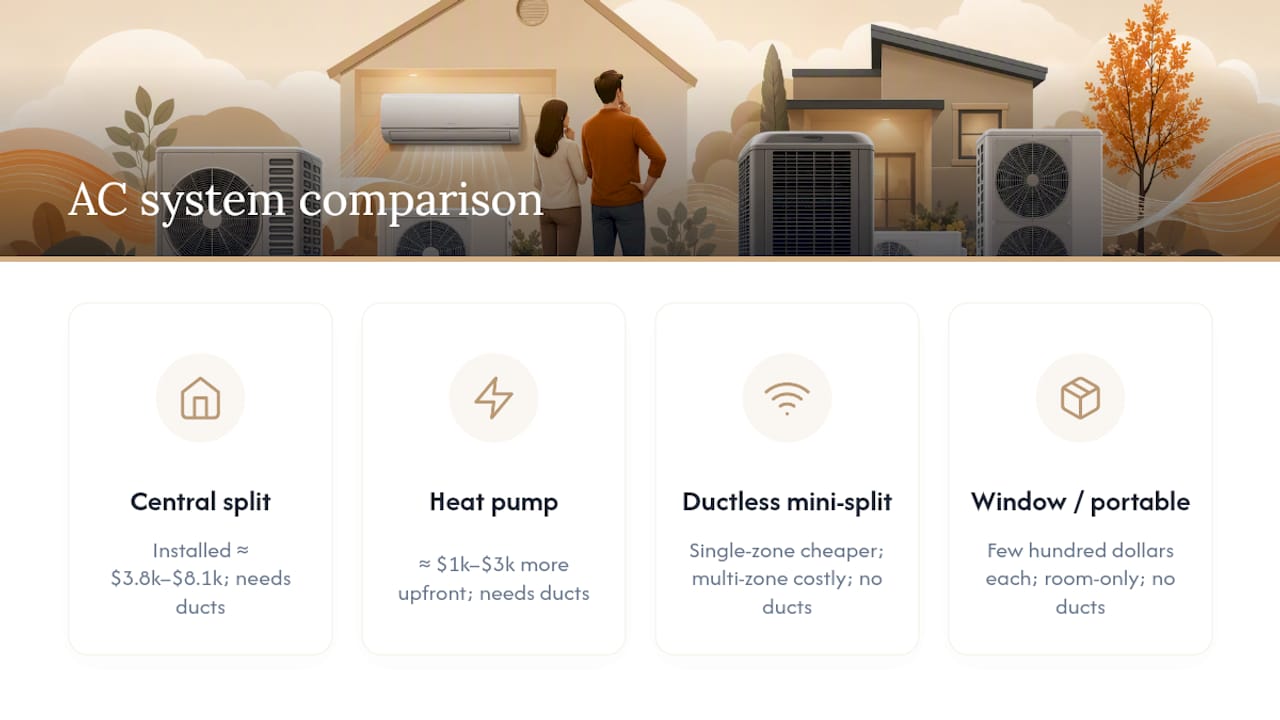
Not every home needs the same setup, and picking the wrong system type is one of the most expensive mistakes a homeowner can make. Here’s how the main options stack up on installed cost.
Central split systems remain the default for homes that already have ductwork. Equipment alone typically runs $2,500 to $6,000 depending on tonnage and SEER2 rating, with installed totals landing in that $3,800 to $8,100 replacement range mentioned earlier. If your ducts are in decent shape, this is usually the most cost-effective path.
Heat pumps cost more upfront than a standard AC condenser, often $1,000 to $3,000 more for equivalent tonnage, because the unit handles both heating and cooling. For Los Angeles homeowners replacing an aging gas furnace and AC combo, a heat pump conversion can make long-term sense, especially with the rebate incentives covered later in this guide.
Ductless mini-splits are the answer for additions, garage conversions, or older homes without any ducts at all. A single-zone mini-split installed typically costs less than a full central system, but multi-zone setups covering several rooms commonly push total project costs into the higher cost range once you add each indoor head and the associated line sets.
Window and portable units stay the cheapest option by far, usually a few hundred dollars per unit installed, but they only make sense as a stopgap or for a single problem room. They won’t touch your whole-home comfort or efficiency picture the way a properly sized central or ductless system will.
What Size AC Unit Do You Need for Your Home?
Contractors size AC units in “tons” of cooling capacity, and getting this number wrong is the fastest way to overpay or end up with a system that never feels comfortable. Rough square-footage guidelines look like this:
- 1,000 to 1,500 square feet: typically needs a 2 ton unit, installed cost usually $3,800 to $5,500.
- 1,500 to 2,000 square feet: typically needs a 3 ton unit, installed cost usually $4,500 to $6,500.
- 2,000 to 2,500 square feet: typically needs a 3.5 to 4 ton unit, installed cost usually $5,500 to $7,500.
- 2,500 to 3,000-plus square feet: typically needs a 4 to 5 ton unit, or a zoned multi-unit setup, installed cost usually $6,500 to $9,000-plus.
Square footage is only a starting point, though. A Manual J load calculation is the industry-standard method that accounts for insulation quality, window count and orientation, ceiling height, local climate, and duct condition to determine the actual tonnage your home needs. Skipping it and sizing by square footage alone is exactly how homeowners end up with an oversized unit that short-cycles and wastes energy, or an undersized one that runs constantly and never quite cools the house.
The price jump between tonnage sizes isn’t trivial either. Moving from a 3 ton to a 4 ton unit typically adds several hundred dollars to equipment cost alone, before labor. That’s real money to spend on a size you don’t actually need, which is exactly why a legitimate contractor should never quote tonnage off a square-footage chart without running the numbers first.
What Hidden Costs Should You Budget For?
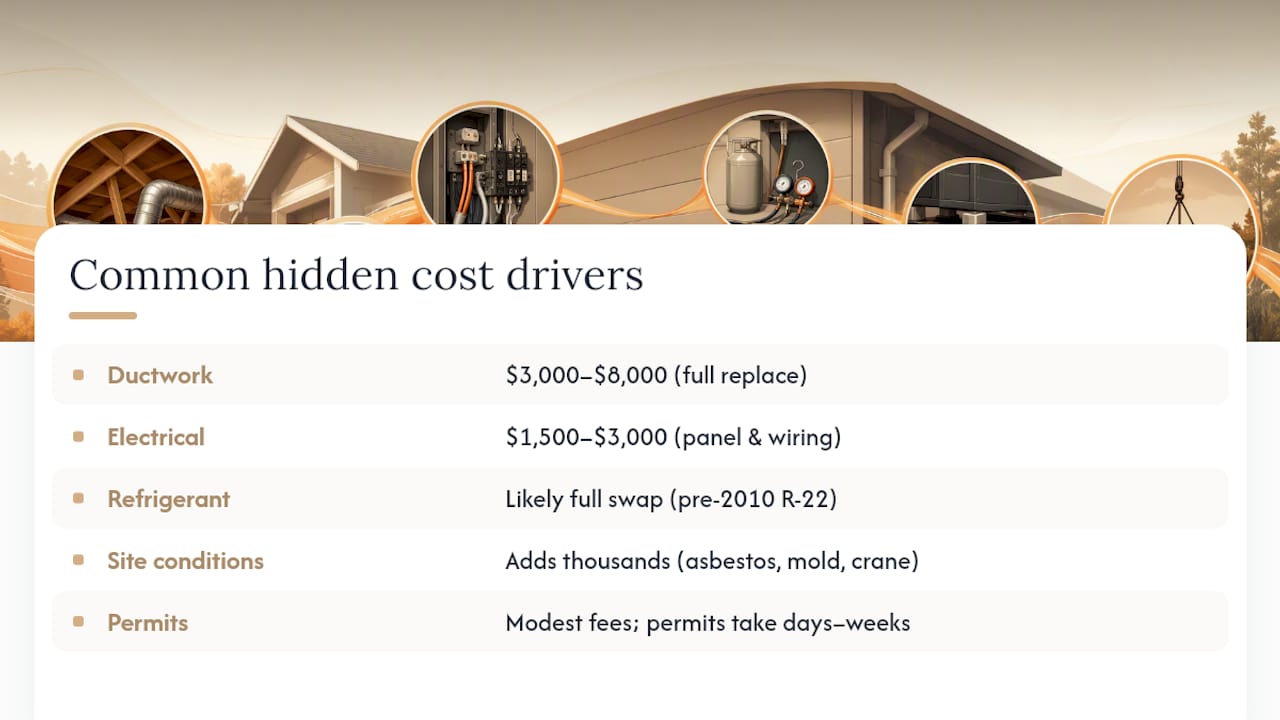
The base installation price is rarely the final number. Here’s where quotes typically grow, and by how much.
Ductwork is the biggest variable. Minor repairs might run a few hundred dollars, but a full ductwork replacement typically adds $3,000 to $8,000 to your project, depending on home size and how accessible your attic or crawlspace is.
Electrical upgrades get triggered more often than homeowners expect. If your panel can’t support the new unit’s amperage draw, or you need a dedicated circuit for the condenser, expect an added $1,500 to $3,000 for panel work and wiring.
Legacy refrigerant systems are a bigger deal than most homeowners realize. If your current system predates 2010, it’s likely running on R-22, and patching an R-22 system isn’t cost-effective and can void your new equipment’s warranty. Budget for a full system swap, not a simple recharge.
Site conditions cause the most expensive surprises. Asbestos in old duct wrap, mold growth inside ductwork, or a unit that requires crane placement for rooftop access can each add thousands of dollars once discovered. This is exactly why a fixed-price contract needs contingency line items spelled out before work begins, not after the crew opens a wall.
Permits and inspections typically add a modest but real cost, and Los Angeles County permitting can take anywhere from a few days to a couple of weeks depending on the jurisdiction and season. Always confirm your contractor is pulling permits. That’s not optional, and skipping it can come back to bite you at resale.
Pro Tip: Ask every contractor to itemize ductwork, electrical, and abatement contingencies as separate line items in the written contract, not folded into a vague “site conditions” allowance. If a bid seems unusually low, that’s often exactly what’s missing.
If you’re weighing full replacement against a smaller emergency repair right now, it helps to understand what typically drives emergency HVAC pricing before you commit either way.
What Rebates and Tax Credits Apply in 2026?
The incentive landscape looks different this year than it did a couple of years ago, and that shift changes how you should shop. The broad federal 25C tax credit that many homeowners relied on largely stepped back after 2025, and 2026’s incentive picture now centers on income-qualified IRA HEAR and HOMES programs alongside utility-run rebate ladders tied to ENERGY STAR and CEE efficiency tiers.
Practically, that means the biggest savings this year come from your local utility, not a flat federal deduction. ENERGY STAR’s rebate finder lets you search by zip code to see what your specific utility offers, and equipment that qualifies for the CEE highest efficiency tier commonly unlocks the largest rebate amounts available.
A few practical steps make this process manageable:
- Search your utility’s rebate page before you buy, since programs and dollar amounts change throughout the year.
- Ask your contractor whether the unit they’re quoting qualifies for CEE’s top tier, since a slightly pricier model often pays for its own premium through rebates and lower energy bills.
- Keep every receipt, model number, and QM PIN (the qualification identifier some rebate programs require) organized before you file for any incentive.
- Confirm your contractor will help coordinate paperwork. A good one submits documentation as part of the job, not as an afterthought you’re left to handle alone.
For a deeper walk-through of how these programs actually process a claim, see how utility rebates for heating work in 2026.
Should You Repair Your AC or Replace It?
Run the numbers before you decide, and use these thresholds as your starting point:
- Repair if the cost is under a fraction of replacement value and the unit is younger than 10 years old with no history of repeated breakdowns.
- Replace if the system runs on R-22, is older than 12 to 15 years, or has a failing compressor. A failing compressor repair alone often costs 40% to 50% of a full replacement, making replacement the better dollar-for-dollar move.
- Consider a retrofit or coil swap only when the ductwork and electrical are already sized correctly for a heat pump conversion. This route can save money versus a full system replacement, but only when an HVAC technician confirms compatibility first. Guessing here tends to create bigger problems later.
If you’re still on the fence, our AC repair vs. replacement checklist and our nine signs your HVAC needs replacement both walk through the warning signs in more detail. It’s also worth applying the same repair-versus-replace math to other aging home components. Homeowners weighing similar decisions on interior doors and energy efficiency face nearly identical logic: patch a failing part, or invest in the upgrade once and stop paying for repeated fixes.
What Should You Ask Before You Hire an HVAC Contractor?
I’ve been running HVAC and construction crews in Los Angeles for over 15 years, and if there’s one thing I want every homeowner reading this to walk away with, it’s this: the quote itself tells you almost as much about a contractor as the price does.
A contract that doesn’t name a Manual J calculation, doesn’t itemize scope, and doesn’t spell out what happens if the crew finds asbestos behind your ductwork isn’t a real quote. It’s a guess with a signature line.
Here’s what I tell every homeowner to require before signing anything: a documented Manual J load calculation, not a square-footage guess. An itemized, fixed-price scope of work with contingency pricing already listed for abatement or ductwork surprises. Clear warranty terms covering both parts and labor, in writing. And proof of active license and insurance, which you can verify independently rather than taking a contractor’s word for it.
The surprise charges we see most often at Upright Construction & HVAC involve exactly what this guide covers: undersized electrical panels, ductwork that looks fine until you open the plenum, and old asbestos wrap on pre1980 duct runs. We document these conditions with photos before any change order goes to a homeowner, because a surprise charge without evidence is just a dispute waiting to happen. If you’re weighing a replacement against Los Angeles-specific pricing, our AC replacement cost guide for Los Angeles breaks down what local homes typically run.
My Take on the 2026 AC Cost Conversation
Most cost guides treat AC installation like a single number problem. It isn’t. The real budgeting skill for 2026 is separating the equipment price from the incentive landscape, because they’re moving in opposite directions this year: base costs are stable to slightly up, while the biggest savings lever, the old flat federal credit, has largely receded in favor of utility and income-qualified programs that vary block by block.
That means the homeowner who wins the best deal in 2026 isn’t the one who finds the cheapest contractor. It’s the one who does two things nobody wants to do: run a Manual J instead of trusting a square-footage guess, and actually search their own utility’s rebate page instead of assuming the incentive picture looks like it did two years ago. Most homeowners skip both steps and pay for it twice, once in oversized equipment and once in rebates left on the table.
My honest advice: spend an extra hour on paperwork before you spend a dollar on equipment. It’s the cheapest insurance you’ll buy on this whole project.
— Ernie M
Get a Straight Answer on Your AC Installation Cost
If you’ve read this far, you already know the biggest risk isn’t the sticker price, it’s the surprise charge nobody wrote down ahead of time. We have extensive experience handling licensed HVAC installation, repair, and emergency service, and every quote we write starts with a Manual J load calculation and an itemized, fixed-price scope, not a ballpark guess.

When you request a quote, you’ll get a real number for your home’s tonnage, transparent pricing on ductwork or electrical work if it’s needed, and help identifying which utility and income-qualified rebates your project qualifies for before we ever start the job. Financing may be available for larger installs, and diagnostic processes should be thorough and transparent to accurately identify system issues. If your system is showing its age or you’re ready to compare a real quote against the ranges in this guide, get in touch with a local HVAC team and we’ll walk you through what your home actually needs.
Where to Verify These Numbers Yourself
- Check ENERGY STAR’s rebate finder to see current utility rebates and CEE tier requirements for your zip code.
- Review IRS guidance on the Energy Efficient Home Improvement Credit and current equipment qualification rules.
- Read our breakdown of Los Angeles AC replacement pricing for regionally adjusted figures.
Sources
- ENERGY STAR — Rebate Finder
- How Much Does an AC Unit Cost in 2026? | HomeAdvisor
- How Much Does Central Air Cost to Install? (2026 Prices) | HVAC Base
FAQ
How much does it cost to install AC in a 2,000 square foot house?
A 2,000 square foot home typically needs a 3 to 3.5 ton unit, with installed costs usually falling between $4,500 and $7,500 depending on ductwork condition and efficiency tier.
Will HVAC prices go down in 2026?
Equipment prices are expected to stay roughly stable to slightly higher in 2026, but net costs for many homeowners will depend more on utility and income-qualified rebates than on any drop in base pricing.
How much should central AC cost for a 1,600 square foot single-story home?
A 1,500 to 2,000 square foot single-story home usually needs a 3 ton unit, and installed costs usually range from $4,500 to $6,500 when existing ductwork is in good condition.
What is the typical price range for installing a 2 ton AC unit?
A 2 ton AC unit typically costs $3,800 to $5,500 installed, fitting homes in the 1,000 to 1,500 square foot range, though final pricing depends on ductwork, electrical needs, and regional labor rates.
Do I really need a Manual J calculation before getting a quote?
Yes. A Manual J load calculation accounts for insulation, windows, and layout rather than square footage alone, and it’s the standard method contractors use to avoid oversizing or undersizing your system.