- Emergency Board Up Los Angeles: What Actually Gets Secured
- How Fast Can You Get an Emergency Board Up in Los Angeles?
- What Happens On-Site: Safety First, Then Documentation
- How Long Can Plywood Stay Up in Los Angeles?
- How to Choose a Board-Up Company in Los Angeles
- Ernie M on What Upright Brings to an Emergency Call
- The Advice Owners Skip Under Pressure
- Get Same-Day Emergency Securing From Upright Construction & HVAC
- Sources
- FAQ
- Recommended
Call a 24/7 emergency board-up crew the moment you find broken windows, a kicked-in door, or storm damage. A same-day crew can secure the property with plywood and tarps within hours, stopping weather and theft before they compound the damage, and a professional job also gives you the photos and paperwork your insurer will want to see.
TL;DR:
- Most emergency crews arrive within 60 to 90 minutes, and securement usually takes between 2 to 6 hours based on damage size and access.
- The cost primarily depends on access difficulty, with roof and second-story jobs requiring specialized equipment and increasing the price.
- Documentation such as pre, mid, and post photos plus an itemized invoice improves insurance claim chances, so request these immediately after work.
- LA law limits temporary boards to approximately 30 to 90 days before permanent repairs are legally required; inspector notices can lead to citations or city intervention.
- Confirm that the crew is licensed, insured, and provides proper materials, fasteners, and documented proof to avoid delays and insurance issues later.
Emergency Board Up Los Angeles: What Actually Gets Secured
Board-up crews respond to a wider range of damage than most owners expect. It’s not just broken windows after a burglary. Fire departments cut holes in roofs to vent smoke, storms rip off gutters and take windows with them, and a car backing into a storefront can take out an entire glass frontage in one shot.
The most common calls Upright Construction & HVAC sees involve:
- Break-ins with shattered windows, pried doors, or forced entry points
- Fire damage, including roof openings cut by first responders during suppression
- Storm and wind damage to windows, siding, and roof sections
- Vehicle impact into storefronts, garages, or exterior walls
- Vandalism, including graffiti-adjacent break-ins and smashed storefront glass
The standard fix uses exterior-grade three-quarter-inch plywood cut to fit each opening, not a generic sheet nailed over the gap. Roofs get heavy-duty poly tarps anchored with wood battens so wind can’t peel them back overnight. Masonry openings need lag screws or tapcons rather than standard nails, since drywall anchors won’t hold plywood against Santa Ana wind gusts. Storefronts sometimes need a temporary door and lock set installed, not just boarded glass, so the space stays accessible to the owner and inaccessible to everyone else.
How Fast Can You Get an Emergency Board Up in Los Angeles?
Metro Los Angeles crews commonly arrive within 60 to 90 minutes of the call, day or night. That window can stretch during widespread events like a windstorm that hits half the county at once, simply because every crew in the region is booked solid.
Typical initial securement wraps up in 2 to 6 hours from arrival, depending on how many openings need covering and how much access the site allows.
Pricing depends on scope more than anything else:
- A single boarded window during daytime hours sits at the low end of the cost range
- Full storefront or multi-opening jobs cost significantly more, especially with roof tarping involved
- After-hours and overnight calls typically carry a surcharge over daytime rates
- Difficult access (second-story windows, steep rooflines, tight alleys) adds labor time and cost
The biggest cost driver isn’t the plywood. It’s access. A ground-floor window is a quick job. A roof opening on a two-story building with no ladder access from the street takes a different crew setup entirely, and that shows up on the invoice.
What Happens On-Site: Safety First, Then Documentation
A good crew doesn’t start nailing plywood the second they pull up. They check the situation first, because a burned or storm-damaged structure can hide problems that aren’t visible from the curb.
- Safety triage. Crews confirm the fire department has cleared the structure, check for downed or exposed electrical lines, and verify gas and water shutoffs before anyone steps inside. If a section of roof or wall looks structurally unstable, a competent crew will stop and call in a structural assessment rather than push forward.
- Pre-board photos. Every opening gets photographed before any material goes up, documenting the damage exactly as the crew found it.
- Mid-board photos. Shots during installation show the fasteners, materials, and technique used, which matters if a dispute ever comes up later.
- Post-board photos. Final images confirm the property is fully secured.
- Written estimate and itemized invoice. You get a paper trail listing materials, labor, and any after-hours charges, formatted the way adjusters expect to see it.
That photo sequence isn’t busywork. Insurers generally expect policyholders to mitigate further damage promptly, and a documented, professional response supports your claim instead of giving the adjuster a reason to question it.
Pro Tip: Ask the crew to email you the photo set and invoice the same night, before they leave the property. Waiting a few days to “send it over later” is how documentation gets lost right when you need it most.
How Long Can Plywood Stay Up in Los Angeles?
Temporary boards aren’t a permanent answer, and the city doesn’t treat them like one. Los Angeles Municipal Code generally limits how long a boarded opening can remain before permanent repairs need to be underway, and that window commonly falls between 30 and 90 days depending on the specifics of your property and situation.
Leave a board up past that window without action, and you risk more than a citation:
- A property that stays boarded too long can get flagged as a nuisance under the city’s vacant and abandoned property provisions
- Persistent nuisance flags can escalate to formal city abatement, which means the city steps in and the owner gets billed for it
- If your repair timeline runs long, notify code enforcement rather than let the deadline pass silently
- Pulling permits for the permanent repair early keeps you documented as actively addressing the damage, not ignoring it
The fastest way to avoid this entire mess is treating the board-up as step one of a repair plan, not the end of the process.
How to Choose a Board-Up Company in Los Angeles
Not every outfit that answers a late-night call is equipped to do this correctly. A few minutes of vetting on the phone saves you a much worse headache later.
Before you hire, confirm the company can answer these clearly:
- Are you licensed and insured? Ask directly for the state contractor license number and proof of general liability and workers’ compensation coverage. A legitimate crew has this ready, not “I’ll email it later.”
- What’s your guaranteed arrival time? A real answer sounds like “60 to 90 minutes,” not a vague “soon.”
- What materials and fasteners will you use? Listen for three-quarter-inch plywood and proper masonry or wood fasteners, not whatever scrap is in the truck.
- Will you document the job for my insurer? You want pre, mid, and post photos plus an itemized invoice, not a handshake and a verbal quote.
- Do you coordinate with fire department or utility crews when needed? This matters most for fire and storm damage where safety checks come first.
Pro Tip: Treat “cash only, no invoice” as an immediate red flag. A crew unwilling to put anything in writing leaves you with zero documentation if your insurer asks questions later, and zero recourse if the work fails.
Ernie M on What Upright Brings to an Emergency Call
I’ve spent more than 15 years running crews across Los Angeles, and the calls that go sideways are almost never about speed. They’re about what happens after the plywood goes up. Upright Construction & HVAC runs 24/7 emergency response with crews trained to document every job the way an adjuster actually wants to see it: pre, mid, and post photos, plus a clean itemized invoice.
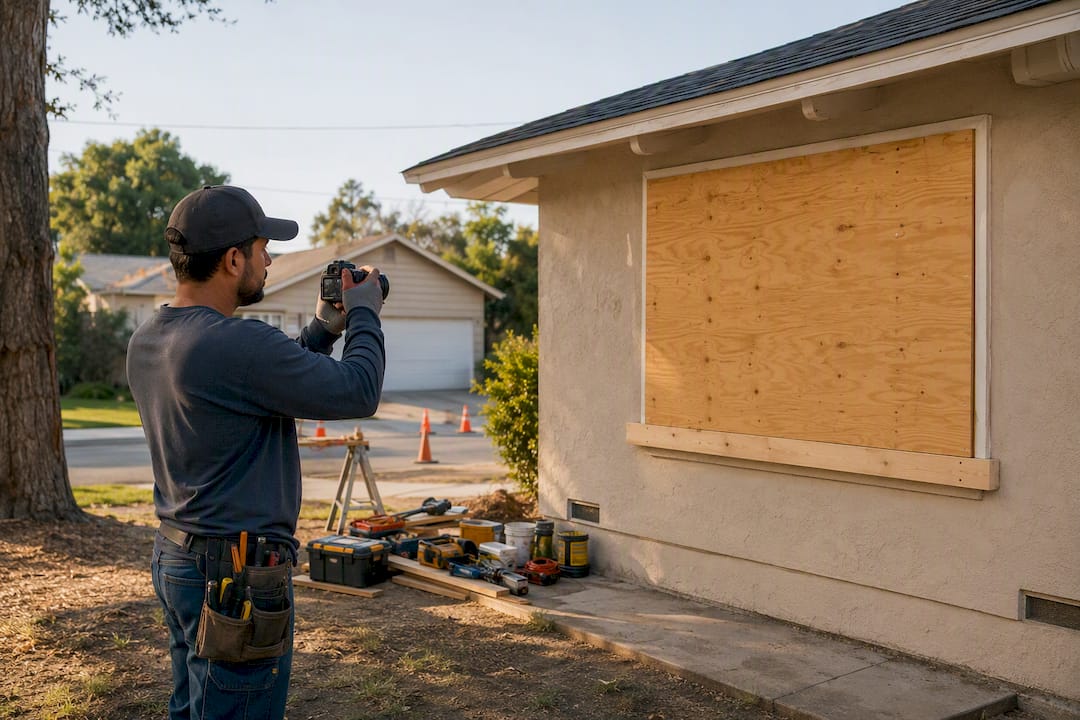
We coordinate directly with fire department personnel and utility crews on-site, because rushing past a safety check to save twenty minutes isn’t worth it if someone gets hurt. When you call us, have your address, a rough description of the damage, and your insurance carrier name ready. That’s it. We handle the rest, from securing the site through the eventual structural repair that follows.
The Advice Owners Skip Under Pressure
Most emergency guides obsess over response time, and I get why. It’s the number that grabs attention. But the research on this backs up something I’ve watched play out for years: the documentation matters just as much as the speed, and it’s the part panicked owners forget entirely.
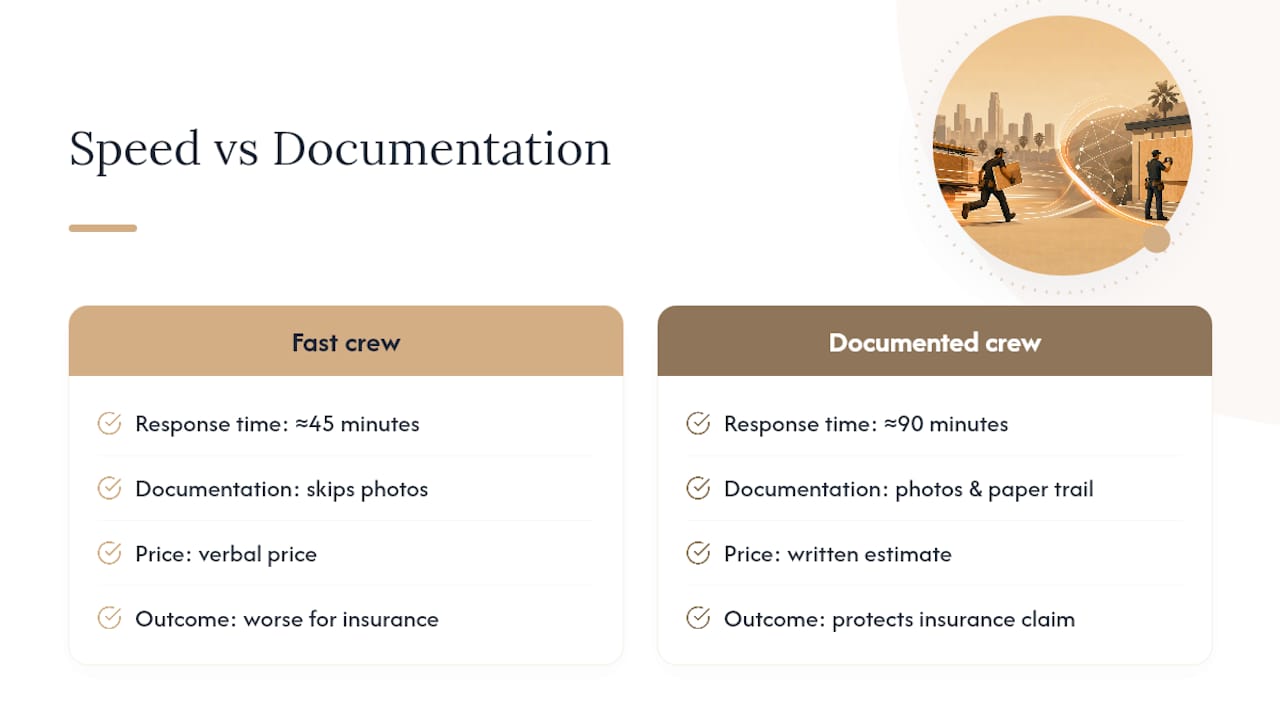
I’d argue conventional advice underrates one thing specifically: the phone call itself. Owners tend to call whoever answers first, without asking a single question about licensing, materials, or documentation. That’s backwards. A crew that shows up in 45 minutes but skips photos and hands you a verbal price is a worse outcome than a crew that arrives in 90 minutes with a full paper trail.
If you take one thing from this article, make it this: when you call, ask about documentation before you ask about price. The plywood is the easy part. Protecting your insurance claim is the part that actually determines whether this emergency costs you thousands more than it should.
— Ernie M
Get Same-Day Emergency Securing From Upright Construction & HVAC
Upright Construction & HVAC gives Los Angeles property owners something a lot of one-off board-up outfits can’t: a crew that’s already licensed, insured, and set up to hand your documentation straight to your restoration and repair timeline, no second contractor required. We run 24/7 emergency response across greater Los Angeles, and every job leaves you with the photos and itemized invoice your insurer will actually accept.
Getting help is three steps. Call us, tell us your address and what happened, and expect a crew on-site within our standard response window with full documentation in hand. If the damage involves fire, we’ll also walk you through next steps like smoke and soot cleaning once the structure is secure. Ready to move? Visit our emergency response page and get a crew headed your way tonight.
Sources
- Los Angeles Municipal Code — Vacant and boarded properties
- Major Restoration — What Happens During Emergency Board-Up Services?
- First Restoration America — Emergency board-up service: when you need it
FAQ
How fast can I get emergency board-up in Los Angeles?
Most metro LA crews arrive within 60 to 90 minutes of your call, with initial securement typically finished in 2 to 6 hours depending on the scope of damage.
Does insurance cover emergency board-up costs?
Board-up is generally treated as loss mitigation and is commonly covered under homeowner policies, though you should confirm details with your specific carrier.
How long can plywood legally stay on my building in LA?
Los Angeles rules generally limit temporary boards to a window of roughly 30 to 90 days before permanent repairs must begin.
What documentation should I get from a board-up crew?
Ask for pre-board, mid-board, and post-board photos along with a written, itemized invoice. That’s the documentation set insurers expect to see with a claim.
Can I board up my own windows instead of hiring a crew?
You can for minor damage, but skip it for fire-affected structures until fire officials clear the site, and know that DIY work won’t come with the insurer-ready documentation a professional crew provides.