
- Heat Pump Installation Cost by System Type and Home Size
- What Makes Heat Pump Installation Quotes Vary So Much
- Heat Pump Rebates and Incentives Available in 2026
- How to Get an Accurate Heat Pump Installation Quote
- Ernie’s Field Notes From 15 Years of Los Angeles Installs
- What Actually Matters When You’re Budgeting for This
- Get an Itemized Heat Pump Estimate From Upright
- Sources
- FAQ
- Recommended
A ducted air-source heat pump installation typically runs $5,800 to $10,000 for a 3-ton system in 2026, while single-zone mini-splits land between $2,700 and $5,800, and geothermal systems run $18,000 to $35,000. The federal 25C/25D tax credits expired for anything placed in service after December 31, 2025, so your best move now is getting three itemized bids and stacking whatever state and utility rebates you still qualify for.
TL;DR:
- Contractor costs vary widely based on electrical upgrades, duct repairs, refrigerant lines, permits, and regional labor rates, influencing final pricing significantly.
- The most substantial cost drivers beyond equipment are electrical panel upgrades and extensive ductwork modifications, which can add thousands of dollars to the project.
- Federal tax credits expired after December 2025, but homeowners can still access state, utility rebates, IRA grants, and LADWP incentives that can cover thousands of dollars.
- Homeowners should obtain detailed, itemized bids that specify equipment ratings, labor, permits, and responsibilities, rather than accepting rough estimates or phone quotes.
- Proper sizing and on-site diagnostics prevent early wear or ineffective operation, ensuring long-term performance and maximizing rebate qualification.
Heat Pump Installation Cost by System Type and Home Size
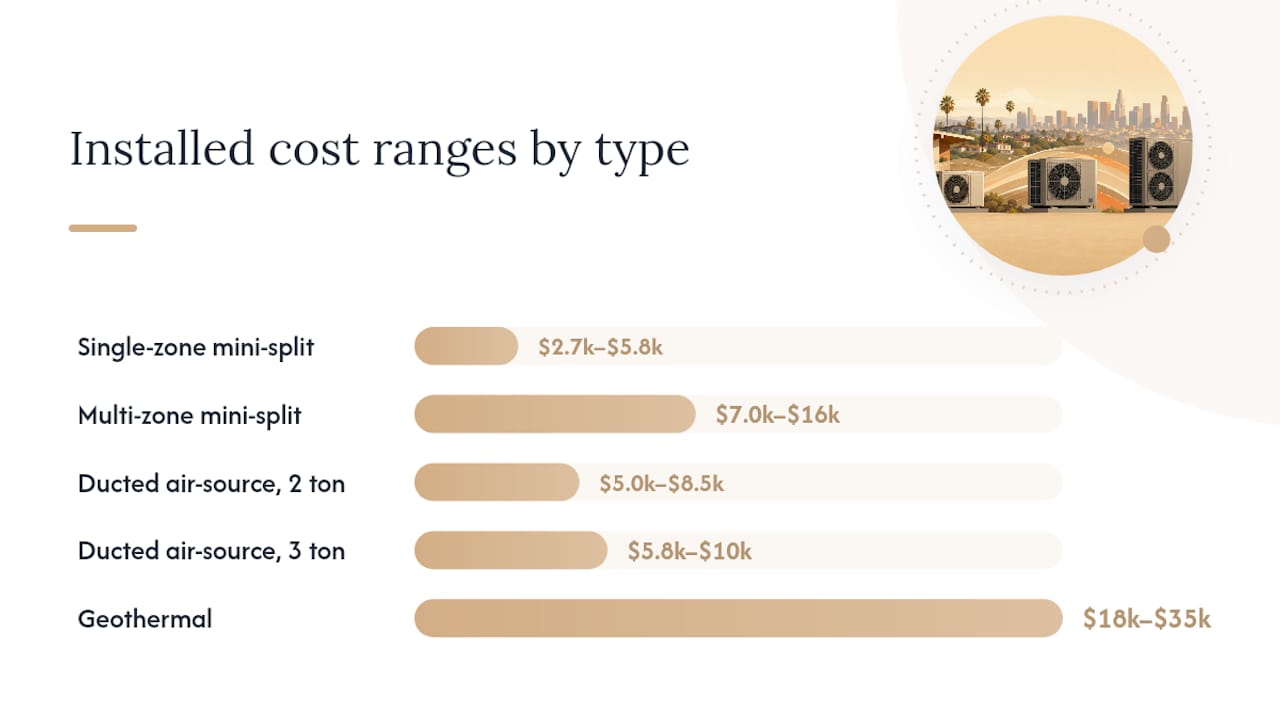
Equipment is only part of what you’re paying for. Roughly 40% of your bill covers the heat pump itself; the rest goes to labor, ductwork, electrical work, and permits. That split explains why two homeowners with identical equipment can get wildly different quotes. The contractor doing more of the “invisible” work—the wiring, the duct sealing, the load calculations—charges more because there’s more to do right.
Here’s how installed pricing typically breaks down by system type:
- Single-zone mini-split (1 room, up to ~600 sq ft): $2,700 to $5,800, ideal for additions, garages, or a single problem room that never gets comfortable.
- Multi-zone mini-split (2 to 4 rooms): $7,000 to $16,000, scaling with the number of indoor heads and total conditioned square footage.
- Ducted air-source, 2 ton (up to ~1,000 sq ft): roughly $5,000 to $8,500.
- Ducted air-source, 3 ton (1,200 to 1,800 sq ft): $5,800 to $10,000, the most common size for a mid-sized Los Angeles single-family home.
- Ducted air-source, 4 to 5 ton (1,800 to 3,000+ sq ft): $9,000 to $16,000, often pushing into whole-home ranges of $6,000 to $18,000 once ductwork and electrical upgrades enter the picture.
- Geothermal: $18,000 to $35,000, with the ground loop itself driving most of the cost variation.
Geothermal pricing hinges almost entirely on loop type. A trenched horizontal loop needs a large yard but costs less to install than a vertical borehole, while an open-loop system depends on having usable groundwater and a legal discharge point nearby. If your lot is small or rocky, expect the borehole option, and expect it to sit at the top of that $35,000 range.
What Makes Heat Pump Installation Quotes Vary So Much
Two contractors can quote the same house $6,000 apart, and it’s rarely because one is overcharging. It’s usually because they found different problems once they got into your attic or electrical panel.
- Electrical panel upgrades ($1,500 to $4,000). Older homes often have 100-amp panels that can’t handle a new heat pump’s electrical draw alongside everything else running. An electrician has to add this work, and it adds both cost and calendar time to your project.
- Ductwork repair or replacement ($2,000 to $8,000). Single-story homes with accessible attics run cheaper; multi-story homes with ducts buried in walls or crawlspaces cost more because of access alone.
- Line sets, mounts, and refrigerant. Roof or pad mounts, extended refrigerant lines for a distant outdoor unit, and code-required disposal of old equipment typically add a few hundred to over a thousand dollars combined.
- Permits and inspection fees. These vary by city but usually run a few hundred dollars in the Los Angeles area, and skipping them is not a shortcut worth taking if you ever plan to sell the house.
- Regional labor rates. California installs run roughly 1.20 to 1.40 times the national average, and cold-climate-rated equipment (needed for reliable heating well below freezing) carries its own premium in colder states.
Pro Tip: Ask every contractor to walk your attic and electrical panel before quoting, not after signing. A phone estimate that skips this step is the single most common reason a “final” price jumps mid-project.
Heat Pump Rebates and Incentives Available in 2026
Here’s the part that trips people up: the federal Section 25C and 25D tax credits expired for any system placed in service after December 31, 2025. Paying a deposit in 2025 does not lock in that credit. What locks it in is having the system actually completed and running, and that window has closed for federal credits.
That doesn’t mean the money is gone. It means the money moved.
- State and utility rebates. These range widely, from $500 up to $16,000 depending on your state, income, and program.
- IRA-funded HEAR grants. Income-qualified households can receive up to $8,000 per heat pump under this program.
- LADWP’s rebate, available to Los Angeles Department of Water and Power customers, pays up to $2,500 per ton of installed capacity, which on a 3-ton system can mean $7,500 back.
On operating costs, switching from natural gas heating typically saves around $370 a year on average, while replacing electric resistance heat or propane often saves far more, sometimes well over $1,000 annually depending on your climate and utility rates. Payback windows run anywhere from 3 years (heavy rebates, high previous fuel costs) to 12 or more years for a straightforward gas-to-heat-pump swap with modest incentives.
To stack incentives successfully, reserve your rebate slot before work starts, since many programs cap annual funding and close early. Confirm your equipment meets the program’s SEER2 and HSPF2 efficiency thresholds. And time the completion date carefully. If a program requires the system to be operational by a certain date to count toward that year’s funding cycle, missing it by a week can cost you thousands.

How to Get an Accurate Heat Pump Installation Quote
An itemized quote is the only quote worth comparing. Anything that just says “heat pump installation, $8,500” is a guess dressed up as a bid.
- Request equipment make, model, and both SEER2 and HSPF2 ratings in writing.
- Ask for a line-item breakdown separating equipment, labor hours, electrical work, ductwork, and permit fees.
- Confirm the contractor holds a valid C-20 HVAC license in California, carries insurance, and can provide references from recent local jobs.
- Ask who pulls the permit and who’s responsible for post-installation commissioning, the process of testing refrigerant charge, airflow, and controls to confirm the system actually performs as sold.
- Get the warranty terms in writing, plus a list of exactly what paperwork you’ll need to file for any rebate you’re counting on.
Our friends at Strong Heating & Cooling break down how HVAC rebates actually work if you want a deeper look at the paperwork side, and a piece on choosing the right general contractor covers vetting questions that apply just as well to HVAC bids as to remodeling ones.
Pro Tip: Get your bids during spring or fall. Contractors are less booked, prices are less inflated by peak-season demand, and you’ll have more room to negotiate before summer heat or winter cold makes you desperate.
Ernie’s Field Notes From 15 Years of Los Angeles Installs
I’ve been doing this in the Los Angeles area for over 15 years now, and the pattern I see most often isn’t a bad heat pump. It’s a homeowner who got a quote for the equipment and got surprised by everything else.
Sizing matters more than most people think. A heat pump that’s too big short-cycles and wears out early; too small and it struggles on the hottest August days. We run a proper load calculation before we quote anything, not a guess based on square footage alone.
On the LADWP rebate specifically, we help customers reserve their slot early and make sure the equipment we’re installing qualifies before we ever schedule the work. In practice, a typical LA install runs one to two days once permits clear, and the permit itself is often the slowest part, not the installation. We document every commissioning step with photos and readings, so if a rebate program ever asks for proof, it’s already on file. And if something goes wrong at 2 a.m. in July, our 24/7 support line means you’re not waiting until Monday.
What Actually Matters When You’re Budgeting for This
Most advice on heat pump costs focuses on the equipment price tag, and that’s the wrong place to focus. The equipment is the most predictable line item on the whole quote. It’s the electrical panel, the ductwork, and the permit timeline that actually determine what you’ll pay, and those are exactly the things a phone quote can’t catch.
The NRDC’s own analysis of California installs found that real-world project costs often run well above bottom-up engineering estimates, largely because the market is still maturing and per-project surprises are common. That gap will likely close as more contractors standardize their processes. Until then, the homeowner who gets three itemized bids and asks pointed questions about panel capacity and duct condition ends up paying closer to the honest number than the one who takes the first quote at face value.
If I had to boil this down to one piece of advice: don’t chase the lowest number. Chase the most detailed one.
— Ernie M
Get an Itemized Heat Pump Estimate From Upright
Upright Construction & HVAC gives you what most Los Angeles homeowners never get from a phone quote: an on-site diagnostic that catches panel and ductwork issues before they become mid-project surprises, not after you’ve already signed. We handle the LADWP rebate paperwork, pull the permits, and document commissioning so your rebate claim isn’t held up by missing proof.

Before your diagnostic visit, have your electrical panel accessible, your current system’s age and fuel type handy, and a rough idea of which rooms run hot or cold. That’s enough for us to start scoping the job accurately. If you’re in Los Angeles, Burbank, or Beverly Hills and ready to see real numbers instead of a ballpark, request a heat pump installation estimate and we’ll get you a written, itemized proposal you can actually compare against other bids.
Sources
- Heat Pump Installation Cost: Complete Pricing Guide (2026) | HVAC Base
- Energy efficient home improvement credit (IRS)
- Heat Pump Cost to Install | Home Energy Decisions
- NRDC technical analysis of California heat pump costs (2026)
Your local utility’s program page remains the final word on rebate eligibility and reservation, since caps and rules change throughout the year.
FAQ
How Much Does a Heat Pump Installation Cost in 2026?
A 3-ton ducted air-source system typically costs $5,800 to $10,000 installed, while single-zone mini-splits run $2,700 to $5,800 and geothermal systems run $18,000 to $35,000.
Are Federal Tax Credits Still Available for Heat Pumps in 2026?
No. The Section 25C and 25D federal credits expired for systems placed in service after December 31, 2025; state, utility, and IRA-funded programs are now the active incentive routes.
Does LADWP Offer a Heat Pump Rebate in Los Angeles?
Yes, LADWP customers can receive up to $2,500 per ton of installed heat pump capacity, meaning a 3-ton system could qualify for up to $7,500 back.
Is Ductless or Ducted Installation Cheaper?
A single-zone ductless mini-split is generally cheaper upfront ($2,700 to $5,800) than a ducted system ($5,800 to $10,000 for 3 tons), but ducted systems can heat and cool an entire home more evenly through existing ductwork.