
- What are the common emergency HVAC cost components?
- How to negotiate emergency HVAC repair costs effectively
- Which emergency repairs justify after-hours premiums?
- How to prepare now so you negotiate better later
- Key Takeaways
- What I have learned negotiating HVAC emergency costs
- How Upright Construction & HVAC helps you avoid overpaying
- FAQ
- Recommended
TL;DR:
- Emergency HVAC repair costs are negotiable, and homeowners can save money by asking the right questions.
- Understanding the breakdown of diagnostic fees, surcharges, labor, and parts helps homeowners negotiate effectively and avoid inflated charges.
Emergency HVAC repair costs are negotiable, and most homeowners never realize it. When your system fails at 2 a.m. in july, the bill can run anywhere from $300 to over $2,000 depending on the repair, with after-hours surcharges adding $100 to $300 on top of that. Knowing how to emergency hvac cost negotiate before the technician arrives puts hundreds of dollars back in your pocket. The right approach is not aggressive. It is informed, calm, and backed by real numbers.
What are the common emergency HVAC cost components?
Understanding your bill is the first step to reducing it. Emergency HVAC pricing typically breaks into four distinct charges, and each one carries different negotiation potential.
The four main cost components are:
- Diagnostic fee: Ranges from $65 to $150. This covers the technician’s time to identify the problem. Some companies waive it if you proceed with the repair.
- After-hours surcharge: Ranges from $100 to $300. This is the premium for calling outside normal business hours, on weekends, or on holidays.
- Labor: Emergency labor rates run 1.5x to 2x the standard hourly rate. Most companies bill a minimum block of 1 to 2 hours regardless of how long the job actually takes.
- Parts: Parts pricing stays relatively stable, but contractor markups can be significant. A capacitor that costs $15 wholesale may appear on your invoice at $75 or more.
The most important thing to understand is that emergency pricing is driven by timing, not just by what is broken. A simple capacitor swap at midnight costs far more than the same repair at 10 a.m. on a Tuesday. That timing premium is exactly where negotiation has the most impact.
| Cost Component | Typical Range | Negotiable? |
|---|---|---|
| Diagnostic fee | $65–$150 | Yes, often waived with repair |
| After-hours surcharge | $100–$300 | Yes, especially with service plan |
| Labor (emergency rate) | 1.5x–2x standard | Partially, via manager approval |
| Parts markup | Varies widely | Yes, ask for itemized parts cost |
| Minimum labor block | 1–2 hours billed | Rarely, but worth asking |
Quotes sometimes include fees labeled “system commissioning” or “electrical modification” that have no clear connection to your actual repair. Unexplained fees like these are a red flag and should be questioned or removed before you agree to anything.
How to negotiate emergency HVAC repair costs effectively
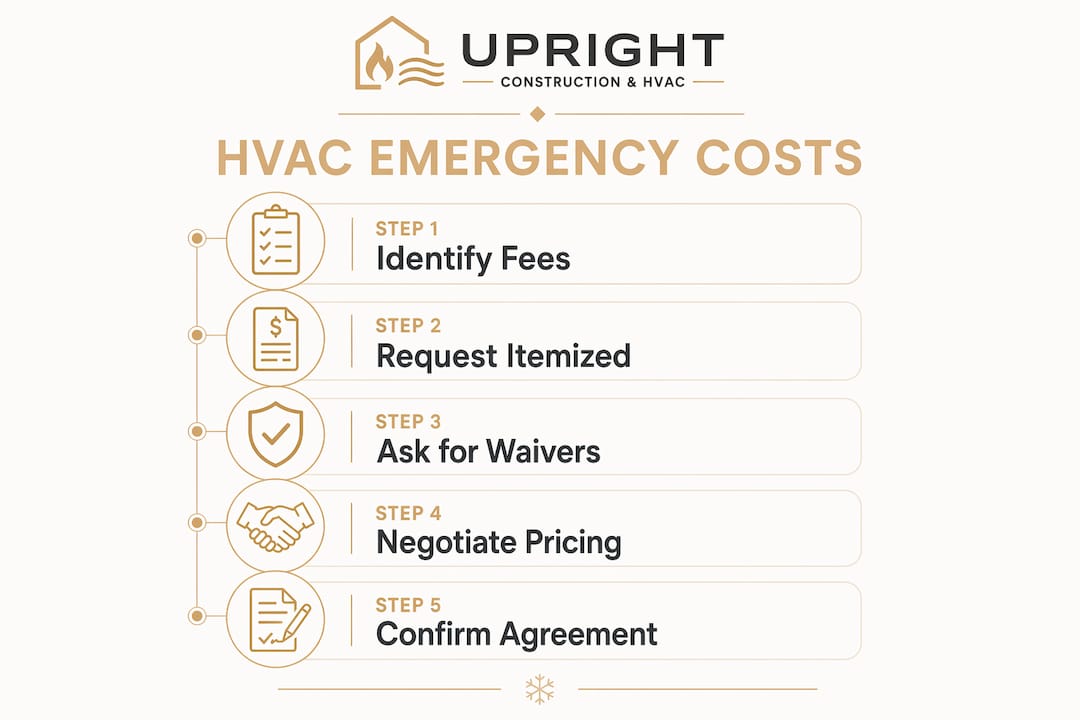
Negotiating HVAC repair costs is a skill, and it works best when you stay calm and come prepared. Here is a step-by-step approach that actually gets results.
Ask for a fully itemized estimate before approving any work. Do not accept a single lump-sum quote. Ask the technician to break out the diagnostic fee, labor, parts, and any surcharges separately. This gives you a clear picture of where the money is going.
Use the unbundling tactic. Removing unnecessary line items from a quote can cut a $750 bill down to $380. Ask directly: “Is this fee required for my specific repair?” If the technician cannot explain it clearly, request it be removed.
Anchor with competitor quotes. Call one or two other HVAC companies before approving work, even if it takes 15 minutes. Then say: “I have estimates between $X and $Y. What can you do?” This specific phrasing is far more effective than a vague “can you do better?”
Ask to speak with the service manager. Field technicians and dispatchers often have pricing discretion, but service managers can approve a 10 to 20 percent discount on the spot when you ask politely and explain your situation. This one step alone can save $75 to $200 on a mid-size repair.
Negotiate the after-hours surcharge directly. After-hours surcharges are almost always negotiable, especially if you mention you are a repeat customer or ask about signing up for a service plan during the call. Many companies will reduce or waive the surcharge to retain your business.
Stay polite and specific throughout. Contractors respond poorly to aggressive demands but respond well to informed, respectful requests. Phrases like “I want to work with you on this” and “Can you help me understand this charge?” keep the conversation productive.
Pro Tip: Write down every fee on the estimate before the technician starts work. Once the job is done, your negotiating position weakens significantly. Always negotiate before approving the repair.
Knowing your HVAC emergency cost factors in advance gives you a real advantage in these conversations. Contractors respect homeowners who ask specific questions.
Which emergency repairs justify after-hours premiums?
Not every HVAC failure is a true emergency. Paying a $200 after-hours surcharge for a problem that can safely wait until morning is money wasted. The key is knowing the difference.
Situations that justify paying emergency rates:
- Gas smell near your furnace or HVAC unit. This is a safety risk that requires immediate action.
- No heat when outdoor temperatures drop below 40°F, especially with children or elderly residents in the home.
- No cooling when indoor temperatures exceed 95°F during a heat wave.
- Active refrigerant leaks or electrical burning smells, which can escalate quickly.
- Water actively flooding from the unit, which risks structural damage.
Situations that can usually wait until morning:
- Reduced airflow or uneven cooling with no safety risk.
- Thermostat malfunctions when temperatures are mild.
- Unusual noises without any loss of heating or cooling function.
- Minor efficiency drops that do not affect comfort significantly.
Waiting until morning can save $100 to $300 in surcharges alone if the issue is not urgent. That is real money for a non-emergency call.
“Emergency repairs should be reserved for genuine safety or habitability risks. Non-urgent issues can wait safely without risking damage or health.” — Cool Call Pro
Understanding when AC repair is truly urgent helps you make that call confidently. The role of an emergency HVAC technician is specifically designed for situations where waiting creates real risk.
How to prepare now so you negotiate better later
The best time to prepare for an HVAC emergency is before one happens. Homeowners who do a little prep work ahead of time negotiate from a position of strength.
Pro Tip: Keep a simple folder, physical or digital, with your HVAC model number, past repair receipts, and any active warranties. When a technician arrives at midnight, you will know exactly what work has already been done and what parts are still under warranty.
Here is what preparation looks like in practice:
Know your system basics. Learn your unit’s brand, model, and age. A 12-year-old Carrier unit has different repair economics than a 3-year-old Lennox system. Knowing this lets you ask better questions and spot inflated parts pricing faster.
Get quotes before you need them. Call two or three local HVAC companies during a non-emergency and ask for their standard and after-hours rates. Save those numbers. When an emergency hits, you already have comparison data ready to use.
Sign up for an HVAC service plan. Service plans typically cost $150 to $350 annually and often waive after-hours emergency surcharges entirely. That single benefit can pay for the plan in one emergency call. Upright Construction & HVAC offers service contract options that reduce emergency costs and include priority scheduling.
Keep maintenance records organized. Contractors are less likely to pad quotes when they see a homeowner who tracks every repair. A documented history also helps you spot if a technician is recommending work that was already completed recently.
| Preparation Step | Benefit | Impact on Negotiation |
|---|---|---|
| Know system model and age | Spot inflated parts pricing | High |
| Collect competitor rate quotes | Anchor your negotiation | High |
| Sign up for a service plan | Waive after-hours surcharges | High |
| Maintain repair records | Prevent duplicate work charges | Medium |
| Learn basic HVAC symptoms | Ask informed diagnostic questions | Medium |
Staying organized year-round makes you a harder target for inflated emergency pricing. Contractors know when a homeowner is paying attention.
Key Takeaways
Negotiating emergency HVAC repair costs requires knowing your cost components, asking for itemized quotes, and using service manager escalation to reduce surcharges and labor rates.
| Point | Details |
|---|---|
| Understand cost components | Break out diagnostic fees, labor, surcharges, and parts before approving any work. |
| Use unbundling to cut costs | Removing unexplained line items can cut a $750 quote to $380. |
| Escalate to service managers | Managers can approve 10–20% discounts on the spot with a polite request. |
| Know when to wait | Non-urgent issues can save $100–$300 by waiting until normal business hours. |
| Prepare before emergencies | Service plans and competitor quotes strengthen your negotiating position significantly. |
What I have learned negotiating HVAC emergency costs
After 15 years running Upright Construction & HVAC in Los Angeles, I have seen homeowners overpay by hundreds of dollars simply because they felt too stressed or too rushed to ask questions. I understand that feeling. When your heat goes out on a cold night, the last thing you want is a negotiation. But I promise you, a calm two-minute conversation before the work starts is worth it every time.
The tactic I see work most consistently is the escalation to a service manager. Most homeowners talk only to the dispatcher or the field technician. Those folks often have limited flexibility. But the moment you politely say, “I appreciate your help. Is there a manager I can speak with about the pricing?” the whole dynamic shifts. I have watched that single move reduce bills by $150 or more.
One thing I warn homeowners about is the vague line item. I have seen quotes with charges like “system commissioning” on a job that was nothing more than a capacitor swap. That fee has no place on that invoice. If you cannot get a clear explanation for a charge in plain English, push back. A reputable contractor will explain it or remove it. A contractor who gets defensive about it is telling you something important.
My honest advice is this: do not accept the first number you hear. You are not being difficult. You are being a responsible homeowner. The contractors I respect most in this industry welcome informed customers because it leads to better, more honest work on both sides.
— Ernie M
How Upright Construction & HVAC helps you avoid overpaying
Upright Construction & HVAC was built on the belief that homeowners deserve honest pricing, especially during emergencies. When you call us, you get a fully itemized estimate before any work begins. No vague fees, no surprise surcharges, and no pressure to approve work you do not understand.

Our service plans reduce or eliminate after-hours surcharges and include priority scheduling for Los Angeles homeowners. If you want to understand exactly what goes into your repair bill, our team walks you through every line item. Start by reading our guide on common HVAC repair challenges to know what to expect before you ever pick up the phone. When an emergency hits, we are ready to help you handle it without overpaying.
FAQ
How much does an emergency HVAC repair typically cost?
Emergency HVAC repairs range from $300 to $1,200 for minor components, with major repairs exceeding $2,000. After-hours surcharges add $100 to $300 on top of the base repair cost.
Can you really negotiate emergency HVAC fees?
Yes. Up to 30–40% of flat-rate quotes can be negotiated downward with polite, data-driven pushback. Asking to speak with a service manager is the single most effective tactic.
What fees on an HVAC invoice should I question?
Question any fee that is not clearly explained, including charges labeled “system commissioning” or “electrical modification” on simple repairs. Unexplained fees are a red flag and should be removed unless the technician can justify them specifically.
Does an HVAC service plan reduce emergency costs?
Yes. HVAC service plans cost $150 to $350 annually and commonly waive after-hours emergency surcharges, which can pay for the plan in a single emergency call.
When should I wait until morning instead of calling for emergency service?
Wait if the issue involves no safety risk, no habitability risk, and no escalating damage. Waiting until morning saves $100 to $300 in surcharges for non-urgent problems like reduced airflow or mild thermostat issues.