
- How to make the HVAC repair vs replacement decision using cost rules
- When should I replace my HVAC system regardless of cost?
- How do maintenance history and warranty status affect the decision?
- Should I replace my HVAC when selling my home or upgrading technology?
- Key takeaways
- What I have learned after 15 years of HVAC decisions in Los Angeles
- Get expert help with your HVAC repair or replacement in Los Angeles
- FAQ
- Recommended
TL;DR:
- The $5,000 rule suggests replacing an HVAC system if multiplying its age by repair costs exceeds that amount.
- Additional factors like maintenance history, ductwork condition, and future plans influence the final decision.
The most reliable method for making the HVAC repair vs replacement decision is the $5,000 rule: multiply your system’s age by the estimated repair cost, and if that number exceeds $5,000, replacing your system typically makes more financial sense than repairing it. Replacement costs range from $5,000 to $28,000, so this rule gives you a quick, grounded starting point before you spend a dime. That said, age and repair cost alone do not tell the whole story. System type, maintenance history, ductwork condition, and your plans for the home all shape the right call. This guide walks you through every factor so you can decide with confidence, not guesswork.
How to make the HVAC repair vs replacement decision using cost rules
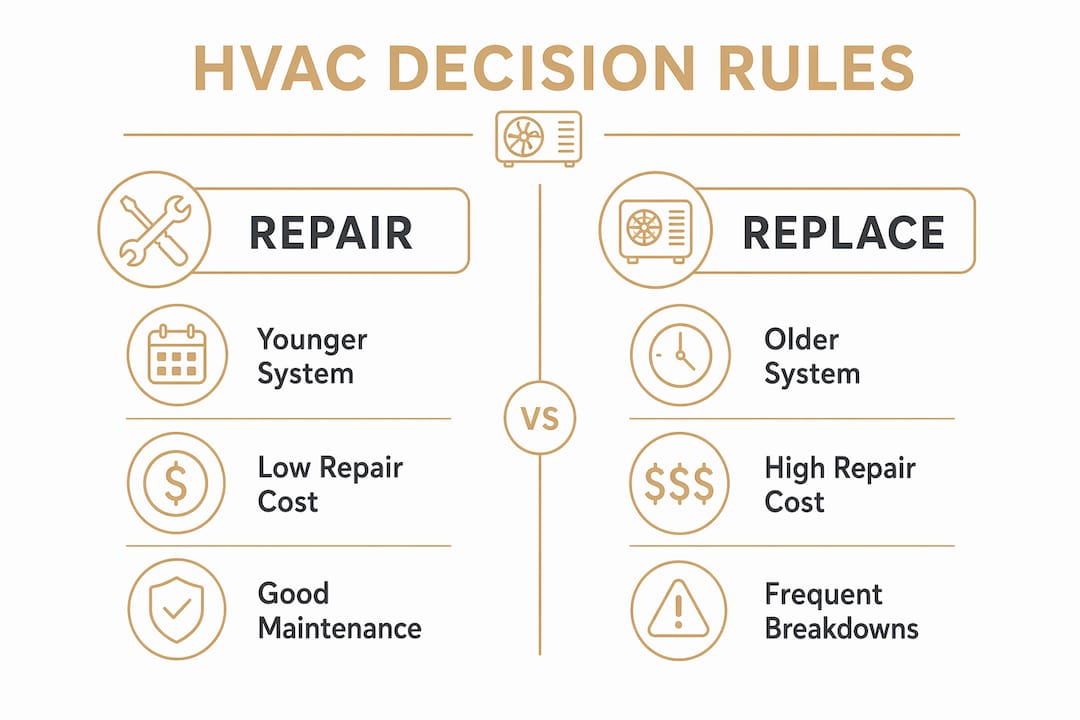
The $5,000 rule is the most widely used heuristic in the HVAC industry. Here is how to apply it in three steps:
- Get a written repair estimate from a licensed HVAC technician before committing to anything.
- Multiply your system’s age (in years) by the repair cost. For example, a 12-year-old system needing a $600 repair scores 7,200. That exceeds $5,000, which points toward replacement.
- Compare that score against the replacement cost for your home’s size and system type.
A $600 repair on a 5-year-old system scores only 3,000. Repair it. The same $600 repair on a 14-year-old system scores 8,400. Start getting replacement quotes.
The 30% and 50% rules as backup checks

The $5,000 rule works well for quick screening, but two additional thresholds sharpen the picture. Repair is generally recommended if the cost is under 30% of what a new system would cost. If repair costs climb above 50% of replacement cost, most HVAC professionals recommend replacing outright. The table below shows how these rules apply across common scenarios.
| Scenario | Repair cost | New system cost | % of replacement | Recommendation |
|---|---|---|---|---|
| Young system, minor fix | $400 | $8,000 | 5% | Repair |
| Mid-age system, moderate fix | $2,000 | $9,000 | 22% | Repair (borderline) |
| Aging system, major fix | $4,500 | $10,000 | 45% | Replace |
| Old system, compressor failure | $3,800 | $7,500 | 51% | Replace |
Keep in mind that lifecycle costs matter too. A repair calculator that factors in projected future repairs, energy use, and maintenance gives you a more accurate comparison than a single repair quote.
Pro Tip: Ask your technician for an itemized quote that separates labor from parts. This helps you spot whether you are paying a premium for an aging system’s hard-to-find components, which is a strong signal to replace.
When should I replace my HVAC system regardless of cost?
Cost math alone does not always settle the question. Certain conditions push toward replacement even when the repair estimate looks manageable.
- Repeated breakdowns: Three or more unscheduled repairs within 36 months is a clear signal that your system is failing systemically, not just experiencing isolated issues.
- System age benchmarks: Furnaces typically reach end of life around 15 years. Central AC units average closer to 10–15 years depending on climate and maintenance. Los Angeles heat puts real stress on cooling equipment.
- Major component failures: Cracked heat exchangers or compressor breakdowns in units older than 10–15 years require immediate replacement. These are not patch-and-move-on situations.
- Carbon monoxide risk: A cracked heat exchanger does not just hurt efficiency. It can leak carbon monoxide into your living space, which is a safety emergency, not a repair decision.
- Obsolete refrigerants: Systems running on R-22 refrigerant face a real problem. R-22 was phased out of production in the United States in 2020. Sourcing it now is expensive and getting harder every year.
“A failing minor component on an aging system is often a symptom of imminent major failure. A capacitor failure on a 15-year-old unit, for example, frequently signals motor strain that will show up as a bigger repair within months.” — HVAC Repair or Replace Calculator
Check out 9 signs your HVAC needs replacement for a full breakdown of end-of-life indicators specific to Los Angeles homes.
How do maintenance history and warranty status affect the decision?
Age alone is not the deciding factor. A well-maintained 15-year-old system may still be repairable, while a poorly maintained 8-year-old unit with repeated breakdowns may need replacement sooner. Maintenance history often predicts remaining useful life better than the year of installation.
Warranty coverage adds another layer. Manufacturer warranties require documented annual professional maintenance, or parts and labor claims may be voided. Many homeowners discover this the hard way when a $2,000 repair that should have been covered comes back as a full out-of-pocket expense.
Here is what to check before making any repair or replacement decision:
- Pull your maintenance records. If you cannot document annual tune-ups, assume your warranty is compromised.
- Check ductwork condition. Old, leaky, or undersized ductwork can drastically reduce the efficiency of a new HVAC system if left unaddressed. Trane’s replacement resource guide flags this as one of the most overlooked factors in the entire decision.
- Factor in duct repair costs. If your ducts need work, add that estimate to the replacement total. A $9,000 new system plus $2,500 in duct repairs changes the math significantly.
- Review your current warranty terms. Some manufacturers offer transferable warranties, which adds value if you plan to sell.
Pro Tip: Before signing any replacement contract, ask the contractor to inspect your ductwork and provide a written assessment. Replacing an HVAC system without addressing duct leaks is like putting new tires on a car with a bent frame. You will not get the efficiency gains you paid for.
Regular HVAC preventative maintenance is the single best way to protect both your warranty and your system’s lifespan.
Should I replace my HVAC when selling my home or upgrading technology?
Your personal timeline and goals shape the repair-or-replace math in ways the $5,000 rule does not capture.
Selling your home within 1–2 years
Homeowners planning to sell within 12–24 months should prioritize functional repairs over full replacement in most cases. However, systems older than 15 years often lead buyers to request price reductions or seller credits to cover eventual replacement. A pre-listing HVAC inspection gives you leverage in negotiations and avoids surprises during escrow.
Heat pumps vs traditional AC units
Heat pumps operate more annual hours than traditional AC units, which changes the wear-and-tear math considerably. Standard heuristics like the $5,000 rule apply, but heat pump decisions also require evaluating whether upgrading to cold-climate heat pump technology makes sense for your home’s heating load. For a deeper look at this comparison, heat pumps vs AC units breaks down the key differences for Los Angeles homeowners.
Efficiency ratings and long-term operating costs
| System type | Key efficiency rating | What to look for in 2026 |
|---|---|---|
| Central AC | SEER2 | Minimum 15 SEER2 in California |
| Gas furnace | AFUE | 80% AFUE minimum; 95%+ for high efficiency |
| Heat pump | HSPF2 / SEER2 | Cold-climate models for variable temps |
New systems with higher SEER2 and AFUE ratings translate directly into lower monthly utility bills. In Los Angeles, where cooling runs most of the year, upgrading from a 10 SEER unit to a 16 SEER2 system can cut cooling costs meaningfully over a 10-year period.
Federal tax credits and California utility rebates are available in 2026 for qualifying high-efficiency systems. These incentives can offset $500 to $2,000 of replacement cost depending on the equipment and your income bracket. Ask your contractor to identify which rebates apply before you finalize any purchase.
Key takeaways
The most cost-effective HVAC repair vs replacement decision combines the $5,000 rule with system age, maintenance history, ductwork condition, and your personal timeline.
| Point | Details |
|---|---|
| Use the $5,000 rule first | Multiply system age by repair cost; replace if the result exceeds $5,000. |
| Watch for repeat breakdowns | Three or more unscheduled repairs in 36 months signals systemic failure, not isolated issues. |
| Maintenance history matters | A well-kept older system may outlast a neglected younger one; check your records before deciding. |
| Ductwork affects replacement value | Leaky or undersized ducts reduce new system efficiency; factor duct repair costs into your total. |
| Selling timeline changes the math | Prioritize repairs if selling within 12 months; aging systems over 15 years may still affect buyer negotiations. |
What I have learned after 15 years of HVAC decisions in Los Angeles
I have walked through hundreds of homes across the San Fernando Valley and greater Los Angeles, and the mistake I see most often is homeowners treating the repair-or-replace question as purely a math problem. The $5,000 rule is a great starting point. I use it myself. But I have seen homeowners repair a 14-year-old system three times in two years because each individual repair looked cheap on paper. By the time they called us for a fourth visit, they had spent more than a new system would have cost and were still sitting in an uncomfortable house.
The other pattern I see is the opposite: homeowners who panic after one repair quote and replace a system that had years of life left. A 9-year-old unit with a $400 capacitor issue does not need to be replaced. It needs to be fixed and put on a maintenance schedule.
What I always tell homeowners is this: plan your maintenance proactively so you are never making a replacement decision in the middle of a July heat wave with no AC. Emergency decisions are expensive decisions. When you have time to get two or three quotes, compare lifecycle costs, and check rebate eligibility, you almost always land on the right answer.
Ask your contractor to show you the math. Any technician worth hiring will walk you through the cost comparison without pressure. If they cannot explain why replacement makes sense in plain numbers, get a second opinion. Transparency is not optional. It is how good decisions get made.
— Ernie M
Get expert help with your HVAC repair or replacement in Los Angeles
Facing an HVAC issue and not sure which direction to go? Upright Construction & HVAC has been helping Los Angeles homeowners work through exactly this decision for over 15 years. We provide honest, written assessments that compare repair and replacement costs side by side, so you know what you are actually choosing between.

Whether you need a fast diagnosis on a struggling system or a full replacement quote with rebate guidance, our team is available 24/7. We cover everything from emergency repairs to complete system installations across the Los Angeles area. Start with our breakdown of common HVAC repair challenges to understand what issues most often drive the repair-or-replace conversation, then call us to get your specific system evaluated.
FAQ
What is the $5,000 rule for HVAC repair vs replacement?
The $5,000 rule multiplies your system’s age in years by the estimated repair cost. If the result exceeds $5,000, replacement is generally the more cost-effective choice.
How many repairs before I should replace my HVAC system?
Three or more unscheduled repairs within 36 months is the standard threshold that signals replacement over continued repairs. Two repairs within 24 months also commonly triggers the same recommendation.
Does HVAC system age alone determine when to replace it?
Age is a factor, but maintenance history often predicts remaining useful life more accurately than age alone. A well-maintained older system can outlast a neglected newer one.
Should I replace my HVAC before selling my home?
If your system is under 15 years old and functional, prioritize repairs. Systems older than 15 years may lead buyers to request price adjustments, so a pre-listing inspection helps you decide whether repair or replacement strengthens your sale position.
Does new ductwork need to be installed with a new HVAC system?
Not always, but leaky or undersized ductwork reduces the efficiency of a new system significantly. Always have ductwork inspected as part of any replacement evaluation and include repair costs in your total budget comparison.