- What Does Furnace Short Cycling Actually Look Like?
- What Causes Furnace Short Cycling?
- How Do I Fix Furnace Short Cycling Myself?
- When Is Short Cycling Actually Dangerous?
- When Should I Call a Licensed HVAC Technician?
- How Do I Prevent Short Cycling From Coming Back?
- Ernie M’s Field Notes: What Our Technicians Check First
- An Editorial Take on Fixing Short Cycling the Right Way
- Get Your Furnace Fixed Right, Without the Guesswork
- Sources
- FAQ
- Recommended
Furnace short cycling means your furnace fires up, runs for just a few minutes, then shuts off, over and over, instead of completing a normal heating cycle. The most common cause is a clogged air filter starving the system of airflow. Your first move: pull the filter, hold it up to a light, and replace it if you can’t see through it. Then watch your next cycle.
TL;DR:
- Most short cycling is caused by a clogged air filter or airflow restrictions that lead to overheating and safety switches shutting down the furnace.
- Timing the cooling cycle is crucial, as seconds-long shutdowns indicate ignition issues, while several-minute cycles suggest overheating or an oversized furnace.
- Homeowners can often fix short cycling by replacing filters, opening vents, and checking thermostats, but safety issues like soot or gas smell demand immediate professional attention.
- Persistent short cycling usually requires a technician to diagnose complex problems such as cracked heat exchangers, venting blockages, or faulty control boards.
- Regular maintenance, including filter replacement and annual tune-ups, can prevent recurrence, but red flags like yellow flames or soot require urgent professional intervention.
What Does Furnace Short Cycling Actually Look Like?
A healthy furnace runs for 10 to 15 minutes per cycle, firing two or three times an hour on a cold day. Short cycling means the burner shuts off in less than the normal full cycle time, sometimes very quickly, within a minute.
Timing it tells you a lot. Grab your phone and time the next cycle from ignition to shutoff. A failure that happens in seconds, almost as soon as the burner lights, usually points to an ignition or flame sensor problem. A cycle that runs several minutes before cutting off suggests overheating and a tripped limit switch, which is often airflow-related. And if the furnace restarts almost instantly even in cold weather, that pattern often signals an oversized unit that overshoots the thermostat setpoint before it can run a full cycle.
What Causes Furnace Short Cycling?
Most short cycling traces back to one of a handful of mechanical or airflow problems. Here’s what typically causes furnace cycling issues, ranked roughly by how often we see them:
- Dirty or clogged air filter. Restricted airflow traps heat inside the furnace, and the high-limit switch trips to protect the heat exchanger, the single most common cause we run into.
- Thermostat problems. Dead batteries, bad placement near a heat vent or drafty window, or a miscalibrated sensor can trigger false readings that mimic short cycling
- Closed vents or blocked returns. Furniture pushed against a return grille or supply registers shut during a remodel choke off airflow the same way a dirty filter does.
- Flame sensor or igniter faults. A sensor coated in soot can’t confirm the flame is burning, so the control board shuts the burner down within seconds as a safety measure.
- Failing limit or pressure switches, or blocked flue and intake. These trigger the same protective shutdown as a dirty filter, just through a different failure point.
- An oversized furnace. Diagnosing this requires a Manual J load calculation from a licensed technician, not guesswork.
- A cracked heat exchanger. Rare, but serious. Treat it as a safety issue, never a nuisance to live with.
How Do I Fix Furnace Short Cycling Myself?
Work through these in order. Stop and call a technician if you smell gas or see soot; don’t keep troubleshooting.
- Replace the air filter. Match the size printed on the frame and stick with a MERV 8 to 11 filter unless your furnace manual specifies otherwise.
- Open every supply vent and clear the returns. Registers closed during a remodel or furniture rearrangement are a surprisingly common culprit.
- Check the thermostat. Swap the batteries, confirm it’s set to “heat,” and note whether it sits near a lamp, sunny window, or supply vent that could throw off its reading.
- Time the next cycle and watch for blinking LED codes on the furnace control board. Seconds-long shutdowns point one direction; multi-minute cycles point another, as covered above.
- Clean the flame sensor, but only if you’re comfortable. Shut off power, remove the small metal rod near the burner, and wipe it gently with fine steel wool or a scouring pad. Never force it or bend the bracket.
Pro Tip: Snap a photo of any error code flashing on the furnace’s control board before you reset it. Technicians can often narrow down the fault from that code alone, which shortens the diagnostic visit and the bill.
If you’ve done all five steps and the furnace still short cycles, stop here. The remaining causes require a professional diagnosis.
When Is Short Cycling Actually Dangerous?
Short cycling isn’t just annoying. Repeated overheating stresses the metal in the heat exchanger until it cracks, and a cracked heat exchanger can leak carbon monoxide into your living space.
Watch for these red flags: a chirping or sounding CO alarm, a burner flame that’s yellow or flickering instead of steady blue, soot around the furnace cabinet, a rotten-egg gas smell, or headaches and nausea among people in the house.
If you notice any of these, shut off the furnace at the thermostat and the breaker, open windows, get everyone outside, and call 911 or your gas utility’s emergency line before calling anyone else. Don’t go back inside until it’s cleared.
When Should I Call a Licensed HVAC Technician?
Filters and thermostats are fair game for homeowners. Heat exchangers, cracked components, venting problems, control boards, and anything involving gas pressure are not. If your five DIY checks didn’t resolve furnace cycling issues, it’s time to book a visit.
A technician will run diagnostics you can’t do at home: static pressure readings, temperature rise across the heat exchanger, gas pressure tests, venting inspections, and a check of the furnace’s stored error codes. Expect a flame sensor cleaning or limit switch swap to run somewhere in the $100 to $350 range, an igniter replacement around $150 to $400, and a full heat exchanger replacement to cost considerably more, sometimes rivaling a new furnace once labor’s factored in. Most diagnostic visits take under two hours.
How Do I Prevent Short Cycling From Coming Back?
Almost every recurring case we see traces back to skipped maintenance.
- Swap the filter regularly every one to three months, more often with pets or heavy use, and stick with a MERV 8 to 11 filter rated for your system.
- Book an annual tune-up so a technician catches a failing sensor or switch before it strands you without heat.
- If you added insulation or new windows recently and now notice quick cycling, ask about furnace sizing since your heating load may have dropped.
- Test your CO alarms twice a year, ideally alongside your smoke detectors.
Ernie M’s Field Notes: What Our Technicians Check First
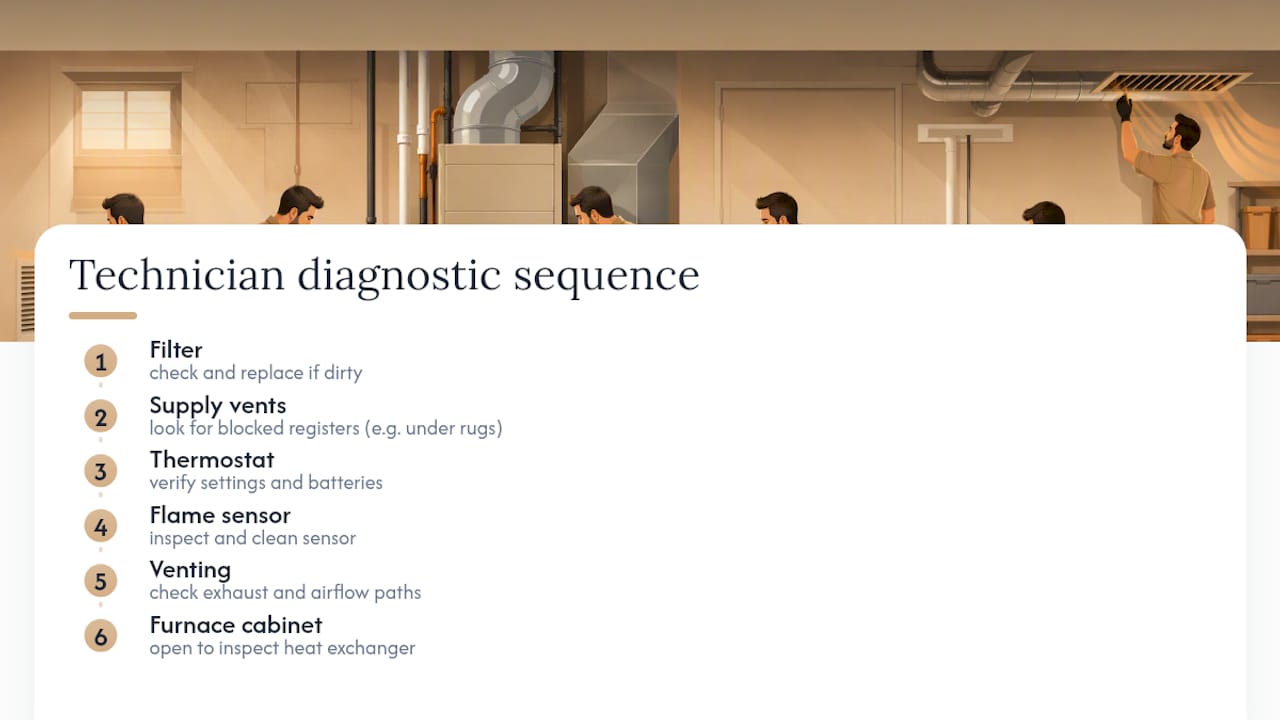
Our techs run the same sequence on nearly every short-cycling call: filter, vents, thermostat, flame sensor, then venting, and only then does anyone pull the furnace cabinet apart to inspect the heat exchanger. It’s faster to rule out the cheap stuff first.
The surprises are rarely dramatic. We’ve found supply registers buried under a rug after a remodel, and we’ve seen furnaces that ran fine for a decade start short cycling the winter after a homeowner upgraded their attic insulation, because the house suddenly needs less heat than the furnace was sized to deliver. Neither one required a new furnace.
An Editorial Take on Fixing Short Cycling the Right Way
Most advice on this topic treats every cause as equally likely, which wastes homeowners’ time and money. It isn’t. A dirty filter or a closed vent explains the overwhelming majority of the short-cycling calls we take, so the conventional wisdom of jumping straight to “maybe your furnace is oversized” or assuming the worst about the heat exchanger gets the order backward.
Here’s where I’ll push back a little: plenty of guides treat every furnace shutdown as a five-alarm emergency. That’s not right, and it’s not fair to readers either. A furnace shutting off after six minutes because the filter’s packed with pet hair is an inconvenience. A furnace shutting off with soot on the cabinet and a headache in the house is an emergency. Those two situations deserve completely different reactions, and conflating them either scares people unnecessarily or, worse, dulls their instinct to act fast when it actually matters.
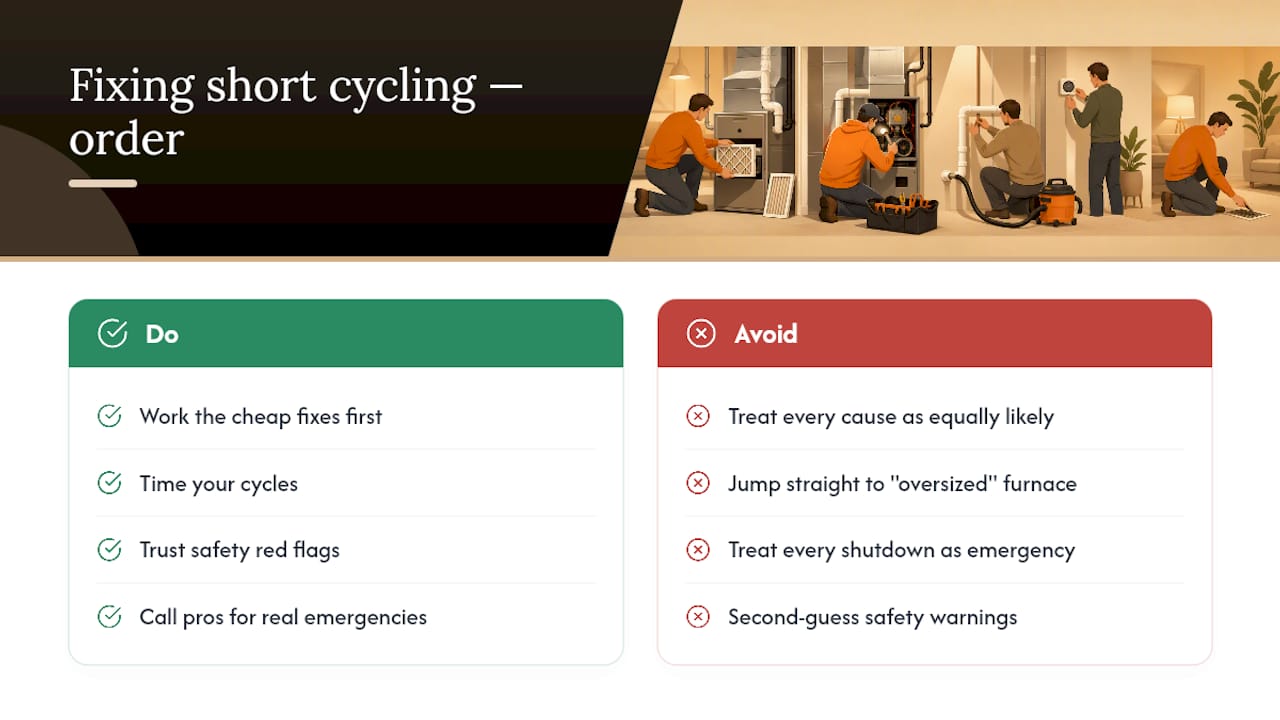
My advice: work the cheap fixes first, time your cycles, and trust the safety red flags without second guessing them. That order protects your wallet and, when it counts, your family.
— Ernie M
Get Your Furnace Fixed Right, Without the Guesswork
We offer prompt diagnosis to avoid a week of trial and error with uncertain parts. With extensive experience running this triage sequence on homes, we know what to check first.

A service call starts with a full inspection: filter, airflow, thermostat calibration, flame sensor, static pressure, and a heat exchanger check if the symptoms point that way. You get a written quote before any repair starts, no surprises on the invoice. If you’re seeing red flags like soot, a yellow flame, or a sounding CO alarm, call us right away for emergency HVAC repair. If your furnace is just cycling oddly and you want it looked at before it strands you on a cold night, book a maintenance visit and we’ll catch small issues before they become expensive ones.
Sources
For deeper troubleshooting detail, Northern One Hour’s breakdown of causes and fixes covers diagnostic tests in more depth. Bryant’s guide explains filter maintenance schedules, and older homes with drafty doors and ducts can find useful context in this piece on interior doors and energy efficiency.
- Furnace short cycling causes, DIY fixes, and when to call a pro | Northern One Hour
- Furnace short cycling: causes, fixes & prevention tips | Bryant
- Furnace short cycling: What it is and how to stop it | Trane
- Furnace short cycling: causes, diagnosis, and fixes | Furnace Direct
- Is furnace short cycling dangerous? Causes, risks, fixes, and prevention | PICKHVAC
FAQ
How Long Can a Furnace Short Cycle Before It Causes Damage?
Even a few days of repeated short cycles stresses the heat exchanger, since each shutdown is a mini overheating event that adds metal fatigue over time. Don’t wait weeks to address it, especially if cycles are running under two minutes.
Should I Turn My Furnace Off If It’s Short Cycling?
If you see no red flags like soot, gas smell, or a yellow flame, it’s generally safe to keep the furnace running while you work through filter and vent checks. If any red flag appears, shut it off immediately and call for emergency service.
How Much Does It Cost to Fix a Short Cycling Furnace?
Simple repairs like a flame sensor cleaning or limit switch replacement typically run $100 to $350, and an igniter replacement runs $150 to $400. A cracked heat exchanger costs considerably more and may make full furnace replacement the more practical option.
Can a Dirty Filter Really Cause Short Cycling?
Yes, and it’s the single most common cause technicians find. A clogged filter restricts airflow enough to overheat the heat exchanger, tripping the safety switch that shuts the burner down.
What’s the Difference Between Short Cycling and a Furnace That Won’t Start at All?
Short cycling means the furnace ignites and then shuts off early. A furnace that won’t start at all usually points to a dead thermostat, tripped breaker, or gas supply issue rather than the airflow and sensor problems behind most cycling issues.