- How does a thermostat work within the HVAC system?
- What are the main types of thermostats used in residential HVAC?
- Why does the thermostat setting matter for energy efficiency?
- How to troubleshoot common thermostat issues and when to upgrade
- Key Takeaways
- What I have learned after 15 years of HVAC work in Los Angeles
- Upright Construction & HVAC is ready to help with your thermostat and HVAC needs
- FAQ
- Recommended
TL;DR:
- The thermostat controls your heating and cooling system and influences energy costs and home comfort. Upgrading to a smart thermostat can save significant money through automated adjustments and remote control features. Proper installation, placement, and settings ensure optimal HVAC performance and energy efficiency.
The thermostat is defined as the command center of your HVAC system, controlling when your heating and cooling equipment turns on and off to maintain your desired indoor temperature. Every degree of comfort you feel at home traces back to this one device. Understanding the role of thermostat in HVAC systems helps you make smarter decisions about energy use, comfort settings, and when to call a professional. The right thermostat, set correctly, can meaningfully cut your utility bills while keeping your home comfortable year-round.
How does a thermostat work within the HVAC system?
A thermostat works by continuously sensing the air temperature in your home and comparing it to the temperature you have set. When the room temperature drifts above or below your setpoint, the thermostat sends a control signal to your HVAC equipment to start or stop.
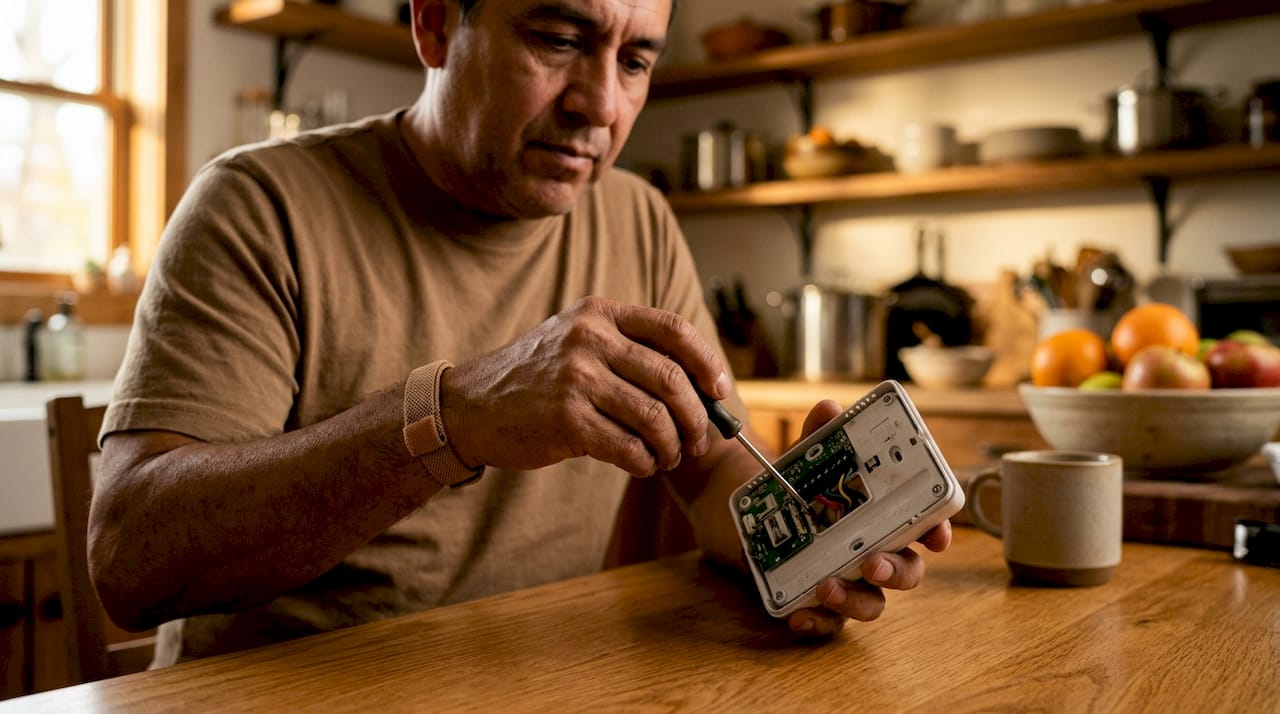
That signal travels through a low-voltage 24 VAC wiring system. A step-down transformer inside your furnace or air handler converts standard household voltage down to 24 volts, which is safe to handle and powers only the control switches, not the high-current heating or cooling components themselves. This separation of control signals from high-power circuits is what makes thermostat wiring safe for homeowners to inspect without serious risk.
The wiring connects to specific terminals on the thermostat board. The most common are:
- R terminal — carries the 24 VAC power from the transformer
- W terminal — activates the heating system (furnace or heat pump in heating mode)
- Y terminal — activates the cooling system (AC compressor)
- G terminal — controls the blower fan independently
- C terminal — the common wire that completes the circuit, required for continuous power in most smart thermostats
Each terminal carries a control signal that energizes a relay inside the HVAC unit. That relay then switches on the high-voltage components like the compressor or furnace burner. The thermostat itself never touches high-voltage power. It just tells the equipment what to do.
Pro Tip: If your system short-cycles (turns on and off too quickly), check the thermostat location first. A unit mounted near a heat source like a lamp or a sunny window will read false high temperatures and trigger unnecessary shutdowns.
What are the main types of thermostats used in residential HVAC?
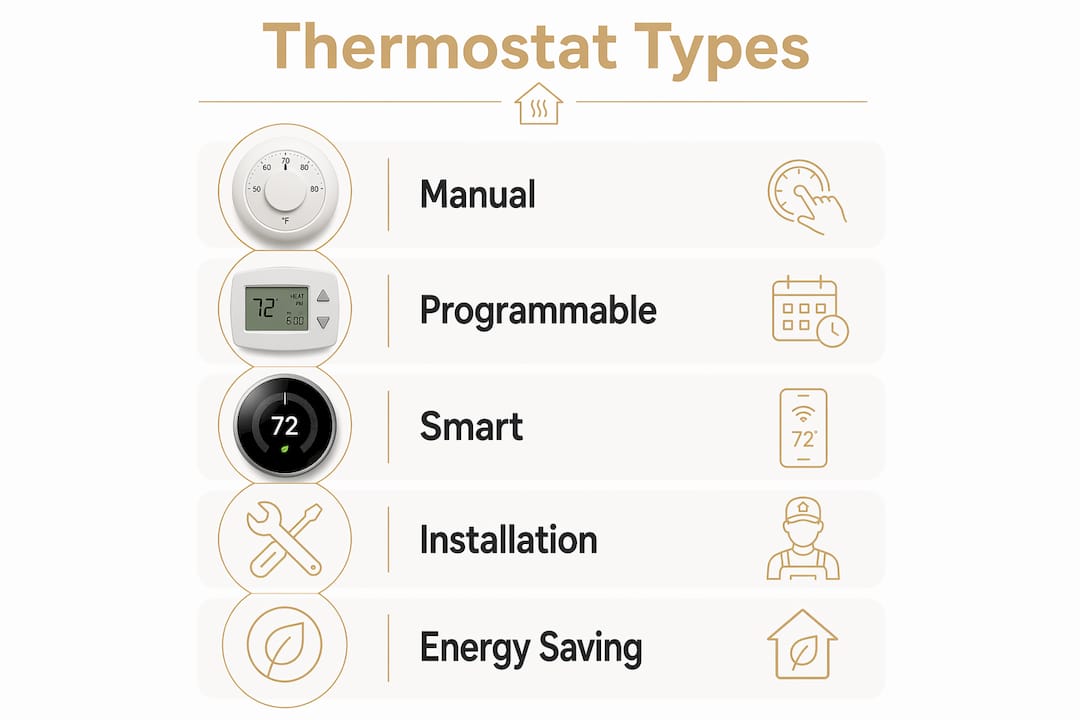
Thermostats fall into three main categories, and the right choice depends on your lifestyle, budget, and how much control you want over your HVAC system.
Manual thermostats
Manual thermostats are the simplest option. You set a temperature by turning a dial or sliding a lever, and the system runs until it hits that number. They have no scheduling ability, which means the system runs the same way whether you are home, asleep, or away. For most households, this leads to wasted energy.
Programmable thermostats
Programmable thermostats let you set different temperatures for different times of day and days of the week. A typical setup might lower the heat at night and raise it before you wake up. Programmable thermostats can reduce heating bills by 8–15% when used correctly. The catch is that user errors, like overriding the schedule too often or setting it up incorrectly, frequently cancel out those savings.
Smart thermostats
Smart thermostats go further by learning your schedule, detecting occupancy, and adjusting automatically. They connect to Wi-Fi, so you can control them from your phone. Smart thermostats save the average U.S. household $130 to $260 annually by reducing HVAC energy consumption by 15–23%. Energy Star-certified models guarantee at least 8% savings based on real-world performance data.
| Feature | Manual | Programmable | Smart |
|---|---|---|---|
| Scheduling | None | Yes, manual setup | Yes, automatic learning |
| Remote control | No | No | Yes, via smartphone |
| Energy savings | Minimal | 8–15% (if used correctly) | 15–23% |
| Upfront cost | Under $30 | $25–$150 | $100–$300 |
| Utility rebates | Rarely | Sometimes | Often $50–$100 |
Smart thermostat costs run $100–$300, while many utilities offer $50–$100 rebates that shorten the payback period to under two years. That makes upgrading a genuinely practical financial decision for most homeowners.
Pro Tip: Before buying a smart thermostat, check your utility provider’s website. Many Los Angeles area utilities offer rebates that bring the real out-of-pocket cost well below the sticker price.
Why does the thermostat setting matter for energy efficiency?
The importance of thermostat settings goes beyond comfort. How you program your thermostat directly determines how long your HVAC system runs each day, and runtime is the biggest driver of your energy bill.
Proper thermostat settings prevent unnecessary equipment strain, extend HVAC lifespan, and maintain consistent indoor comfort. A system that cycles on and off too frequently wears out faster and delivers uneven temperatures throughout the home.
The most common mistakes homeowners make with thermostat settings include:
- Cranking the temperature up or down to heat or cool faster. HVAC systems work at a fixed rate regardless of how extreme the setpoint is. Setting your thermostat to 85°F will not heat your home faster than setting it to 72°F.
- Overriding programmed schedules too often. Every manual override erases the energy savings the schedule was designed to create.
- Ignoring compatibility between the thermostat and the HVAC equipment. Multi-stage systems and heat pumps require thermostats that support staging logic, or the system will not run at peak efficiency.
Smart thermostats address these issues through features like adaptive recovery and geofencing. Energy Star’s adaptive recovery requirement means the thermostat learns how long your home takes to reach a target temperature and starts the system early enough to hit that temperature exactly when you need it, without running longer than necessary.
“The biggest energy wins come not from the thermostat itself, but from removing the human tendency to override it. Smart thermostats succeed precisely because they automate the setbacks that most people forget to program or choose to skip.”
Geofencing takes this further by using your phone’s location to detect when you leave or return home, adjusting the temperature automatically without any manual input.
How to troubleshoot common thermostat issues and when to upgrade
Most HVAC problems that seem like equipment failures actually start at the thermostat. Before assuming your furnace or AC compressor has failed, check the thermostat first.
Follow these steps when your system is not behaving as expected:
- Check the display. A blank screen usually means a dead battery or a tripped circuit breaker, not a broken system.
- Verify the mode setting. Confirm the thermostat is set to “heat” or “cool” as appropriate, not “fan only” or “off.”
- Inspect the wiring connections. Loose or corroded wires at the R, W, Y, or G terminals can interrupt control signals entirely. HVAC technicians verify control signals and wiring before assuming equipment failure.
- Test the setpoint. Set the temperature well above or below the current room temperature and listen for the system to respond within a minute or two.
- Check for location issues. A thermostat near a drafty window, exterior wall, or heat-producing appliance will read inaccurate temperatures and cause erratic system behavior.
When troubleshooting points to the thermostat itself, upgrading is often the smarter move over repairing an old unit. Signs it is time to replace include frequent temperature swings, a thermostat that is more than 10 years old, or a desire to add scheduling and remote access.
One installation detail that catches many homeowners off guard: many smart thermostats require a C wire for continuous power. Older homes often lack this wire in the thermostat cable. Adapters exist, but a professional installation ensures the wiring is correct and the system communicates properly with your equipment.
Pro Tip: Take a photo of your existing thermostat wiring before removing it. Label each wire with tape and a marker. This makes reinstallation or professional diagnosis much faster.
Key Takeaways
The thermostat controls every heating and cooling cycle in your home, making it the single most impactful device for both comfort and energy costs.
| Point | Details |
|---|---|
| Thermostat as system controller | The thermostat sends 24 VAC control signals that activate your furnace, AC, and fan. |
| Smart thermostats save real money | Energy Star-certified smart models save $130–$260 per year through automated setbacks. |
| Settings directly affect lifespan | Correct programming reduces unnecessary HVAC cycling and extends equipment life. |
| Upgrade triggers are clear | Replace thermostats older than 10 years or those causing frequent temperature swings. |
| Professional wiring matters | C-wire requirements and staging compatibility make professional installation worth the cost. |
What I have learned after 15 years of HVAC work in Los Angeles
The thermostat is the most underestimated device in the home. I have walked into hundreds of houses where the HVAC system was perfectly functional, but the homeowner was paying far more than necessary simply because the thermostat was outdated, poorly placed, or set up incorrectly.
The biggest oversight I see is homeowners treating the thermostat as a simple on/off switch rather than a programmable control system. A $200 smart thermostat paired with a well-matched HVAC system will outperform a $5,000 equipment upgrade if the settings are never touched. The technology only works when you let it do its job.
I also see a lot of DIY thermostat installs that create problems down the line. Mismatched wiring, missing C wires, and incompatible staging settings are the three most common issues. Getting the installation right the first time saves a service call later. If you are unsure about your wiring or whether your new thermostat is compatible with your system, call a professional before you start. The HVAC maintenance checklist we put together covers thermostat checks as part of a full seasonal review, and I recommend going through it at least twice a year.
The bottom line is this: your thermostat is worth paying attention to. Review your settings every season, check the placement, and do not ignore warning signs like short cycling or blank screens. Small adjustments here consistently deliver the biggest returns on comfort and cost.
— Ernie M
Upright Construction & HVAC is ready to help with your thermostat and HVAC needs
Getting the most from your HVAC system starts with the right thermostat, correctly installed and properly configured for your home’s equipment.

Upright Construction & HVAC has served Los Angeles homeowners for over 15 years, handling everything from thermostat wiring and smart upgrades to full system diagnostics. Our team checks compatibility, installs C wires where needed, and confirms your new thermostat communicates correctly with your furnace, AC, or heat pump. We also help you identify available utility rebates to reduce your upfront costs. If your system is acting up or you are ready to upgrade, our HVAC repair specialists are available 24/7. Contact Upright Construction & HVAC for a personalized home assessment and start getting more from every degree you set.
FAQ
What is the role of a thermostat in an HVAC system?
The thermostat acts as the control center for your HVAC system, sending low-voltage signals to activate heating, cooling, and fan operations based on your temperature setpoint. Without it, your system has no way to know when to run or stop.
How does a smart thermostat save energy?
Smart thermostats learn your schedule and occupancy patterns, automatically adjusting setpoints when you are away or asleep. Energy Star-certified models reduce HVAC energy consumption by 15–23%, saving the average household $130–$260 per year.
Where should a thermostat be placed for best results?
A thermostat should be mounted on an interior wall, away from direct sunlight, drafts, doorways, and heat-producing appliances. Poor placement causes false temperature readings and makes your HVAC system run longer than necessary.
Do I need a C wire for a smart thermostat?
Most smart thermostats require a common C wire for continuous power. Homes without one may need a wiring adapter or a professional to run a new wire, which is the most reliable long-term solution.
How often should I replace my thermostat?
A thermostat older than 10 years is a strong candidate for replacement, especially if you notice frequent temperature swings, short cycling, or a blank display. Upgrading to a programmable or smart model also delivers measurable energy savings.