
- What is the role of the expansion valve in HVAC systems?
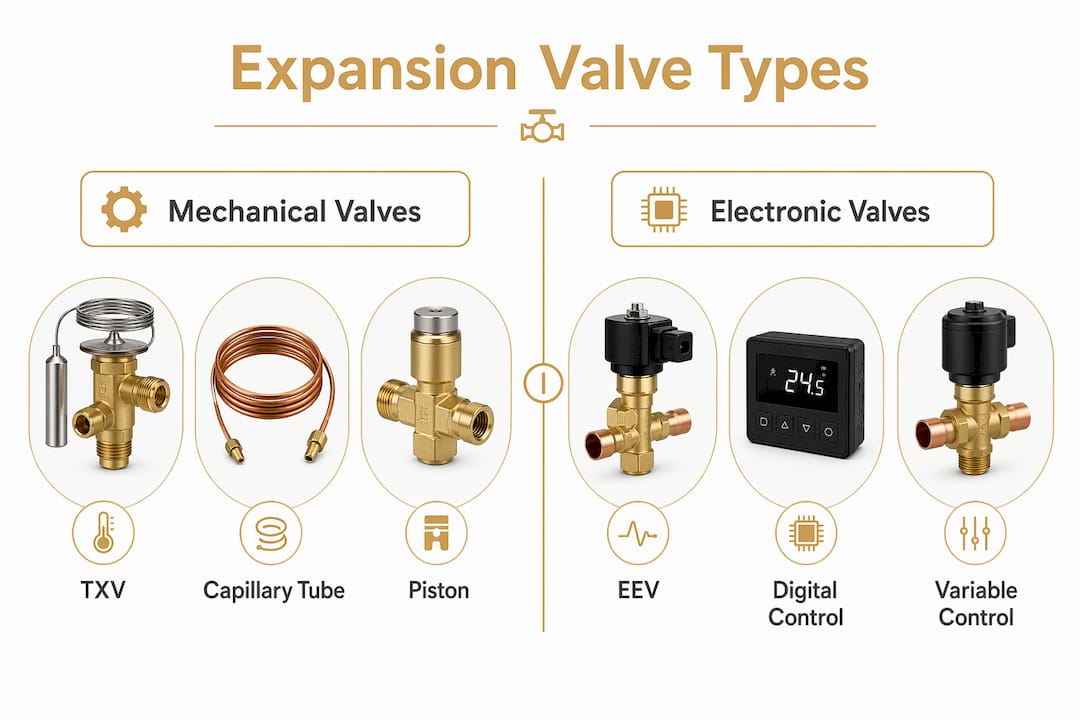
- What types of expansion valves are used in HVAC systems?
- What are the signs of a failing expansion valve?
- How do technicians diagnose expansion valve problems?
- How should an expansion valve be installed correctly?
- How long do expansion valves last, and what causes early failure?
- TXV vs. capillary tube vs. EEV: which metering device fits your system?
- Quick answers to common expansion valve questions
- Key Takeaways
- What I’ve learned about expansion valves after 15 years in the field
- Upright Construction & HVAC handles expansion valve diagnostics in Los Angeles
- Useful sources
- FAQ
- Recommended
The expansion valve is the metering device that drops high-pressure liquid refrigerant down to a low-pressure, partially vaporized state before it enters the evaporator coil, controlling superheat and protecting the compressor from liquid slugging. According to ASHRAE, this component’s primary job is to allow refrigerant to enter the evaporator at exactly the rate needed to maximize heat absorption. A residential expansion valve is designed to last around 15 years when properly maintained, though contamination or moisture can shorten that lifespan.
Three things the valve does simultaneously:
- Controls refrigerant flow rate into the evaporator, matching it to the actual heat load on the system
- Maintains target superheat, keeping vapor leaving the evaporator slightly above its boiling point so the compressor never sees liquid
- Prevents liquid return to the compressor, which would cause mechanical damage and dramatically shorten compressor life
When the valve fails, the consequences move fast. Either the compressor gets flooded with liquid refrigerant, or the evaporator starves and the system loses cooling capacity entirely. Either way, you are looking at an expensive repair if it goes undiagnosed.
What is the role of the expansion valve in HVAC systems?
To understand why the expansion valve matters so much, you need to follow the refrigerant around the circuit. High-pressure liquid leaves the condenser and travels down the liquid line. At the expansion valve, pressure drops sharply. That pressure drop causes partial vaporization, a process called isenthalpic expansion, and the refrigerant enters the evaporator as a cold, low-pressure mixture of liquid and vapor.
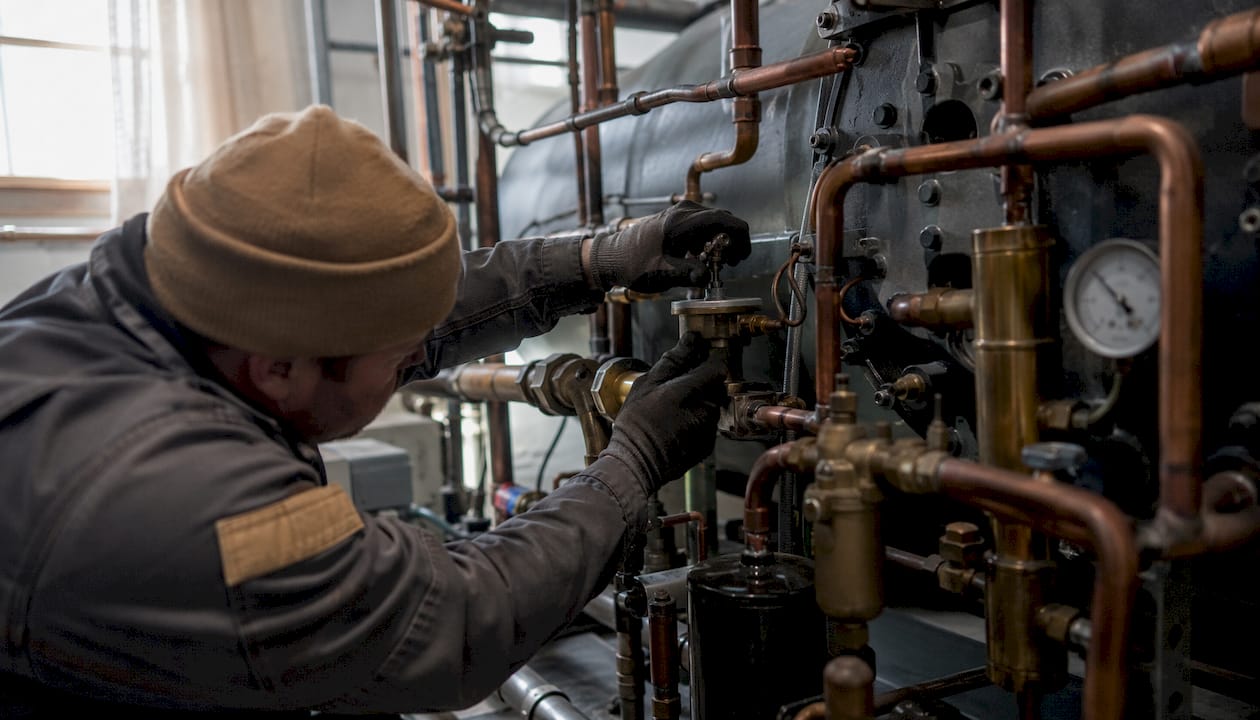
Inside the evaporator, that mixture absorbs heat from the indoor air, finishing the phase change from liquid to vapor. What leaves the evaporator outlet should be fully vaporized refrigerant with a small amount of extra heat added on top of the boiling point. That extra heat is superheat, and it is the signal the valve uses to regulate itself.
How a TXV balances three forces
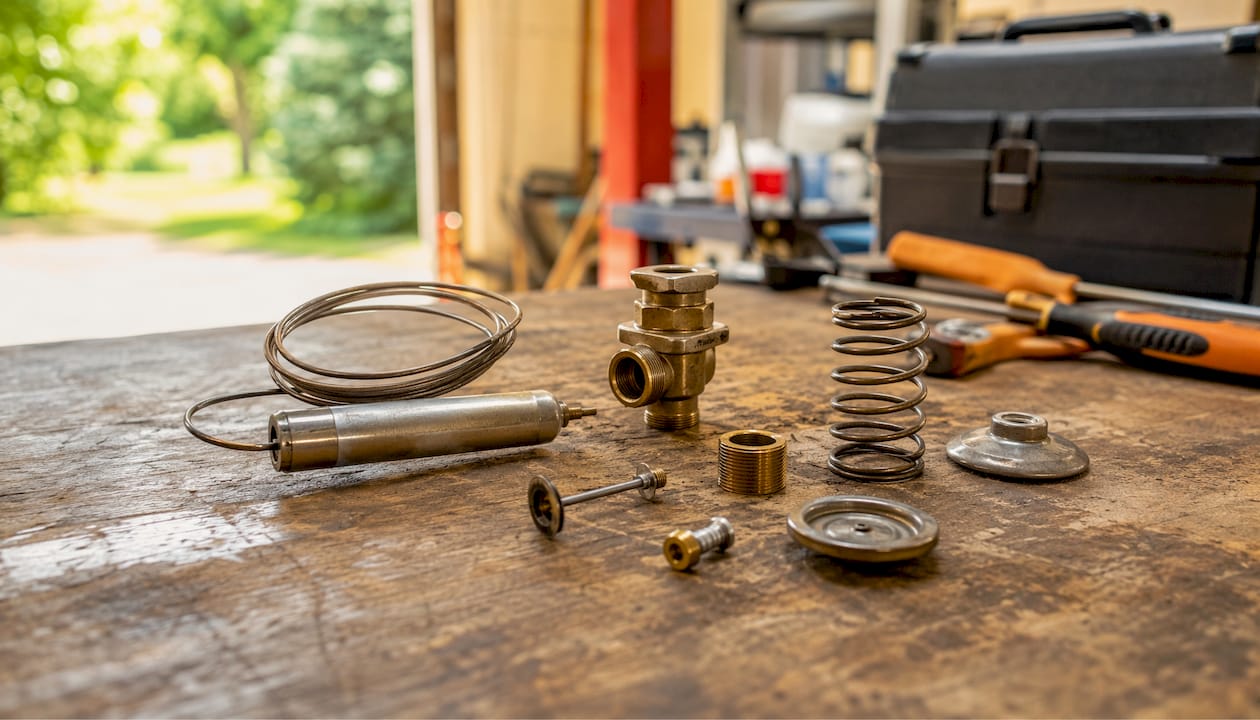
A thermostatic expansion valve (TXV, also called a TEV or TX valve) holds its needle position by balancing three competing pressures acting on a diaphragm:
- Bulb pressure (opens the valve): the sensing bulb clamped to the suction line reads evaporator outlet temperature and generates a corresponding pressure that pushes the diaphragm open.
- Spring pressure (closes the valve): a factory-set spring force biases the valve toward closed, establishing the target superheat setpoint.
- Evaporator pressure (closes the valve): the pressure inside the evaporator pushes back against the diaphragm from below.
When superheat rises, the bulb gets hotter, bulb pressure increases, and the valve opens wider to feed more refrigerant. When superheat drops, the bulb cools, pressure falls, and the spring closes the valve. It is a continuous mechanical feedback loop with no electronics involved.
TXV force-balance also depends on whether the valve is internally or externally equalized. An internally equalized valve reads evaporator pressure at the valve inlet, which works fine on single-circuit coils with low pressure drop. An externally equalized valve reads pressure at the evaporator outlet, compensating for any pressure drop across the coil. Multi-circuit systems and distributor-fed coils require external equalization; substituting an internally equalized valve on those systems will cause elevated superheat and poor performance.
How electronic expansion valves differ
Electronic expansion valves (EEVs) replace the mechanical bulb-and-diaphragm with a stepper motor or servo actuator driven by a controller that reads temperature and pressure sensors directly. ASHRAE notes that EEVs offer finer metering control via electronic feedback and can improve performance in variable-load systems, though they require controller tuning and electrical integration. The practical upside is tighter superheat control across a wider range of operating conditions. The downside is added complexity: sensors, wiring, and a controller that can all fail independently.
Key insight: A common misconception is that the expansion valve directly controls indoor temperature. It does not. The valve controls refrigerant superheat only. Actual cooling capacity depends on compressor size, airflow volume, and heat exchanger design. Adjusting a TXV to chase a comfort complaint without first verifying charge and airflow is a diagnostic shortcut that usually makes things worse.
Pro Tip: Never use TXV adjustment to mask airflow restrictions or an incorrect refrigerant charge. Doing so shifts the symptom without fixing the cause and puts the compressor at risk.
What types of expansion valves are used in HVAC systems?
Not every system uses a TXV. The metering device choice depends on system size, application, refrigerant type, and how much load variability the system sees.
| Type | Control Method | Pros | Cons | Typical Applications |
|---|---|---|---|---|
| TXV / TEV | Thermostatic (bulb + diaphragm) | Responsive, self-adjusting, no power needed | Sensitive to bulb placement, can hunt | Residential splits, light commercial, heat pumps |
| Capillary tube | Fixed restriction (tube diameter/length) | Simple, no moving parts, low cost | No load adjustment, sensitive to charge | Small window units, mini-splits, refrigerators |
| Fixed orifice / piston | Fixed restriction (orifice size) | Durable, low cost, bidirectional flow | No modulation, efficiency loss at part load | Residential heat pumps, packaged rooftop units |
| EEV | Electronic (stepper motor + controller) | Precise, wide control range, variable load | Complex, requires sensors and controller | High-efficiency systems, VRF, commercial chillers |
A few things worth knowing about each type:
- Capillary tubes are calibrated for a specific refrigerant charge and ambient condition. They cannot adapt to load changes, so system efficiency drops significantly at part load or in variable climates.
- Fixed-orifice pistons are popular in residential heat pumps because they allow bidirectional refrigerant flow, which simplifies the reversing-valve circuit. They are durable and nearly maintenance-free, but they sacrifice efficiency at part load.
- TXVs are the workhorse of light commercial and residential split systems. Their self-regulating nature means they handle load swings well, but they are sensitive to sensing-bulb placement and refrigerant contamination.
- EEVs are increasingly standard in high-efficiency systems and variable refrigerant flow (VRF) equipment because their computer-controlled metering reduces steady-state superheat error and allows independent control of multiple evaporators.
Correct valve selection and commissioning directly affects system efficiency and prevents compressor slugging, which is why matching the metering device to the application matters as much as matching the compressor.
What are the signs of a failing expansion valve?
Common indicators of a failing expansion valve include inconsistent cooling, evaporator coils freezing or frosting, and audible hissing or gurgling with the system running constantly without reaching setpoint. Here is how each symptom maps to a likely valve condition:
- Evaporator icing or frost buildup: The valve is overfeeding refrigerant (stuck open or hunting), flooding the evaporator with liquid that cannot fully vaporize. Ice forms on the coil surface and eventually blocks airflow entirely.
- Warm air with the system running: The valve is restricted or stuck closed, starving the evaporator of refrigerant. The coil cannot absorb enough heat, and the supply air temperature stays high.
- Erratic cycling or “hunting”: The valve oscillates between open and closed, causing suction pressure and supply air temperature to swing repeatedly. This often points to a loose or poorly insulated sensing bulb, or a valve that is slightly out of calibration.
- Hissing or gurgling sounds: Flash gas forming at the valve inlet due to a pressure drop in the liquid line, or a partially restricted valve creating turbulence. Both are audible clues worth investigating.
- System runs constantly without reaching setpoint: Reduced refrigerant flow through a restricted valve means the system never builds enough cooling capacity to satisfy the thermostat.
Before condemning the valve, recognize that low refrigerant charge, a dirty condenser, and restricted airflow across the evaporator all produce nearly identical symptoms. A technician should verify airflow and charge before concluding the valve is at fault.
Pro Tip: Before touching the valve, check sensing-bulb contact and insulation. A loosely clamped or uninsulated bulb reads ambient air temperature instead of suction-line temperature, causing erratic valve behavior that looks exactly like a mechanical fault.
How do technicians diagnose expansion valve problems?
Diagnosing a TXV fault correctly requires working through system-level conditions first. Jumping straight to the valve wastes time and risks replacing a part that was not the problem.
Step-by-step diagnostic flow
- Verify airflow: Check filter condition, evaporator coil cleanliness, and blower operation. Restricted airflow reduces heat load on the evaporator and mimics a restricted valve.
- Confirm refrigerant charge: Measure subcooling at the condenser outlet and compare to manufacturer specifications. Low charge produces low suction pressure regardless of valve condition.
- Check condenser: Confirm condenser coil cleanliness and fan operation. A dirty condenser raises head pressure and can cause liquid-line flash gas that starves the valve.
- Measure pressures and temperatures: Connect manifold gauges to suction and discharge service ports. Record suction pressure, discharge pressure, liquid-line temperature, and suction-line temperature at the evaporator outlet.
- Calculate superheat: Superheat = suction-line temperature minus saturation temperature at suction pressure. Compare to manufacturer target ranges provided in the valve documentation for most residential TXVs.
- Check bulb placement and insulation: Confirm the sensing bulb is clamped at the correct clock position on the suction line and fully insulated.
Pressure and superheat patterns by fault condition
| Condition | Suction Pressure | Head Pressure | Superheat | Likely Fault | Technician Action |
|---|---|---|---|---|---|
| Restricted valve | Low | High | High | Valve stuck closed, debris, ice at valve | Replace valve; install filter-drier |
| Overfeeding valve | High | Normal/Low | Low or zero | Valve stuck open, bulb charge lost | Replace valve; check for liquid slugging |
| Hunting valve | Fluctuating | Fluctuating | Oscillating | Loose/uninsulated bulb, calibration drift | Re-clamp and insulate bulb; replace if persists |
| Low charge (not valve) | Low | Low | High | Refrigerant leak | Find and repair leak; recharge |
| Airflow restriction | Low | Low/Normal | Low | Dirty filter or coil | Clean or replace; retest |
Safety note: Refrigerant handling requires EPA Section 608 certification. Never vent refrigerant to atmosphere. Use calibrated manifold gauges and a recovery machine before opening any refrigerant circuit. High-pressure refrigerant can cause serious injury.
Pressure pattern analysis is the fastest way to distinguish a restricted valve from an overfeeding one: restricted valves pull suction pressure down while pushing head pressure up, while overfeeding valves do the opposite.
Pro Tip: Cleaning a TXV is appropriate only when contamination is minor and the valve body shows no mechanical wear. If the valve has been exposed to moisture, acid, or debris that reached the needle seat, replacement is the right call. Cleaning a worn or acid-damaged valve buys days, not years.
How should an expansion valve be installed correctly?
Installation choices made during commissioning directly determine how well the valve performs for the next decade. Getting these right the first time is far less expensive than a callback.
Sensing-bulb placement and insulation
- Mount the sensing bulb on the suction line at the evaporator outlet, before any elbows or fittings that could affect temperature reading.
- On suction lines up to 7/8-inch OD, mount the bulb at the 12 o’clock position. On larger lines, mount at the 4 or 8 o’clock position to keep the bulb in contact with liquid refrigerant rather than oil that pools at the bottom.
- Wrap the bulb completely with closed-cell insulation tape and secure it tightly. An uninsulated bulb reads ambient air and causes the hunting behavior described above.
Equalizer-line routing
- Use an internally equalized valve only on single-circuit coils with minimal pressure drop.
- Any system with a refrigerant distributor, multiple parallel circuits, or a long evaporator coil requires an externally equalized valve. Route the external equalizer line to the suction line downstream of the sensing bulb, never upstream.
Compatibility and part selection
- Match the replacement valve to the system’s refrigerant type, capacity (tons), and port size. Using a non-matching replacement valve can cause poor superheat control, evaporator icing, or compressor damage.
- Verify oil compatibility. POE oil systems (common with R-410A and R-32) require valves with compatible internal seals.
Commissioning checklist
- Install a new filter-drier and inlet strainer ahead of the valve on every replacement job.
- Purge the system and pressure-test before charging.
- After charging, measure and document superheat and subcooling at the design operating condition.
- Braze connections with nitrogen flowing through the line to prevent copper oxide scale that can later migrate to the valve seat.
Pro Tip: Never reuse an old sensing bulb or swap valve variants (internal vs. external equalization) without verifying calibration and port sizes against the manufacturer’s specification sheet. A valve that looks identical can have a completely different spring force.
How long do expansion valves last, and what causes early failure?
A residential expansion valve is designed to last around 15 years when properly maintained. In practice, several factors can reduce that lifespan.
Common causes of premature failure:
- Moisture in the system: Water freezes at the valve orifice, causing intermittent restriction that clears when the ice melts, then returns. Repeated freeze-thaw cycles damage the needle seat.
- Debris and particulates: Metal shavings from a failing compressor or copper oxide from unprotected brazing migrate to the valve seat and cause partial restriction or prevent full closure.
- Oil degradation and acid: Overheated or contaminated oil breaks down into acids that attack valve internals, particularly the diaphragm and needle seat.
- Refrigerant conversion without valve re-selection: Switching from R-22 to a replacement refrigerant without selecting a valve calibrated for the new refrigerant’s pressure-temperature curve causes chronic superheat errors.
Maintenance steps that extend valve life:
- Replace the filter-drier at every service visit that opens the refrigerant circuit.
- Verify suction-line temperature at the evaporator outlet annually and compare to the prior year’s baseline.
- Inspect sensing-bulb insulation during every preventative maintenance visit.
- On commercial systems, consider periodic oil analysis to detect acid or moisture contamination before it reaches the valve.
Replacement triggers: persistent mis-calibration after cleaning, mechanical binding confirmed by pressure testing, evidence of moisture or acid contamination, or a refrigerant conversion that requires a different valve calibration. A good HVAC maintenance checklist will flag most of these before they become failures.
TXV vs. capillary tube vs. EEV: which metering device fits your system?
The right metering device depends on the application, not just preference. Here is a direct comparison of the three most common types across the criteria that actually matter in the field.
| Criteria | TXV | Capillary Tube | EEV |
|---|---|---|---|
| Load adaptability | Good (self-regulating) | None (fixed) | Excellent (active control) |
| Contamination tolerance | Moderate | Low (clogs easily) | Moderate |
| Part cost | Low–moderate | Very low | High |
| Serviceability | Replaceable | Replaceable (cut and solder) | Requires controller |
| Precision | Good | Poor | Excellent |
| Refrigerant compatibility | Wide (with correct selection) | Limited | Wide |
Selection criteria by application:
- Small residential split (1–3 tons, single zone): A TXV or fixed-orifice piston is the standard choice. Simple, reliable, and easy to replace. A capillary tube works in very small equipment but offers no load adaptability.
- Multi-zone or VRF systems: EEVs are the only practical choice. Independent control of each zone’s superheat is not possible with mechanical devices.
- Commercial refrigeration racks: TXVs with external equalization are standard. EEVs are used on high-efficiency racks where energy savings justify the added complexity.
- Mobile A/C (automotive): Block-type externally equalized TXVs are the norm, though some newer vehicles use EEVs for improved efficiency.
The efficiency argument for EEVs is real in variable-load applications. In a single-speed residential system that runs at full capacity most of the time, the efficiency gain over a well-matched TXV is marginal. Paying for EEV complexity in a simple single-zone system rarely pencils out. Correct valve selection and commissioning, including verifying target superheat and subcooling, is where home energy loss from HVAC inefficiency is actually prevented.
Quick answers to common expansion valve questions
- What happens when an expansion valve goes bad? The system either starves the evaporator (restricted valve, causing warm air and high superheat) or floods it (overfeeding valve, causing icing and potential compressor damage). Either condition degrades efficiency and, if left uncorrected, risks compressor failure.
- Can an AC work without an expansion valve? Not in a vapor-compression system. Every refrigerant circuit requires a metering device. Systems that appear to lack a TXV use a different metering device, such as a capillary tube or fixed-orifice piston, which performs the same pressure-drop function.
- How do you know if the valve is broken? Look for evaporator icing, inconsistent cooling, erratic cycling, or the system running continuously without reaching setpoint. Confirm with manifold gauge readings: abnormal suction pressure combined with off-target superheat points to the valve after airflow and charge have been ruled out. AC emergency warning signs like these warrant a same-day service call.
- How long do expansion valves last? Roughly 15 years under normal conditions. Moisture, debris, or acid contamination can cause failure much sooner.
- When should you call a licensed technician? Any time you observe icing, hear unusual sounds from the indoor unit, or notice the system running without cooling. Refrigerant diagnosis and recovery require EPA Section 608 certification. Do not attempt to adjust or replace a TXV without proper gauges and training.
Key Takeaways
The expansion valve meters refrigerant into the evaporator to control superheat, protect the compressor from liquid slugging, and maintain system efficiency across varying load conditions.
| Point | Details |
|---|---|
| Primary function | The valve drops refrigerant pressure and meters flow to maintain target superheat in the evaporator. |
| Expected lifespan | A properly maintained residential valve typically lasts around 15 years; moisture and debris shorten that. |
| Diagnosis order | Verify airflow and charge before suspecting the valve; most symptoms overlap with other faults. |
| Sensing-bulb installation | Correct bulb placement and full insulation are the most commonly overlooked factors in valve performance. |
| Upright Construction & HVAC | Upright Construction & HVAC provides same-day diagnostics and valve replacement in greater Los Angeles. |
What I’ve learned about expansion valves after 15 years in the field
After more than a decade of HVAC work across greater Los Angeles, the expansion valve is the component I see misdiagnosed most often. Homeowners call us convinced their compressor is dead, and we arrive to find a sensing bulb that slipped off the suction line six months ago. Re-clamp it, re-insulate it, and the system runs perfectly. That is a $50 fix that almost became a $2,000 compressor replacement.
The other pattern I see constantly: technicians adjusting the TXV spring to chase a comfort complaint. That almost never ends well. If the charge is low or the condenser is dirty, turning the spring just moves the problem somewhere else, usually toward the compressor. Fix the root cause first. The valve is a feedback device, not a tuning knob.
One thing I want homeowners to understand: you do not need to diagnose this yourself. What you do need to recognize are the warning signs, icing on the indoor unit, the system running all day without cooling the house, strange gurgling sounds from the air handler. Those are your cues to call before the problem escalates. We offer same-day HVAC repair across Los Angeles, and our diagnostic process always starts with the full system check, not just the valve, so you get an honest answer about what actually needs fixing.
For larger jobs like valve replacement combined with refrigerant recovery and recharge, we offer financing options so the repair does not have to wait until the next paycheck. Comfort in a Los Angeles summer is not optional.
Upright Construction & HVAC handles expansion valve diagnostics in Los Angeles
If your system is icing up, running constantly, or blowing warm air, the expansion valve is one of the first things our technicians check, right after airflow and charge. Upright Construction & HVAC offers same-day diagnostics and 24/7 emergency HVAC repair across greater Los Angeles, with a transparent process that tells you exactly what is wrong before any repair begins.

Our services relevant to expansion-valve issues include full refrigerant circuit diagnostics, EPA-compliant refrigerant recovery and recharge, TXV and EEV replacement, system commissioning with documented superheat and subcooling readings, and preventative maintenance plans designed to catch valve and refrigerant issues before they become emergency calls. We serve homeowners and property managers throughout greater Los Angeles.
If your AC is showing any of the symptoms covered in this article, the fastest next step is a diagnostic appointment. Book your repair today and get a straight answer from a licensed technician.
Useful sources
- ASHRAE: The authoritative standards body for HVAC system design and refrigerant metering. Primary reference for expansion valve theory, superheat definitions, and EEV considerations.
- Thermal expansion valve — Wikipedia: Detailed technical overview of TXV operating principles, force-balance mechanics, internal vs. external equalization, and EEV construction.
- Trane — AC expansion valve troubleshooting: Manufacturer guidance on residential valve lifespan, failure modes, and replacement criteria.
- Tomorrow’s Technician — TXV diagnostics: Trade-level diagnostic procedure emphasizing system-level verification before valve condemnation.
- How TXVs Work — Industrial Stores PDF: Clear explanation of the three-force balance and internal vs. external equalization selection criteria.
- ACHR News: Technician guidance on correct TXV replacement, calibration matching, and port-size verification.
- MEP Details — HVAC expansion valve guide: Practical commissioning checklist and efficiency implications of valve selection.
- ThermoDirect Inc. — AC not cooling: expansion valve issues: Field-level symptom descriptions for failing expansion valves.
- Auto A/C Repair LLC — Expansion valve pressure guide: Pressure-pattern reference for restricted vs. overfeeding valve diagnosis.
- Upright Construction & HVAC — HVAC repair Los Angeles: Local service page for same-day diagnostics and repair in greater Los Angeles.
FAQ
What happens when an AC expansion valve goes bad?
A failing expansion valve either restricts refrigerant flow (causing warm air, high superheat, and the system running constantly) or overfeeds the evaporator (causing icing and potential compressor damage from liquid slugging). Both conditions reduce efficiency and worsen quickly without repair.
Can an AC system work without an expansion valve?
No vapor-compression system operates without a metering device. Systems that appear to lack a TXV use a capillary tube or fixed-orifice piston instead, which performs the same pressure-drop function through a different mechanism.
How do you tell if an expansion valve is broken?
Look for evaporator icing, inconsistent or absent cooling, erratic system cycling, or audible hissing and gurgling from the air handler. Confirm with manifold gauges: a restricted valve shows low suction and high head pressure with elevated superheat; an overfeeding valve shows high suction pressure with near-zero superheat.
How long does an AC expansion valve last?
A properly maintained residential expansion valve typically lasts around 15 years. Moisture contamination, debris, or acid from oil breakdown can cause failure well before that point.