
- Key Takeaways
- 1. How does an electric heat pump water heater actually work?
- 2. Why the efficiency numbers on HPWHs are worth paying attention to
- 3. What are the real downsides of a heat pump water heater?
- 4. Where should you install a heat pump water heater?
- 5. How do you size a HPWH and what specs actually matter?
- 6. What does a heat pump water heater cost, and what rebates are available?
- 7. Your contractor site visit checklist before buying a unit
- 8. How long do heat pump water heaters last, and what maintenance do they need?
- 9. When a heat pump water heater is probably not the right choice
- What I’ve seen go wrong — and how to avoid it
- Ready to install a heat pump water heater in Los Angeles?
- Sources
- FAQ
- Recommended
An electric heat pump water heater (HPWH) pulls warmth from the surrounding air and transfers it to your water tank — the same basic principle as a refrigerator, just running in reverse. For most U.S. households replacing a standard electric-resistance tank, that means 2–3× better efficiency and roughly $550 in annual savings, according to ENERGY STAR. Payback can land around three years when rebates are applied. The one thing to check before you buy: your install space needs to stay between about 40°F and 90°F year-round and have enough air volume to feed the unit. The U.S. Department of Energy, ENERGY STAR, and Upright Construction & HVAC are the references I lean on throughout this guide.
Key Takeaways
An electric heat pump water heater is one of the highest-return efficiency upgrades available to U.S. homeowners, but the install space, electrical capacity, and sizing decisions determine whether you actually capture those savings.
| Point | Details |
|---|---|
| Efficiency advantage | HPWHs deliver a UEF of 3.5–4.0, making them 2–3× more efficient than standard electric-resistance tanks. |
| Annual savings | ENERGY STAR estimates $550/year and $5,610 lifetime savings for a household of four. |
| Siting non-negotiables | Install space must stay 40°F–90°F year-round and have adequate air volume. |
| 2026 cost range | Installed price averages around $4,200, varying with electrical scope, ducting, and condensate needs. |
| Upright Construction & HVAC | Handles full installation scope in Los Angeles, including LADWP rebate assistance and pre-buy site assessments. |

1. How does an electric heat pump water heater actually work?
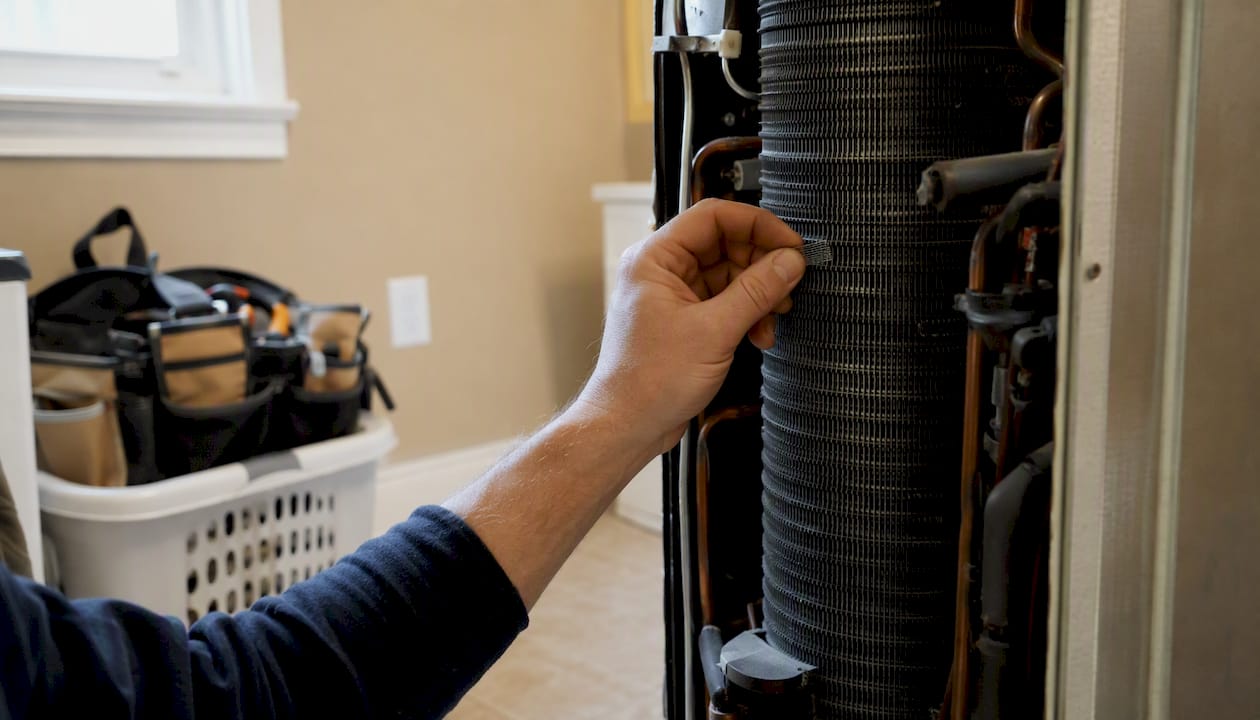
The short version: a HPWH doesn’t generate heat — it moves it. A fan draws warm room air across an evaporator coil filled with refrigerant. That refrigerant absorbs the heat and evaporates into a gas. A compressor then pressurizes the gas, raising its temperature significantly. That hot gas passes through a condenser coil wrapped around (or submerged in) the water tank, transferring heat to the water. The refrigerant cools, returns to liquid, and the cycle repeats.
Picture it as: air intake → evaporator → compressor → condenser/heat exchanger → tank → repeat.
Because you’re moving heat rather than creating it with resistance coils, you get far more hot water per kilowatt-hour. That’s the whole efficiency story.
Main types homeowners encounter:
- Integrated (all-in-one): The heat pump sits directly on top of the storage tank. Most common for residential installs. Requires adequate ceiling height (usually 7 feet minimum) and surrounding air volume.
- Retrofit add-on: A heat pump module attaches to an existing electric-resistance tank. Lower upfront cost, but efficiency gains depend on the existing tank’s condition and insulation.
- Split system: The compressor/evaporator unit sits outdoors; the storage tank stays inside. Quieter indoors, better for tight spaces, but higher installation complexity and cost.
- Desuperheater (geothermal-tied): A secondary heat exchanger on a geothermal heat pump preheats domestic water. Very efficient, but only relevant if you already have a geothermal system.
For most homeowners, the integrated all-in-one is the practical choice. Split systems make sense when indoor space is genuinely tight or noise is a concern. Retrofit add-ons can work, but I’d only recommend them when the existing tank is relatively new and in good shape.
2. Why the efficiency numbers on HPWHs are worth paying attention to
A standard electric-resistance water heater converts electricity to heat at roughly a 1:1 ratio — one unit of electricity in, one unit of heat out. An ENERGY STAR certified HPWH typically delivers a Uniform Energy Factor (UEF) of 3.5–4.0, meaning you get three to four units of heat for every unit of electricity consumed.
That’s not a marginal improvement. For a family running back-to-back showers every morning, the operating cost difference adds up fast. The DOE’s water heater guidance puts typical annual electricity use for a HPWH at around 2,000–2,200 kWh, compared to significantly more for a conventional electric-resistance tank.
The environmental math follows the same logic. Less electricity consumed per gallon of hot water means a lower carbon footprint per household, and that benefit grows as the electrical grid gets cleaner over time. If you’re on a utility with a high share of renewable generation, the carbon savings are already meaningful today.
Savings are largest when you’re replacing an electric-resistance tank (not gas), and when your household uses a moderate-to-high volume of hot water. A single person in a small apartment won’t see the same return as a family of four.
3. What are the real downsides of a heat pump water heater?
HPWHs have genuine tradeoffs, and I’d rather you hear them from me now than discover them after installation.
The main ones:
- They cool and dehumidify the room they’re in. The unit extracts heat from surrounding air, which lowers the ambient temperature by a few degrees. In a basement or garage, that’s often a non-issue or even welcome in summer. In a conditioned living space, it can add to your heating load in winter.
- Noise. A HPWH runs at roughly 50–60 decibels — similar to a window air conditioner or a quiet dishwasher. That’s fine in a basement or detached garage. Installed in a closet adjacent to a bedroom, it will be noticeable.
- Cold-climate performance drops. Below about 40°F, the heat pump can’t extract enough warmth from the air to operate efficiently. ENERGY STAR explains that in these conditions, the unit automatically switches to electric-resistance heating — which is less efficient and costs more to run. In a Los Angeles garage or basement, this is rarely a problem. In an unheated Minnesota utility room in January, it matters a lot.
- Recovery time under heavy demand. If five people shower back-to-back, the heat pump mode alone may not keep up. The unit will kick into hybrid or full electric-resistance mode to recover faster, which is why households with spiky morning loads sometimes see lower-than-expected savings.
Pro Tip: Set your HPWH to “Efficiency” or “Economy” mode for daily use, but switch to “Hybrid” mode when you know demand will spike — like hosting guests. That way the unit uses heat pump mode as much as possible without running out of hot water.
The LBNL analysis confirms these adoption barriers are real but manageable in most single-family homes. The key is matching the unit to the right space and usage pattern from the start.
4. Where should you install a heat pump water heater?
Siting is the single most important decision in a HPWH installation. Get it wrong and you’ll either underperform or need to move the unit.
| Siting Requirement | Specification |
|---|---|
| Ambient temperature range | 40°F–90°F year-round |
| Minimum surrounding air volume | adequate air volume (roughly a 10×10×10 ft space) |
| Ceiling height (integrated units) | 7 feet minimum, 8+ feet preferred |
| Condensate drainage | Floor drain or condensate pump required |
| Electrical supply | Dedicated 240V/30A circuit (most units) |
| Clearance from walls | Per manufacturer spec, typically 6–12 inches on sides |
The DOE’s guidance is clear: the installation space must stay within that 40–90°F range and have adequate air volume. A cramped closet with no ducting will starve the unit of the air it needs and tank efficiency will drop.
If a closet is your only option, plan for ducted air intake and exhaust. That adds cost but makes the installation viable. You’ll also need a condensate pump if there’s no floor drain nearby — the unit produces condensate as it dehumidifies the air, and that water has to go somewhere.
On the electrical side, confirm whether your panel can support a dedicated 240V/30A circuit before you buy the unit. Many older Los Angeles homes are already near panel capacity, and a panel upgrade can add significant cost to the project. Upright Construction & HVAC handles electrical upgrades as part of a full installation scope, so you’re not coordinating two separate contractors.
Basements and attached garages are the most practical locations in most Southern California homes. They typically have the space, the temperature range, and easier access to a floor drain.
5. How do you size a HPWH and what specs actually matter?
Start with first-hour rating (FHR), not tank size. FHR tells you how many gallons the unit can deliver in the first hour of use — which is what matters during a morning rush, not the total tank volume.
Quick sizing guide by household:
- 1–2 people: 40–50 gallon tank, FHR around 50–60 gallons
- 3–4 people: 50–65 gallon tank, FHR around 60–80 gallons
- 5+ people: 65–80 gallon tank, FHR 80+ gallons
Proper sizing matters — an undersized unit will rely on resistance heating more often, which cuts into your efficiency gains.
Specs to compare when shopping:
- UEF (Uniform Energy Factor): The efficiency rating. Higher is better. Look for 3.5 or above for meaningful savings over a resistance tank.
- Control modes: Most ENERGY STAR units offer Efficiency/Economy (heat pump only), Auto/Hybrid (heat pump plus resistance as needed), and Electric/Boost (resistance only for fast recovery). Understand what mode ships as the default.
- Connected features: Wi-Fi-enabled units can participate in utility demand-response programs, which can earn you bill credits. Worth having if your utility offers it.
- Refrigerant GWP: ENERGY STAR now tracks refrigerant global warming potential. Lower-GWP refrigerants such as some newer options are preferable for long-term environmental compliance.
- Warranty: Look for at least a 10-year tank warranty and a separate compressor warranty of 5–10 years. Confirm whether the compressor warranty covers parts only or parts and labor.
Watch for warranty exclusions around sediment buildup, improper installation, and failure to perform annual maintenance. These are the most common reasons a warranty claim gets denied.
6. What does a heat pump water heater cost, and what rebates are available?
Installed price ranges for 2026:
| Scenario | Estimated Installed Cost |
|---|---|
| Like-for-like electric swap (simple) | moderate to high installation cost |
| Typical mid-complexity install | installation cost varies by complexity |
| High-complexity (panel upgrade, ducting, condensate pump) | higher costs expected if upgrades needed |
Unit-only retail pricing by tank size, per Home Energy Decisions: 40–50 gallon units run roughly $1,300–$1,900; 65-gallon units around $1,900–$2,500; 80-gallon units $2,300–$3,200 or more. Angi reports professional installation averages around $4,200, with labor, electrical upgrades, and access issues driving the variation.
The factors that push a job into the high band: needing a new 240V dedicated circuit, a panel upgrade, condensate pump installation, ducting for a closet install, or converting from gas (which adds gas line capping and venting removal). Confirm all of these during a site visit before you buy the unit.
On federal incentives: The 25C federal tax credit for heat pump water heaters was limited to systems placed in service on or before December 31, 2025. For most 2026 installations, that credit is no longer available. Check with a tax professional for your specific situation.
State and utility rebates are still very much alive. LADWP offers rebates for qualifying heat pump water heater installations, and understanding how utility rebates work can meaningfully change your payback math. Use the ENERGY STAR rebate finder to locate programs in your ZIP code.
Simple payback example: A typical installed cost of $4,200 minus a $500 utility rebate equals $3,700 net. At $550 in annual savings, that’s roughly a 6.7-year payback on the incremental cost over a standard electric tank (which might cost $1,200 installed). Factor in a larger rebate or a higher electricity rate and that number shrinks.
7. Your contractor site visit checklist before buying a unit
Don’t buy the unit first. A site visit from a licensed installer should happen before you spend a dollar on equipment. Here’s what I walk through on every HPWH assessment.
What to have ready for your contractor:
- Your electrical panel location and current amperage (100A, 150A, 200A)
- Whether you have an existing 240V circuit near the water heater location
- The dimensions of your proposed install space (height, width, depth)
- Whether there’s a floor drain nearby or if a condensate pump will be needed
- Your current water heater fuel type (electric, gas, propane)
- Your preferred install location and any space constraints
Questions to ask your contractor:
- Who pulls the permit, and is it included in the quote?
- Do you hold EPA 608 refrigerant-handling certification?
- How is the manufacturer warranty handled if the compressor fails in year three?
- What noise level should I expect, and where will the unit exhaust?
- Will you commission and test the unit after installation, and what does that include?
Red flags to watch for:
- A contractor who quotes without visiting the site
- No mention of condensate drainage in the proposal
- A closet install proposed with no ducting plan
- Electrical scope excluded from the quote with no explanation
- Tank sizing based only on household size, not first-hour rating
Pro Tip: Ask for the permit number after the job is done. A pulled permit means the installation was inspected. An uninspected HPWH install can void your warranty and create problems when you sell the home.
Upright Construction & HVAC includes a full pre-buy site assessment as part of our installation process. We check panel capacity, drain access, clearances, and electrical scope before recommending a unit, so there are no surprises on install day.
8. How long do heat pump water heaters last, and what maintenance do they need?
The compressor is the heart of the system. It’s more complex than a resistance element, but modern units from established manufacturers are reliable when the unit is properly sited and maintained. The anode rod (present in most tank-style units) protects the tank from corrosion and typically needs inspection every 3–5 years.
Basic annual maintenance tasks:
- Visually inspect the condensate drain line for clogs or algae buildup
- Check the air filter or evaporator coil for dust accumulation (some units have a washable filter)
- Listen for unusual compressor noise — rattling or grinding warrants a service call
- Verify the unit is still in the correct operating mode (not stuck in full electric mode)
- Check anode rod condition every 3–5 years and replace when more than 50% depleted
A routine maintenance schedule keeps the compressor running efficiently and extends tank life. Neglecting the evaporator coil is the most common maintenance miss — a dusty coil forces the compressor to work harder and shortens its life.
At purchase, verify two separate warranty coverages: tank (look for 10 years) and compressor (5–10 years). Some manufacturers cover parts only; others include labor for the first few years. Read the exclusions carefully, particularly around sediment damage and installation requirements.
9. When a heat pump water heater is probably not the right choice
HPWHs are a strong choice for most U.S. single-family homes, but there are clear situations where another type will serve you better.
Skip the HPWH if:
- Your only available install space is a small, unventilated closet with no ducting option. Starving the unit of air kills efficiency and can shorten compressor life.
- Your mechanical room stays below 40°F for extended periods and there’s no conditioned space alternative. The unit will run on resistance heat most of the time, eliminating the efficiency advantage.
- Your household has very spiky hot-water demand (large family, multiple simultaneous showers) and you’re not willing to size up or accept occasional resistance-mode operation.
- You’re renting and the landlord controls the mechanical room. HPWHs need space and electrical work that most landlords won’t approve.
Alternatives worth considering:
- Conventional electric-resistance tank: Lower upfront cost, simpler install, no space or temperature constraints. Higher operating cost. Makes sense when the install location is genuinely incompatible with a HPWH.
- Gas storage water heater: Lower operating cost than electric resistance in most U.S. markets, but requires gas line access and venting. Not a path toward electrification.
- Tankless/demand water heaters (gas or electric): No standby heat loss, endless hot water on demand, but high flow-rate electric tankless units require very large electrical service upgrades. Gas tankless is practical where gas is already present.
- Solar water heating systems: High efficiency in sunny climates (Los Angeles is ideal), but higher upfront cost and requires roof space and a backup element. Worth evaluating alongside a HPWH for maximum long-term savings.
Two quick diagnostic checks: Does your install space stay above 40°F year-round? Does your panel have room for a 240V/30A circuit (or can it be upgraded)? If both answers are yes, a HPWH is worth pursuing seriously.
What I’ve seen go wrong — and how to avoid it
After 15 years of HVAC installations across Los Angeles, the most common HPWH mistake I see is buying the unit before doing the site assessment. A homeowner finds a great deal online, orders a 65-gallon unit, and then discovers their utility closet has 7-foot ceilings, no floor drain, and a 100A panel that’s already full. Now they’re either returning the unit or spending an extra $2,000 on electrical work they didn’t budget for.
The second most common issue is undersizing. People size by tank gallons alone and ignore first-hour rating. A 50-gallon tank with a low FHR will disappoint a family of four every single morning.
In Los Angeles specifically, most homes are good candidates. Our mild climate means garages and utility rooms stay well within the 40–90°F operating range year-round. LADWP rebates are available for qualifying installations, and I help homeowners navigate that paperwork as part of every job. The LADWP rebate program can meaningfully reduce your net cost, and it’s worth confirming eligibility before you finalize your equipment choice.
My honest advice: schedule the site visit first, confirm your electrical and space constraints, then choose the unit. That order saves money and frustration every time.
Ready to install a heat pump water heater in Los Angeles?
Upright Construction & HVAC handles the full scope of a HPWH installation: equipment selection, electrical panel assessment and upgrades, condensate solutions, permit pulling, and post-install commissioning. With 15+ years serving Los Angeles homeowners and direct experience with LADWP rebate applications, we take the guesswork out of what can otherwise be a complicated project.

Our site visits are thorough. We check panel capacity, measure your install space, confirm drain access, and give you a clear scope and price before you buy a single piece of equipment. No surprises on install day.
If you’re ready to cut your water heating bill and want a licensed team to handle it right, schedule your assessment with Upright Construction & HVAC today.
Sources
Before you buy or book an installer, these are the resources I’d bookmark:
- Heat pump water heaters and American homes: a good fit? | LBNL Energy Analysis
- Heat Pump Water Heater Cost in 2026: Installed Price by Tank Size | Home Energy Decisions
- How Much Does It Cost to Install a Heat Pump Water Heater? 2026 Data | Angi
FAQ
Are electric heat pump water heaters worth it?
For most households replacing an electric-resistance tank, yes. ENERGY STAR data shows a family of four can save roughly $550 per year, with payback around three years when rebates are applied.
What are the downsides of a heat pump water heater?
The main tradeoffs are noise (roughly 50–60 decibels), cooling of the installation space, reduced efficiency below 40°F ambient, and slower recovery under heavy demand when the unit falls back to resistance heating.
Why don’t some contractors recommend heat pumps?
Many contractors hesitate when the install site lacks adequate space, airflow, or electrical capacity. A cramped closet with no ducting plan or a full electrical panel are the two most common reasons a job gets complicated or declined.
Do heat pump water heaters use a lot of electricity?
Much less than conventional electric tanks. The DOE estimates typical annual electricity use around 2,000–2,200 kWh for a HPWH, compared to significantly more for a standard resistance unit running the same household.