
Our Services
Asbestos Heating Ducts: What Every Homeowner Must Know
If your older home has heating ducts, learn how to identify potential asbestos risks and protect your family from harmful exposure.
- CSLB C-20 Licensed
- NATE Certified
- EPA 608 Certified
- Licensed & Insured
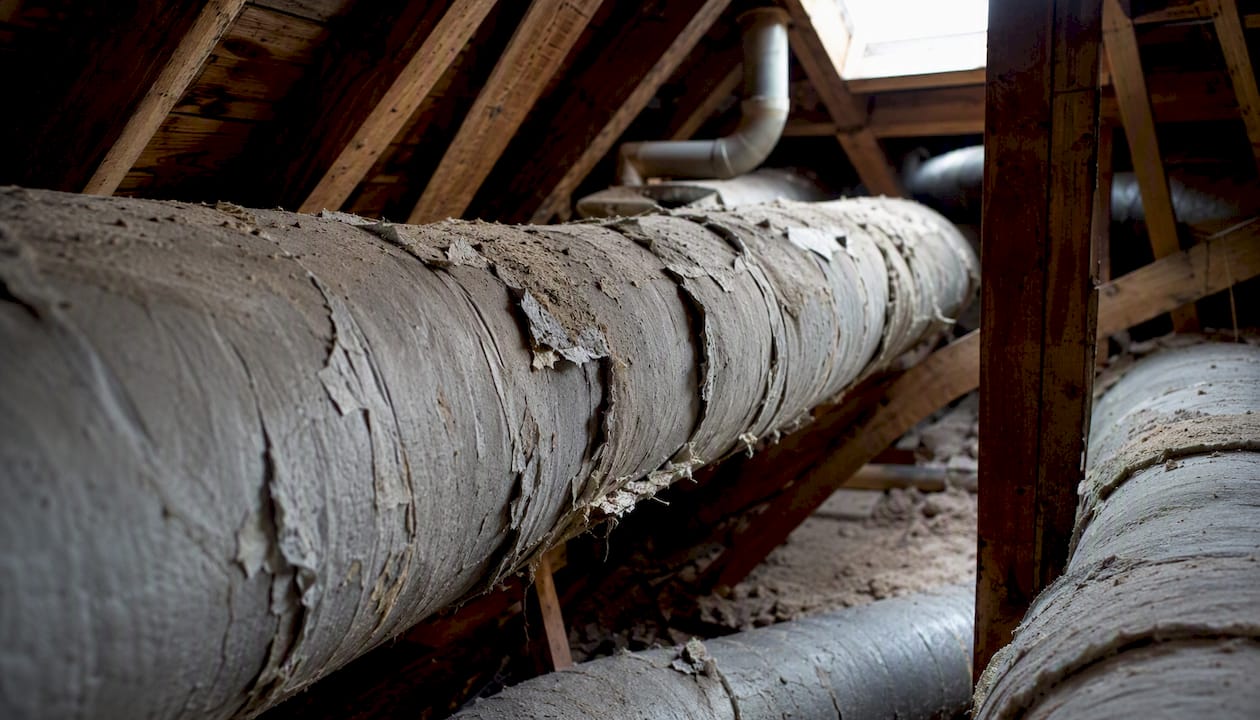
Yes, your heating ducts may contain asbestos, and if you live in an older home built before the widespread phaseout of asbestos, potential asbestos presence should be considered.
Duct insulation wraps, seam tape, vibration dampers, and mastic compounds in older homes were routinely made with asbestos-containing materials (ACMs). The industry term “ACM” covers any product with more than 1% asbestos by weight. If any of that material has been disturbed, crumbled, or torn, airborne fibers can move throughout your entire HVAC system within minutes.
Three immediate steps if you suspect disturbed material:
- Shut off the HVAC system completely. Running it spreads fibers through every room.
- Restrict access to the area. Close the door, keep children and pets out, and do not vacuum or sweep.
- Call an accredited asbestos inspector or licensed abatement contractor before anyone re-enters that space for more than a few seconds.
Do not:
- Touch, poke, or break off a sample to “check it yourself”
- Run a shop vac or household vacuum anywhere near the material
- Hire anyone who offers to “pull it out today” without a written containment plan and post-clearance air testing
- Assume the material is safe because it looks intact
Pro Tip: Take photos from a safe distance before you do anything else. Date-stamp them. Those photos become your documentation record for the inspector, your insurer, and potentially your doctor.
Key Takeaways
Asbestos-containing materials in pre-1980 heating ducts are common, and the only safe response to suspected ACM is to stop the HVAC system, restrict access, and arrange accredited lab testing before any work begins.
| Point | Details |
|---|---|
| Pre-1980 homes are highest risk | Duct insulation, seam tape, and vibration dampers in older homes frequently contain asbestos. |
| Visual inspection is not enough | Fibers are microscopic; only PLM or TEM lab analysis from an AIHA-accredited lab confirms ACM. |
| Disturbance drives health risk | Intact ACM poses low immediate risk; a running HVAC with damaged ACM spreads fibers throughout the home. |
| Management options vary | Leave-undisturbed, encapsulation, and full removal are all legitimate options depending on material condition and renovation plans. |
| Clearance testing is mandatory | Post-abatement air testing by an independent, AIHA-accredited lab confirms the space is safe before re-occupancy. |
| Upright Construction & HVAC | Coordinates inspection, containment, abatement, and clearance documentation for Los Angeles homeowners. |
## 1. How asbestos ended up in your heating ducts and HVAC system
Asbestos was the go-to insulating material for most of the 20th century because it handled heat, resisted fire, and was cheap. Builders, HVAC installers, and sheet-metal workers used it across nearly every component that touched hot air or steam. Steam pipes, boilers, and furnace ducts were commonly insulated with asbestos blankets or paper tape, and when those materials are damaged or disturbed, they can release fibers that require professional containment and disposal.
Common asbestos-containing ductwork materials include:
- Insulation wraps: Corrugated paper or blanket-style wrap around supply and return ducts, especially in attics and furnace rooms
- Seam tape and mastic: Fabric-backed tape and paste used at duct joints; often gray, tan, or off-white
- Millboard: Dense, rigid board used as a heat shield behind furnaces and at plenum connections
- Vibration dampers (canvas connectors): Woven fabric sections connecting the furnace to the main duct run; these flex to absorb blower vibration and were frequently made from asbestos cloth
- Gasket materials: Thin sheets used at register boots and furnace collars to seal connections
- Duct liner: Soft insulation applied to the inside of metal ducts for sound and thermal control
The highest-risk era is pre-1975. Regulatory pressure from the EPA’s ongoing asbestos restrictions began pushing manufacturers to reformulate products through the late 1970s, but legacy materials remained in use and in buildings well into the 1980s. A home built in 1983 could still have original ductwork installed with 1970s-era materials.
Friable vs. non-friable matters a lot. Friable ACM crumbles under hand pressure and releases fibers easily. Non-friable ACM is bound in a matrix (like floor tile) and poses far lower risk when intact. Duct insulation wrap and seam tape tend to become friable as they age, especially if they have gotten wet, been bumped during renovations, or simply dried out over decades. The EPA’s guidance on ACM categories places pipe and duct insulation in a category where friability is the primary risk driver.
One more thing worth knowing: secondary contamination. If a previous owner or contractor worked near asbestos ductwork without proper protection, fibers can settle on surfaces throughout the furnace room, attic, and even on clothing. Check the furnace room, attic plenum, and any area where old duct tape or wrap is visible and flaking.
## 2. Why you cannot tell by looking and how lab testing actually works
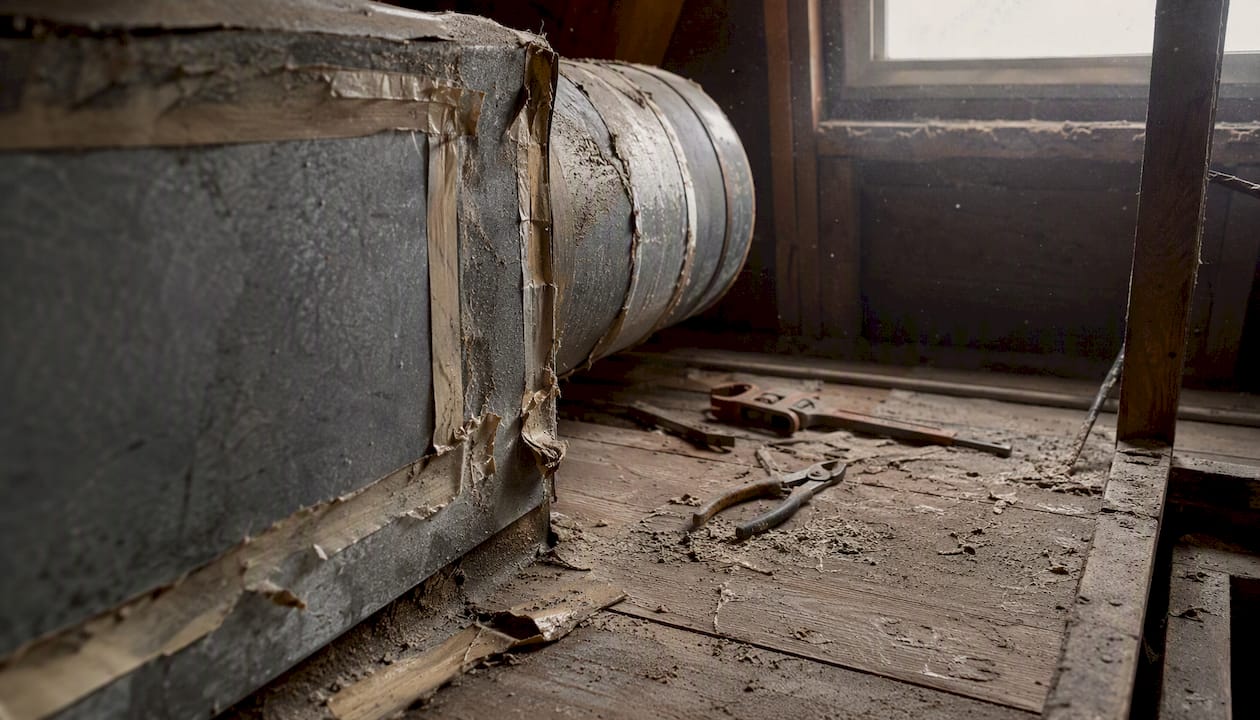
Asbestos fibers are microscopic and cannot be reliably identified by visual inspection alone, which means no visual inspection, no matter how careful, can confirm or rule out asbestos. The EPA is direct on this point: assume that duct insulation or tape in homes built before the mid-1980s may contain asbestos and arrange accredited lab testing rather than relying on sight.
Fiberglass duct wrap, cellulose insulation, and old paper-backed tape can all look nearly identical to asbestos-containing versions. Here is a rough guide to what you might see and what it could actually be:
| What you see | What it might be | Probability of ACM | Next step |
|---|---|---|---|
| Gray or tan corrugated wrap on ducts | Asbestos paper wrap or fiberglass | Moderate to high in older homes built before the widespread phaseout of asbestos in HVAC materials | Stop HVAC, call inspector |
| White or silver tape at duct seams | Asbestos cloth tape or foil tape | Moderate in older homes built before the widespread phaseout of asbestos in HVAC materials | Do not disturb, call inspector |
| Stiff gray board behind furnace | Millboard (often ACM) or cement board | High in pre-1975 installations | Do not disturb, call inspector |
| Soft canvas-like connector at blower | Asbestos vibration damper or fiberglass | High if pre-1980 | Do not disturb, call inspector |
| Crumbling gray paste at joints | Asbestos mastic or non-ACM caulk | Moderate | Treat as ACM, call inspector |
Safe documentation checklist while you wait for the inspector:
- Photograph the material from at least 3 feet away (close-up and wide-angle context shot)
- Note the exact location: furnace room, attic, crawlspace, specific duct run
- Record whether the material is crumbling, flaking, or intact
- Note whether the HVAC was running when any disturbance occurred
- Write down the approximate age of the home and any recent renovation work near the area
Health authorities, including Cleveland Clinic, are unambiguous: do not take your own samples. Improper sampling breaks the material, releases fibers, and creates the very exposure you are trying to avoid.
## 3. What the health risks from an asbestos heating duct actually are
Having asbestos in your ductwork is not the same as being exposed to it. The risk comes from airborne fibers, and fibers only become airborne when material is disturbed, damaged, or friable. That distinction matters, but it does not mean you can ignore the issue.
Asbestos is classified as a known human carcinogen by the National Cancer Institute, IARC, and OSHA. Diseases linked to asbestos fiber inhalation include:
- Mesothelioma: A rare cancer of the lining of the lungs, abdomen, or heart; almost exclusively caused by asbestos exposure
- Lung cancer: Risk is compounded significantly in people who also smoke
- Asbestosis: Progressive scarring of lung tissue that reduces breathing capacity over time
- Pleural plaques and pleural effusion: Thickening or fluid buildup around the lungs, often an early marker of past exposure
The latency period for asbestos-related diseases ranges from roughly 10 to 50 years after exposure. That long gap is exactly why exposure history matters so much when you talk to a doctor, even if you feel fine right now.
Symptoms worth reporting to a physician if you have had known or suspected exposure:
- Persistent shortness of breath or a dry cough that does not resolve
- Chest tightness or pain
- Unexplained fatigue combined with respiratory symptoms
- Crackling sound when breathing (a sign a doctor listens for with a stethoscope)
A critical context point: a single brief household exposure, such as walking past a slightly damaged duct wrap once, carries statistically far lower risk than the repeated, prolonged occupational exposure that drove the disease rates in insulation workers and shipyard laborers. Public health guidance consistently emphasizes that the main hazard is disturbing asbestos repeatedly without protection. That said, operation of an HVAC system with damaged asbestos-containing materials can cause ongoing exposure. It recirculates fibers continuously until the system is shut down, which is why step one is always: turn it off.
## 4. How professional asbestos testing of duct materials works
Testing is a two-part process: sample collection by a certified inspector and analysis by an accredited laboratory. Neither step is optional if you want a result you can rely on.
What a certified asbestos inspector does on-site:
- Conducts a visual survey of all accessible ductwork, the furnace, plenum, and connected components
- Identifies suspect materials by type, location, and condition (friable vs. intact)
- Sets up containment around the sampling area using plastic sheeting and, for enclosed spaces, a glove bag to prevent fiber release during sample collection
- Collects a small core or piece of the material using wet methods to suppress dust, then seals it in a labeled container
- Completes a chain-of-custody form that travels with the sample to the lab
- May collect air samples using a pump and filter cassette if there is reason to believe fibers are already airborne
Lab methods and what they mean:
- PLM (Polarized Light Microscopy): The standard bulk-material method. Identifies asbestos fiber type and estimates percentage by weight. Fast and cost-effective; used for most duct insulation and tape samples. Detection limit is around 1% by weight, which is the regulatory threshold.
- TEM (Transmission Electron Microscopy): More sensitive than PLM; can detect fibers at concentrations below 1% and identifies fiber type with greater precision. Used when PLM returns a “non-detect” but suspicion remains high, or for air sample analysis.
- PCM (Phase Contrast Microscopy): Used for air samples to count total fiber concentration; does not distinguish asbestos from other fibers. Often used during and after abatement to monitor fiber levels in real time.
What to ask before you hire a lab:
- Are you AIHA-accredited or NVLAP-accredited for asbestos bulk analysis?
- Which analytical method will you use for this sample type?
- What is your detection limit?
- Will you provide a written report with chain-of-custody documentation?
- What is your turnaround time for standard vs. rush results?
It does not mean the entire duct system is clear. A good inspector will sample multiple locations and material types, not just one spot.
## 5. Your real options for managing asbestos in ducts: leave it, seal it, or remove it
Once testing confirms ACM is present, you have four practical paths. Which one makes sense depends on the condition of the material, your renovation plans, and your budget.
Pro Tip: If you are planning a kitchen remodel, bathroom renovation, or any work that requires cutting into walls or ceilings near ductwork, get asbestos testing done before the first hammer swing. Renovation is the single most common trigger for accidental ACM disturbance.
| Management option | Best when | Typical cost range varies by location and scope | Timeline varies depending on project size and complexity | Key limitation |
|---|---|---|---|---|
| Leave undisturbed and monitor | Material is intact, no renovation planned | Low (inspection cost only) | Ongoing | Requires periodic re-inspection; any future renovation changes the equation |
| Encapsulation (sealant applied) | Minor surface damage, accessible location | Costs can range widely depending on the size of the area and local market rates | Duration typically takes a few days depending on the extent of encapsulation | Not appropriate for heavily damaged or wet material |
| Enclosure (covering with new material) | Larger sections, accessible ductwork | Costs vary based on the extent of enclosure and accessibility | Duration depends on project details and complexity | Adds bulk; may affect airflow if not engineered correctly |
| Localized repair | Small damaged section, otherwise intact system | Repair costs vary depending on area and damage | Repair timelines vary with job size and access | Requires licensed abatement team; not a DIY option |
| Full removal and abatement | Extensive damage, major renovation, home sale | Removal costs depend heavily on project scope, location, and complexity | Removal projects generally take several days including necessary clearance testing | Most disruptive and costly; requires post-clearance air testing |
Cost ranges above are general U.S. ballpark figures. Actual costs vary significantly by region, scope, access difficulty, and disposal fees. Always get written estimates from licensed contractors.
EPA guidance confirms that encapsulation and enclosure are legitimate professional management options for some asbestos insulating materials, performed by trained professionals using containment protocols. Full removal is not always the right answer. If the material is intact and you have no renovation plans, leaving it undisturbed and monitored is often the safest short-term choice.
When full removal becomes the clear choice:
- The material is heavily friable or actively crumbling
- You are planning a renovation that will require cutting or moving ductwork
- You are selling the home and buyers or their inspectors flag the ACM
- The HVAC system itself needs replacement and the ductwork will be disturbed anyway
Disposal is regulated. Asbestos waste must be wetted, double-bagged in labeled polyethylene bags, and taken to a licensed disposal facility. Unlicensed disposal is illegal under federal NESHAP regulations and in virtually every state, and the fines are substantial.
## 6. How to hire a licensed abatement contractor without getting burned
The contractor you choose for asbestos work matters more than almost any other home-services hire you will make. The wrong team can make your home less safe, not more.
Contractor vetting checklist:
- State asbestos abatement license (required in most states; verify with your state environmental or labor agency)
- General liability insurance and workers’ compensation coverage, both current
- NESHAP/TSCA compliance experience for residential work
- NIOSH-approved respirators and personal protective equipment for all workers
- Written scope of work that includes containment setup, work procedures, waste disposal, and post-clearance air testing
- Named AIHA or NVLAP-accredited lab for clearance testing (not the same company doing the abatement)
- References from residential asbestos projects, not just commercial
Questions to ask every contractor before signing anything:
- Are you currently state-licensed for residential asbestos abatement?
- Will you provide a written containment plan before work begins?
- Who performs your post-clearance air testing, and are they AIHA-accredited?
- Will I receive a written clearance report I can keep for my records?
- How do you handle waste disposal, and can you provide documentation?
Red flags that should end the conversation immediately:
- A quote given over the phone without an on-site inspection
- Refusal to provide a written containment plan or scope of work
- “We can start tomorrow” with no mention of containment or clearance testing
- Suggesting they can “bag it and go” without negative-pressure containment
- No named lab partner for clearance testing
- Pressure to decide on the spot
Pro Tip: Ask specifically whether the clearance air test will be performed by a third party independent of the abatement crew. If the same company does both the removal and the clearance test, that is a conflict of interest. Independent clearance testing is the standard.
Under NESHAP (National Emission Standards for Hazardous Air Pollutants), renovation and demolition projects that disturb regulated amounts of ACM require advance notification to your state environmental agency. Your contractor should handle this notification, but you should ask for a copy. Keep every inspection report, lab result, clearance certificate, and contractor invoice in a dedicated home file. These documents matter when you sell, refinance, or make an insurance claim.
For a broader look at HVAC contractor red flags beyond asbestos, that resource covers the warning signs that apply to any major HVAC hire.
## 7. Should you get your ducts cleaned if asbestos might be present?
No. Not until you have confirmed there is no ACM in the system.
Standard duct cleaning methods can disturb asbestos-containing materials and release fibers, thus are unsafe without confirming asbestos absence
EPA and NADCA guidance is clear: inspect for asbestos before cleaning, and do not apply sealants or disturb asbestos-containing materials during routine duct-cleaning procedures. If ACM is present, specialized abatement procedures are required before any standard cleaning can take place.
Do/don’t list for homeowners considering duct cleaning:
- Do ask the duct-cleaning company whether they inspect for ACM before starting work
- Do request an asbestos inspection from a certified inspector before scheduling any duct cleaning in a pre-1980 home
- Do not allow standard duct-cleaning brushes or vacuum nozzles near suspect material
- Do not assume a duct-cleaning company is qualified to identify or handle ACM; most are not licensed abatement contractors
- Do not apply duct sealant over wet, moldy, or ACM-containing liner; the EPA specifically cautions against this
The difference between standard duct cleaning and asbestos abatement is not just technique. It is licensing, containment, disposal protocols, and clearance testing. A standard duct-cleaning crew, however skilled, is not equipped or legally authorized to handle ACM. For a clear picture of what professional duct cleaning actually involves, this homeowner’s guide to air duct cleaning explains the process and what a legitimate inspection-first approach looks like.
## 8. When to see a doctor after suspected asbestos exposure
A single brief encounter with a slightly damaged duct wrap is not the same medical situation as months of working in a building with crumbling ACM. Context matters, and your doctor needs that context to give you useful guidance.
Seek medical attention if any of these apply:
- You were present during significant disturbance of suspect material (renovation, demolition, aggressive cleaning) without respiratory protection
- You saw visible dust or debris in the air and inhaled it
- You have persistent respiratory symptoms: dry cough, shortness of breath, chest tightness, or crackling when you breathe
- A clinician advises follow-up after reviewing your exposure history
- You have a prior history of occupational asbestos exposure and are now concerned about additional household exposure
What to bring to your appointment:
- A written timeline of when and how the disturbance occurred
- Photos of the material and the area
- Any inspection or lab reports you have received
- Your home’s approximate build year and any renovation history
- Your own occupational history, including any jobs that involved insulation, construction, shipbuilding, or automotive work
Routine imaging without documented exposure and symptoms is rarely recommended. Asbestos-related diseases have latency periods measured in decades, so medical monitoring focuses on symptoms and exposure history rather than screening everyone who has ever lived in an older home. What matters is giving your doctor an accurate, documented picture so they can make an informed decision about whether imaging or specialist referral is appropriate.
## 9. What I’ve learned from 15 years of asbestos situations in Los Angeles homes
I have been doing HVAC and construction work in the Los Angeles area for over 15 years, and I can tell you that asbestos in ductwork is not a rare edge case. It comes up regularly in homes built before 1980, and it shows up in the places most homeowners least expect: the canvas connector right at the furnace, the gray wrap in the attic above the master bedroom, the crumbling tape at the plenum.
The most common scenario I see is a homeowner who called for a furnace replacement or a duct repair and had no idea the old system had ACM until we flagged it during the inspection. That is exactly the right time to find out. The worst scenario is when someone has already had a contractor pull out old ductwork without proper containment, and now they are asking what to do about the dust that settled everywhere.
The decision between encapsulation and full removal comes down to three things: condition of the material, your renovation timeline, and the location. If the wrap is intact and you are not planning to touch the ductwork for the next decade, encapsulation by a licensed team is often the smarter, less disruptive choice. If you are replacing the furnace anyway, or if the material is actively crumbling, removal is the right call even though it costs more upfront.
One anonymized example: a homeowner in the San Fernando Valley called us after a previous contractor had partially removed old duct insulation without containment during a furnace swap. We coordinated an AIHA-accredited air quality test, confirmed elevated fiber counts in two rooms, and arranged licensed abatement with negative-pressure containment before the new system went in. The clearance test came back clean. Total timeline from our first call to clearance: nine days. The homeowner had documentation for everything, which mattered when they refinanced the following year.
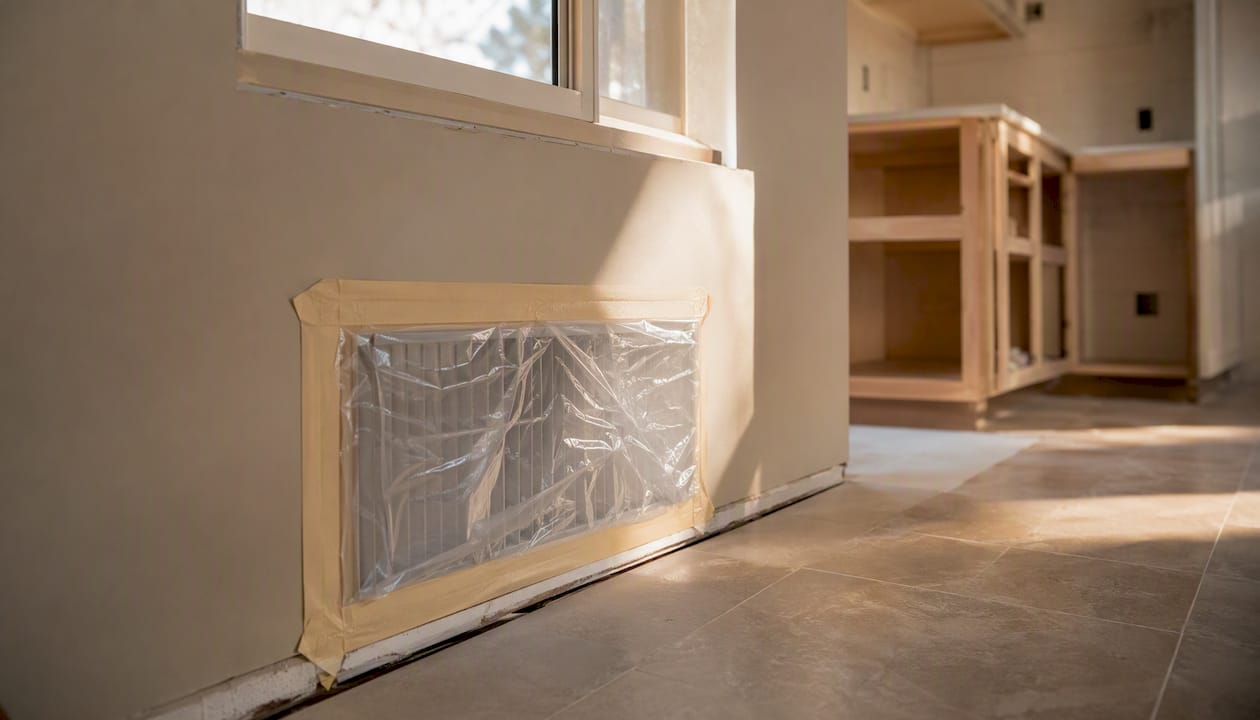
Pro Tip: Before abatement begins, seal HVAC registers in unaffected rooms with plastic sheeting and tape. Shut the system down completely. Stage containment barriers at the doorways nearest the work area. These steps, done in the right sequence, are what keep a contained abatement from becoming a whole-house contamination event.
## 10. My honest take on asbestos and older homes
The thing I want homeowners to walk away understanding is this: having asbestos in your ductwork does not mean your home is a disaster zone. Millions of older homes have ACM that has sat undisturbed for decades and poses no active risk. The danger is in the disturbance, not the presence.
What I see go wrong, consistently, is panic leading to bad decisions. A homeowner finds crumbling gray tape, gets scared, and either ignores it entirely or hires the first contractor who answers the phone and promises a quick fix. Neither response is right. The correct move is methodical: document, stop the HVAC, get accredited testing, then make a calm, informed decision about management.
The other thing I want to say plainly: encapsulation is not a lesser option. When a licensed professional applies the right sealant to intact or minimally damaged material, it is a legitimate, EPA-recognized management approach. Full removal sounds more decisive, but it also creates the highest fiber-release risk if not done with proper negative-pressure containment. The goal is always to minimize fiber release, not to maximize the scope of work.
If you are unsure about your home’s ductwork, the first call is to a certified asbestos inspector, not a general contractor. Get the facts from the lab before you make any decisions. And if you are in the Los Angeles area and want a straight conversation about what you are looking at, I am always happy to talk it through before you commit to anything.
Upright Construction & HVAC is ready to help you handle this the right way
If your home is pre-1980 or you have already spotted suspect duct material, the next step is a professional assessment, not a guess. Upright Construction & HVAC coordinates HVAC inspections and emergency containment in Los Angeles with the same transparency and documentation standards described throughout this article.

Here is what Upright Construction & HVAC handles for homeowners in this situation: inspection coordination with AIHA-accredited labs, HVAC shutdown and containment sequencing, encapsulation and licensed abatement coordination, and post-work clearance testing documentation. Before you call, pull together your home’s build year, any photos of the suspect material, and any prior inspection reports you have. That information cuts the first site assessment from an hour to 30 minutes.
Call or book online. Licensed contractors typically provide written estimates and maintain proper documentation including licensing and insurance Reach the team at Uprightch or call for same-day availability.
Sources
These are the authoritative resources referenced throughout this article. Each one is worth bookmarking.
- Asbestos Exposure and Cancer Risk Fact Sheet - NCI
- Cpsc
- Asbestos in Homes: What To Know | Cleveland Clinic
This article is general information, not a substitute for advice from a qualified doctor. Consult a qualified healthcare professional about your own circumstances before acting on anything here.
FAQ
How do you tell if ductwork has asbestos?
Visual identification cannot confirm asbestos presence; suspected materials in older homes should be tested by accredited labs collected by a certified inspector.
Will 30 minutes of asbestos exposure hurt you?
A single brief exposure carries far lower risk than the prolonged, repeated occupational exposure linked to mesothelioma and asbestosis. However, if a running HVAC system was distributing fibers from damaged ACM, the exposure may be more significant than it appears; document the event and discuss it with a physician.
How do you get rid of asbestos HVAC ducts?
Removal requires a state-licensed asbestos abatement contractor using negative-pressure containment, NIOSH-approved respirators, and wet methods. Post-removal clearance air testing by an independent AIHA-accredited lab confirms the space is safe before re-occupancy. This is not a DIY project.
What do asbestos ducts look like?
Asbestos duct insulation typically appears as a gray or tan corrugated wrap, a stiff gray board, or a fabric-like canvas connector at the furnace blower. Seam tape may look like gray cloth tape. None of these appearances are definitive; fiberglass and paper products look nearly identical, which is why lab testing is the only reliable answer.
Can I clean my ducts if I suspect asbestos is present?
No. Standard duct-cleaning equipment will disturb and fragment ACM, releasing fibers into your home. EPA and NADCA guidance requires an asbestos inspection before any cleaning, and ACM must be addressed by licensed abatement professionals before standard cleaning can proceed.
Recommended
Ready to get started?
Licensed, insured & available 24/7 across Los Angeles and the San Fernando Valley.